
At the end of a grueling workday, unwinding in bed with social media feeds or video streaming feels like a harmless personal reward. Yet when you finally power down your screen and close your eyes, your mind races, sleep latency drags on, and you wake up exhausted as if you barely rested.
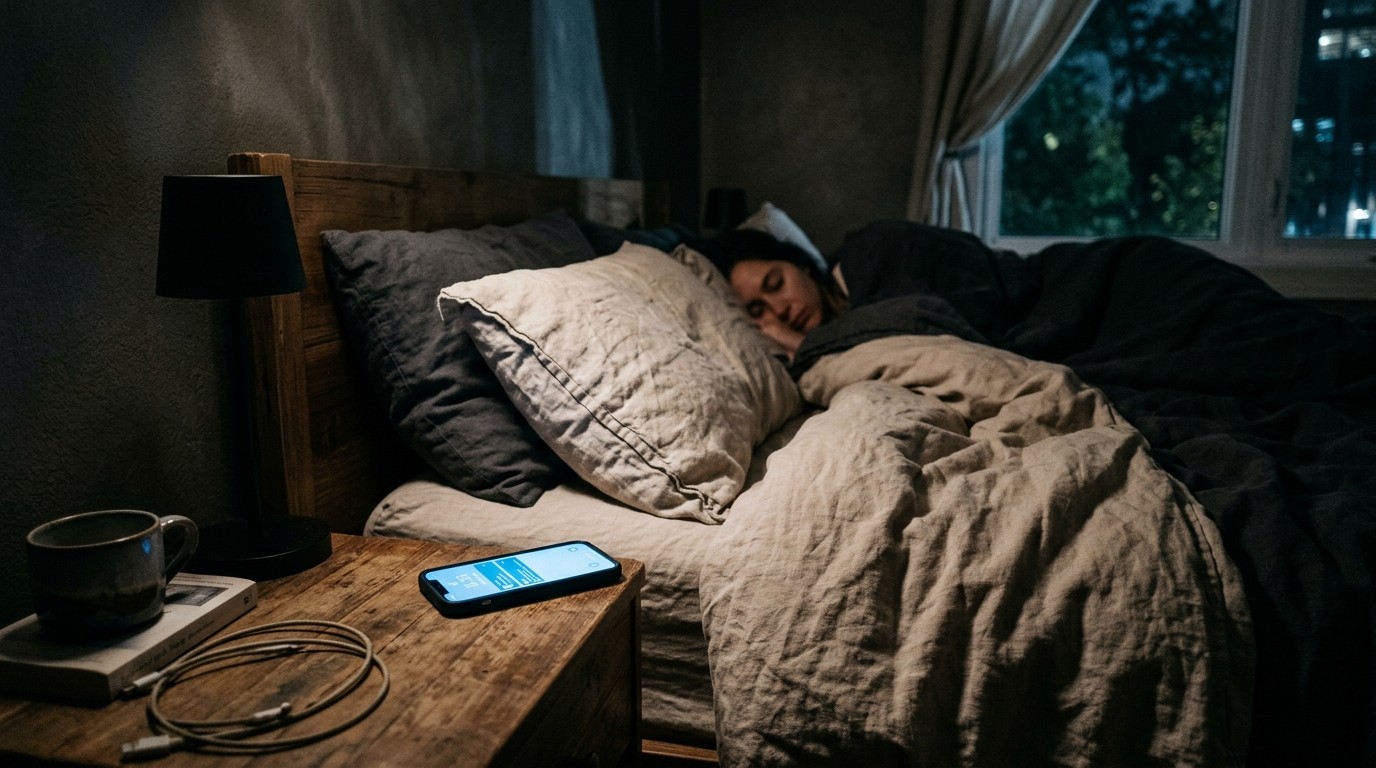
"Staring at a bright screen in a pitch-black bedroom is like beaming a miniature lighthouse directly onto your retina; your circadian pacemaker assumes it is noon and cancels nocturnal cleanup."
Biological pathway reaction sequence:
│ Solar 480nm photons
Retinal ipRGCs containing Melanopsin pigment │
│ Retinohypothalamic tract (RHT)
Direct firing into master clock SCN │
│ Pineal Melatonin suppressed
Daytime vigilance and optimal cognitive drive│
│ Nocturnal Melatonin surge blocked > 50%
Circadian phase delay 1.5h │
│ Truncated Slow-Wave Sleep (SWS)
Impaired Glymphatic cerebral clearance│
1. The Neurobiological Mechanism: Secret Photoreceptors in the Retina
Most people believe retinal vision relies exclusively on rods (night vision) and cones (color vision). However, in the early 2000s, neuroscientists uncovered a third class: Intrinsically Photosensitive Retinal Ganglion Cells (ipRGCs) expressing the photopigment Melanopsin.
These ipRGCs contribute zero input to visual image formation; their exclusive biological duty is measuring ambient irradiance to calibrate the central circadian clock. Critically, Melanopsin displays peak sensitivity to narrow-band blue photons between 460 and 480 nanometers (the exact spectral emission peak of modern LED smartphones, tablets, and monitors).
When bombarded with blue photons at 11 PM, ipRGCs fire sustained action potentials directly along the retinohypothalamic tract into the Suprachiasmatic Nucleus (SCN), signaling: "Midday sun is blazing overhead!".
2. Melatonin Suppression and Truncation of Slow-Wave Sleep (SWS)
A landmark clinical trial from Harvard Medical School published in PNAS demonstrated that participants reading light-emitting e-readers in bed suffered:
- A 90-minute delay in evening Melatonin secretion onset compared to printed book readers under warm illumination.
- Substantial curtailment of Slow-Wave Sleep (SWS), the critical stage where the Glymphatic system purges neurotoxic metabolic waste from the cortex.
- Prolonged morning sleep inertia, causing hours of persistent grogginess upon waking.
| Sleep Architecture Marker | Printed Book / Amber Lamp | Screen Use in Dark Bedroom | Clinical Consequence |
|---|---|---|---|
| Sleep Onset Latency | Rapid (10-15 minutes) | Prolonged (35-60 minutes) | Bedtime frustration and cognitive arousal |
| Midnight Melatonin Peak | Robust, uninterrupted surge | Suppressed by over 50% | Fragmented sleep, frequent arousals |
| Slow-Wave Delta Sleep Duration | Optimal duration for brain detox | Truncated by 20-30% | Long-term memory consolidation deficits |
3. Actionable Photobiological Protocol: Creating a Restorative Sanctuary
To reclaim deep biological sleep without pharmaceutical sedatives, the NIH and clinical sleep societies recommend three circadian interventions:
- Establish a 60-minute digital sunset: Disconnect from screens at least 45 to 60 minutes prior to intended sleep. Replace screen time with physical books, audiobooks, or ambient conversation.
- Activate warm color temperature shift: If critical late messaging is non-negotiable, engage continuous warm color shifting (Night Shift/f.lux) and maximize screen-to-eye distance beyond 40 cm.
- Deploy warm ambient lighting (< 2700K): Equip bedrooms with warm amber or dim incandescent lighting; long wavelengths do not trigger ipRGC Melanopsin, allowing pineal Melatonin synthesis to proceed undisturbed.
The Doctor's Reflection: Restoring the Bedroom as a Sanctuary
In digital civilization, smartphones serve as cognitive appendages. We scroll through messages and media to decompress, unaware that high-energy photons are signaling noon to an ancestral nervous system programmed by hundreds of millennia of celestial twilight.
Restorative sleep is not a digital switch; it resembles an aircraft executing a gradual, measured descent. It demands ambient dimming, thermal drop, and a pristine nocturnal melatonin curve unmarred by artificial glare. Rather than enforcing punitive screen bans that spark resentment, craft a soothing 30-minute transitional runway: warm amber incandescent lamps, tactile paper books, or calming acoustics. When darkness is welcomed rather than fended off, your nervous system readily initiates cellular repair.
Official Scientific Guidelines & Peer-Reviewed References
- Evening use of light-emitting eReaders negatively affects sleep, circadian timing, and next-morning alertness: DOI: 10.1073/pnas.1418490112 · PMID: 25535358. Light-emitting devices in the evening prolong sleep latency, delay the circadian clock, suppress melatonin secretion by over 50%, and impair next-morning cognitive alertness.
- Phototransduction by retinal ganglion cells that set the circadian clock: DOI: 10.1126/science.1067262 · PMID: 11834835. Discovery of melanopsin-expressing intrinsically photosensitive retinal ganglion cells (ipRGCs) that project directly to the suprachiasmatic nucleus to synchronize the central circadian pacemaker.