
Listen to Audio Dispatch Brief
The 60-second read
Evidence level:Human trials (RCT)Consuming 15-20g of dark chocolate (>85% cacao) daily activates Nitric Oxide synthesis, relaxing arteries and naturally supporting healthy blood pressure.
- Epicatechin in cocoa stimulates endothelial eNOS to release Nitric Oxide, promoting vascular smooth muscle relaxation.
- Only dark chocolate with >=85% cacao or non-alkalized cocoa powder retains clinically effective levels of bioavailable flavanols.
- The targeted clinical intake is 200-400 mg of cocoa flavanols daily, achieved with 15-20 grams of high-purity dark chocolate.
A familiar scenario unfolds daily in cardiology clinics: Mr. Nam, a 52-year-old corporate executive suffering from chronic stress, notices his systolic blood pressure hovering consistently between 138 and 145 mmHg. Although not yet requiring prescription antihypertensive medication, his physician strongly advises lifestyle and dietary interventions.
During his research, he stumbles upon claims that dark chocolate can lower blood pressure. Naturally skeptical, he wonders whether a sweet treat could truly offer genuine clinical benefits or if it is merely commercial marketing.
The truth lies in the chemical distinction between types of chocolate. Commercial milk chocolate bars are packed with refined sugar and unhealthy saturated fats. In contrast, high-purity dark chocolate containing 85% or higher cacao solids represents a potent bioavailable phytonutrient package.
Randomized controlled clinical trials demonstrate that cocoa flavanols induce significant improvements in endothelial function and arterial pressure. Let us trace the molecular journey of dark chocolate flavanols from the palate to the microscopic lining of the vascular wall.
"Imagine the plumbing system in your home getting constricted over time, putting immense pressure on the main water pump. Our blood vessels face a similar challenge with aging and stress. The endothelial lining acts like an intelligent inner coating equipped with microscopic gas valves. When cocoa flavanols signal these valves, they immediately release Nitric Oxide gas. This gas acts as a biological natural lubricant, signaling the surrounding vascular smooth muscle to loosen up. The arterial pipe opens smoothly, allowing blood to flow effortlessly without overworking the cardiac pump."
Molecular Pathway Flowchart
Cacao Flavanols (Epicatechin)
Kích hoạt Enzym eNOS (Ser1177)
Sản xuất Khí Oxit Nitric (NO)
Kích hoạt sGC & cGMP Tế bào Cơ trơn
Giãn Mạch & Hạ Huyết áp
Molecular journey: From Cocoa Flavanols to eNOS enzyme and Nitric Oxide gas
To understand how high-cocoa dark chocolate lowers blood pressure, we must zoom into the endothelium, the single layer of delicate cells lining the inner wall of the entire human vascular system. The endothelium is not merely a passive barrier; it is a highly dynamic autocrine and paracrine endocrine organ. Its primary physiological duty is maintaining vascular tone by balancing the release of vasoconstrictors and vasodilators.
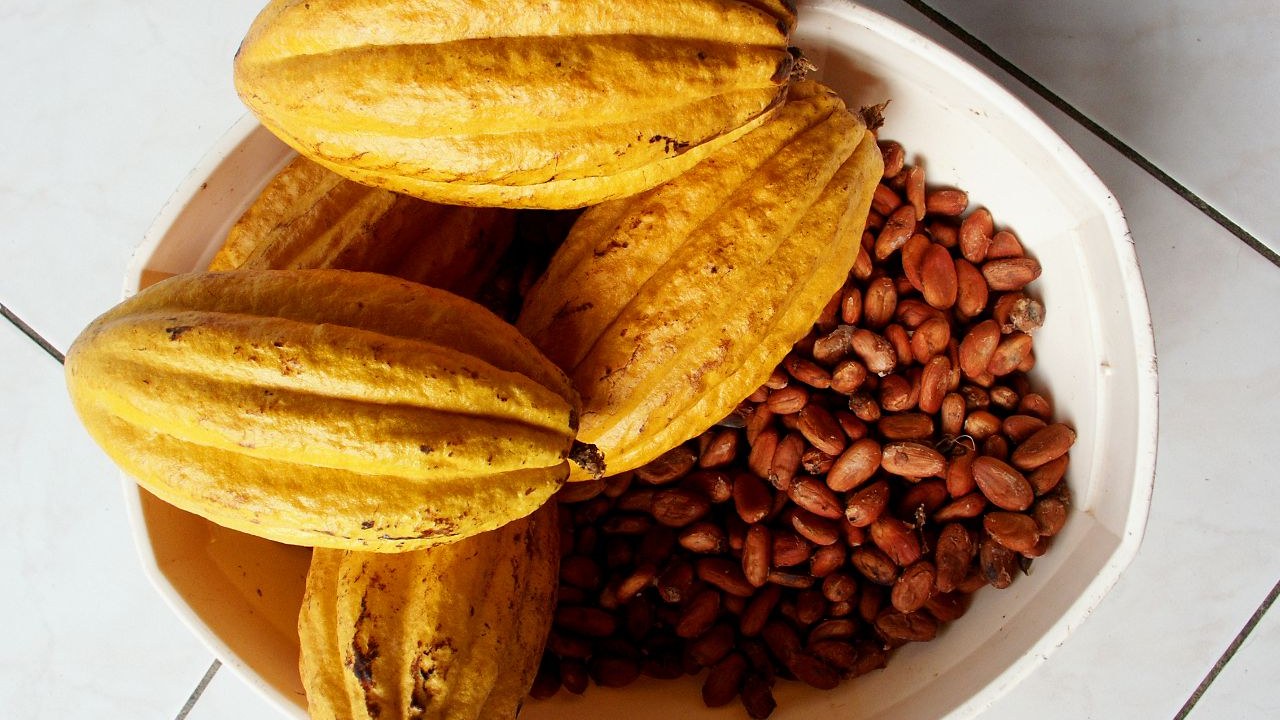
The star bioactive component in cocoa beans is epicatechin, a monomeric flavanol belonging to the polyphenol family. Upon consuming concentrated dark chocolate, epicatechin is rapidly absorbed across the small intestine into systemic circulation. Once in the bloodstream, epicatechin binds to endothelial surface receptors and activates the intracellular PI3K/Akt signaling pathway. This cascade triggers the phosphorylation of endothelial Nitric Oxide Synthase (eNOS) at the Serine 1177 residue.
Activated eNOS catalyzes the biotransformation of the amino acid L-arginine into Nitric Oxide (NO) gas. Nitric Oxide is a lipophilic, highly diffusible gas molecule that rapidly permeates from endothelial cells into the adjacent vascular smooth muscle cells (VSMCs).
Within smooth muscle, NO binds to soluble guanylyl cyclase (sGC), converting GTP into cyclic GMP (cGMP). Elevated cGMP levels decrease intracellular free calcium ions, causing smooth muscle fibers to relax. Consequently, the arterial lumen dilates, systemic vascular resistance drops, and blood pressure decreases naturally.
Scientific truth decoding and Clinical comparison of chocolate varieties
A widespread consumer misconception assumes that all cocoa-containing food items convey identical cardiovascular benefits. This is fundamentally incorrect. In industrial food processing, most commercial chocolate undergoes alkalization (known as Dutch processing) to neutralize bitterness and enhance dark color. However, this alkaline exposure destroys up to 80-90% of the native flavanol content present in raw cacao.
Furthermore, standard milk chocolate and white chocolate products contain high quantities of refined sucrose and processed fats. Excessive sugar consumption induces endothelial inflammation, drives advanced glycation end-products (AGEs) formation, and impairs eNOS activity. Consequently, eating milk chocolate fails to lower blood pressure and instead increases the long-term risk of insulin resistance and vascular stiffness.
The following clinical matrix details the nutritional and physiological differences among common cocoa products:
| Clinical Parameter | Milk Chocolate | Dark Chocolate 70% | Dark Chocolate 85-90% | Raw Non-Alkalized Cacao Powder |
|---|---|---|---|---|
| Flavanol Content (mg/20g) | < 30 mg (Negligible) | 100 - 150 mg (Moderate) | 250 - 400 mg (High) | 400 - 600 mg (Optimal) |
| Added Sugars (per 20g) | 10 - 14 g (Excessive) | 5 - 7 g (Moderate) | 1 - 3 g (Minimal) | 0 g (None) |
| eNOS Activation Capacity | Absent / Inhibitory | Mild stimulation | Potent activation | Maximum activation |
| Blood Pressure Effect | Neutral or slight increase | Minor reduction (1 - 2 mmHg) | Significant reduction (3 - 5 mmHg) | Optimal reduction (4 - 6 mmHg) |
| Clinical Utility | Not recommended | General wellness | Cardiovascular support | Therapeutic deep-dive |
| Endothelial Response | Blunted | Fair | Excellent | Superior |
Randomized controlled clinical trials show that daily ingestion of 200 to 400 mg of cocoa flavanols (found in 15-20g of 85% dark chocolate) for 2 to 4 weeks significantly enhances Flow-Mediated Dilation (FMD) by 1.5% to 2.0%. This magnitude of endothelial improvement translates directly into tangible long-term cardiovascular protection.
Practical applications and Strategic lifestyle recommendations
To successfully leverage dark chocolate as an evidence-based clinical tool for cardiovascular support, specific criteria regarding selection, dosage, and timing should be followed.
First, selection standards are critical. Always inspect the ingredient list on the product label. Ensure the cacao percentage is 85% or higher, and verify that cocoa mass (or cacao liquor) is listed as the primary ingredient rather than sugar. Explicitly avoid products marked as 'processed with alkali' to guarantee that beneficial epicatechin polymers remain intact.
Second, observe precise dosing and timing protocols. The evidence-based daily target is 15 to 20 grams (approximately two small squares of a standard bar). The optimal window for consumption is mid-morning (around 9:30-10:00 AM) or 30 minutes prior to physical exercise. The resulting release of Nitric Oxide optimizes microvascular perfusion to working muscles and buffers exercise-induced spikes in vascular resistance.
Third, implement nutritional synergy. Pair dark chocolate with dietary nitrate sources such as cooked beetroots or leafy greens. This activates the complementary Nitrate-Nitrite-NO pathway alongside the endothelium-dependent eNOS mechanism, producing a dual-action surge in bioavailable Nitric Oxide. Avoid consuming dark chocolate with fluid dairy milk, as casein proteins can bind to polyphenols and reduce flavanol absorption in the gut.
Putting it into practice — safely
What you can do
- Select dark chocolate labels showing 85-90% cacao, listing cocoa liquor/mass first, with total sugars under 3g per serving.
- Consume 15-20g (approx 2 small squares) mid-morning or 30 minutes prior to exercise to optimize systemic endothelial perfusion.
- Pair with nitrate-rich foods like beetroot or leafy greens to create a dual-pathway synergy for boosted Nitric Oxide production.
When to talk to a doctor
Consult a cardiologist if systolic blood pressure consistently exceeds 140 mmHg or if experiencing chest discomfort, dizziness, or shortness of breath.