
Introduction: Waking Up With a Brain Full of Metabolic Waste
Have you ever woken up after a night of intense work or sleep deprivation, feeling as though your brain is a computer suffering from depleted RAM: thoughts moving at a snail's pace, short-term memory failing, and a dull, heavy pressure lingering behind your eyes?
We often reassure ourselves with a quick rationalization: "I just need a double shot of dark roast espresso to reboot."
Under the discerning lens of molecular biology, however, that morning espresso is merely an optical illusion tricking your adenosine receptors. The raw physiological reality is stark: Your brain is physically drowning in uncollected metabolic trash.
"Our brain operates like a bustling metropolis by day, crowded with millions of commuters, freight trucks, and ongoing construction. During peak daylight hours, municipal street sweepers cannot pressure-wash avenues without causing gridlock. Only under cover of midnight, when traffic subsides and citizens sleep, do municipal sweepers release pressurized washwater to flush debris and toxic waste down the city's drainage canals."
1. The Century-Old Anatomical Mystery: Why Does the Brain Lack Lymphatics?
Throughout the rest of the human body, from your fingertips and digestive tract to your calves, every single organ relies on a dedicated sewage network known as the Lymphatic System. Whenever somatic cells discard cellular debris, misfolded proteins, or microbial fragments, lymphatic vessels capture the fluid and channel it into lymph nodes for destruction.
Yet, for more than a century, classical anatomical textbooks dogma firmly stated: The mammalian brain has no lymphatic vessels.
This created an immense evolutionary paradox: The human brain represents barely 2% of total body mass, yet it voraciously burns 20% to 25% of your daily caloric energy. How could an organ running like a red-hot biological nuclear reactor produce metric tons of metabolic waste without an exhaust pipe? Was the central nervous system doomed to marinate in its own metabolic sewage across decades?
It was not until 2012 that a team at the University of Rochester, led by Prof. Maiken Nedergaard, shattered neuroscience dogma by discovering a specialized waste-clearance pathway. They christened it the Glymphatic System (fusing Glial cells with Lymphatic function).
2. Aquaporin-4 Channels: Microscopic Pressure Nozzles at Astrocyte Endfeet
How does the Glymphatic system actually flush the brain? To understand the mechanism, we must meet three primary biological components:
- Cerebrospinal Fluid (CSF): The crystal-clear, pressurized washwater bathing the spinal cord and outer brain ventricles.
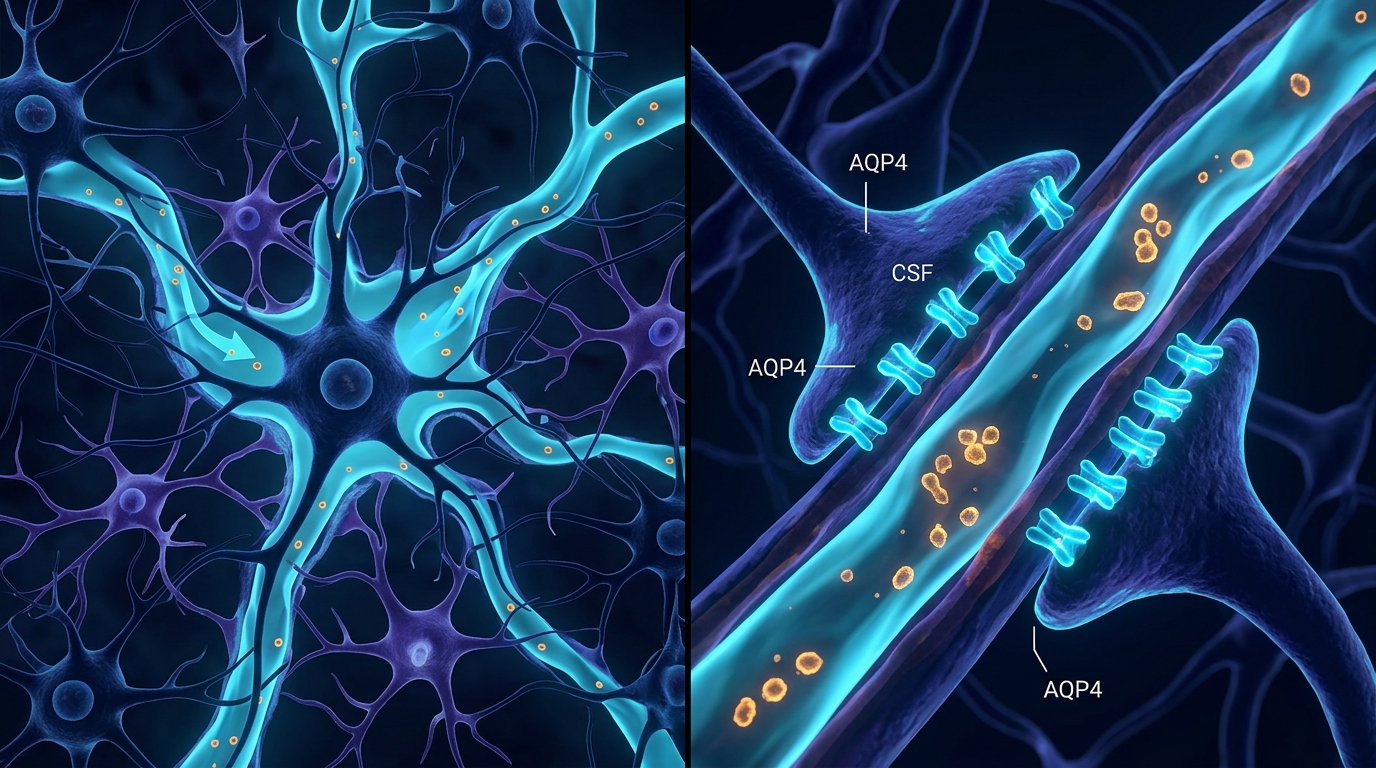
- Astrocytes: Star-shaped glial support cells acting as pipeline engineers, encasing cerebral capillaries with specialized endfeet.
- Aquaporin-4 (AQP4) Water Channels: Microscopic bidirectional water gates densely concentrated on astrocyte endfeet directly interfacing with blood vessels.
Deep Slow-Wave NREM Sleep
Central Noradrenergic Tone Plummets
Interstitial Space Expands by 60%
AQP4 Channels Open Convective Flux
CSF Flushes Away Amyloid-Beta & Tau
During waking hours, when your neurons fire continuously, astrocytes remain swollen, tightly packing interstitial spaces. The brain parenchyma is like a congested, narrow alleyway crammed with parked cars: cerebrospinal fluid cannot penetrate deep tissue layers.
However, once you slip into deep slow-wave NREM sleep, biological magic occurs:
Central levels of the wake-promoting stress hormone Noradrenaline plunge to their circadian nadir. Deprived of noradrenergic stimulation, brain cells shrink in volume, expanding the interstitial space by an astonishing 60%!
Overnight, the congested alleyway opens into a wide, unobstructed boulevard. Astrocytic Aquaporin-4 (AQP4) channels open wide, driving pressurized convective waves of cerebrospinal fluid across the neural matrix, washing through every crevice and flushing misfolded peptides out of the skull.
3. Amyloid-Beta and Tau: The Seeds of Neurodegeneration
What exactly does this nightly convective washwater carry away?
The two most dangerous metabolic byproducts generated by firing neurons during the day are:
- Amyloid-Beta (Aβ): Sticky peptide fragments with an aggressive propensity to aggregate into neurotoxic oligomers and senile plaques.
- Protein Tau: Hyperphosphorylated structural proteins that detach from microtubules, tangling into toxic neurofibrillary knots.
Both culprits represent the definitive pathological hallmarks of Alzheimer's Disease and related dementias.
| Brain Physiological State | Interstitial Volume Fraction | Amyloid-Beta Clearance Efficiency | Morning Cognitive Sensation |
|---|---|---|---|
| Awake & Working (Daytime) | 100% (Tightly packed, constricted) | Basal (<10% peak clearance) | Alert, but gradually accumulating metabolic load |
| Fragmented Sleep / Insomnia | Minimal expansion (+10%) | Disrupted, stagnant convective flux | Heavy head, brain fog, blunted working memory |
| Deep Slow-Wave Sleep (NREM) | Maximal expansion (+60%) | Surges 200% - 300% (Peak wash) | Sharp executive function, restored cognitive clarity |
Rigorous human isotope-tracer studies reveal an alarming consequence: A single night of total sleep deprivation increases cerebrospinal Amyloid-Beta and Tau concentrations by 25% to 50%. Left unchecked across decades, chronic sleep fragmentation leaves neural circuits buried under uncollected molecular garbage.
4. Actionable Protocols: 3 Biological Keys to Optimize Glymphatic Flushing
You cannot purchase a pill at a pharmacy to replace natural glymphatic clearance. However, translational neurobiology provides 3 practical levers to maximize your nightly wash cycle:
1. Adopt the Lateral Sleeping Position
Dynamic contrast-enhanced MRI studies demonstrate that convective glymphatic influx reaches peak hydrodynamic efficiency when sleeping in the lateral posture (on your left or right side) compared to supine (on your back) or prone (on your stomach). Lateral alignment optimizes jugular venous outflow and reduces intracranial resistance.
2. Implement the 3-Hour Pre-Bed Fasting Rule
Consuming carbohydrates or heavy meals late in the evening triggers elevated postprandial Insulin spikes. High circulating insulin suppresses nocturnal growth hormone pulses and fragments delta slow-wave architecture. Give your digestive system at least 3 hours of caloric rest before sleep to ensure astrocytes receive the biological signal to contract.
3. Cool Your Core Body Temperature to Silence Noradrenaline
Glymphatic cleansing strictly requires the silencing of central noradrenergic tone. Maintaining an ambient bedroom temperature around 18-20°C (65-68°F) and taking a warm bath 60 minutes prior to bed (inducing peripheral vasodilation that lowers core body temperature) triggers vagal parasympathetic dominance, accelerating the onset of deep delta waves.
Remember: Sleep is not idle lost time: it is your brain's most vital, hardworking maintenance shift of the entire 24-hour cycle.