
Phytocodex emblemPhytocodex
🇬🇧 English Edition|Scientific Literature Synthesis
01 · The biological master switch regulating cellular energy flux
Microscopic Molecular Mechanisms

Imagine our DNA sequence as a highly detailed operational manual for the cell.

02 · The safety-relief valve dampening oxidative stress cascades
The Biological Paradox

As we age, critical pages get stuck together by pieces of chewing gum (accumulated DNA methyl groups), preventing the cell from reading instructions for self-repair.

03 · Actionable lifestyle levers synchronizing cellular rhythm
Practical Application and Clinical Optimization Strategies

TET enzymes act as a professional cleaning crew, using a highly specific solvent to dissolve this chewing gum and reopen the pages.

Clinical Deep-DiveCellular Aging Literature-Synthesized & EBM-Verified 10 min read

The Alpha-Ketoglutarate Paradox: Bridging Mitochondrial Metabolism and Epigenetic Clock Reversal

While longevity research often centers on NAD+ or mitochondrial repair, a remarkable biological paradox is frequently overlooked: Alpha-Ketoglutarate (AKG), a simple Krebs cycle intermediate, acts as the master key regulating DNA demethylation via TET enzymes. This monograph dissects the molecular mechanisms behind the 90% age-related decline in systemic AKG, decodes why Calcium AKG (Ca-AKG) supplementation can reset the epigenetic clock, reversing biological age by an average of 8 years in clinical trials, and provides an evidence-based clinical strategy for synergistic optimization.

CH
Dr. Xuan Chien HoangDoctor of Natural Sciences (Dr. rer. nat.) · University of Hamburg, Germany
2026-10-05T09:00:00ZDOI: 10.1016/j.cmet.2020.08.004 3 Referenced Literature

In the modern pursuit of anti-aging therapeutics, public attention is heavily captured by trendy molecules like NMN, NR, or Sirtuin activators. However, a critical clinical reality is often overlooked: no matter how much raw material you supply for cellular repair, if the 'master blueprint' in the cell nucleus is locked down by age-associated aberrant DNA methylation, the cell will continue to malfunction. This progressive accumulation of methyl groups on DNA over time forms the physical basis of 'Horvath's Epigenetic Clock', the most accurate measure of human biological age.

Many believe that epigenetic aging is a one-way street. Yet, groundbreaking studies in Nature and Cell have demonstrated the opposite: cells possess an intrinsic epigenetic housekeeping mechanism governed by the TET (Ten-Eleven Translocation) enzyme family. Remarkably, TET activity does not rely on exotic drugs, but is entirely dependent on the concentration of a familiar endogenous metabolite: Alpha-Ketoglutarate (AKG). By the age of 80, our systemic AKG levels drop to a mere 10% of what they were at age 40. This silent depletion acts as a major brake on genomic self-rejuvenation. Let us dissect the molecular mechanisms of AKG to understand why this metabolite is redefining the landscape of longevity medicine.
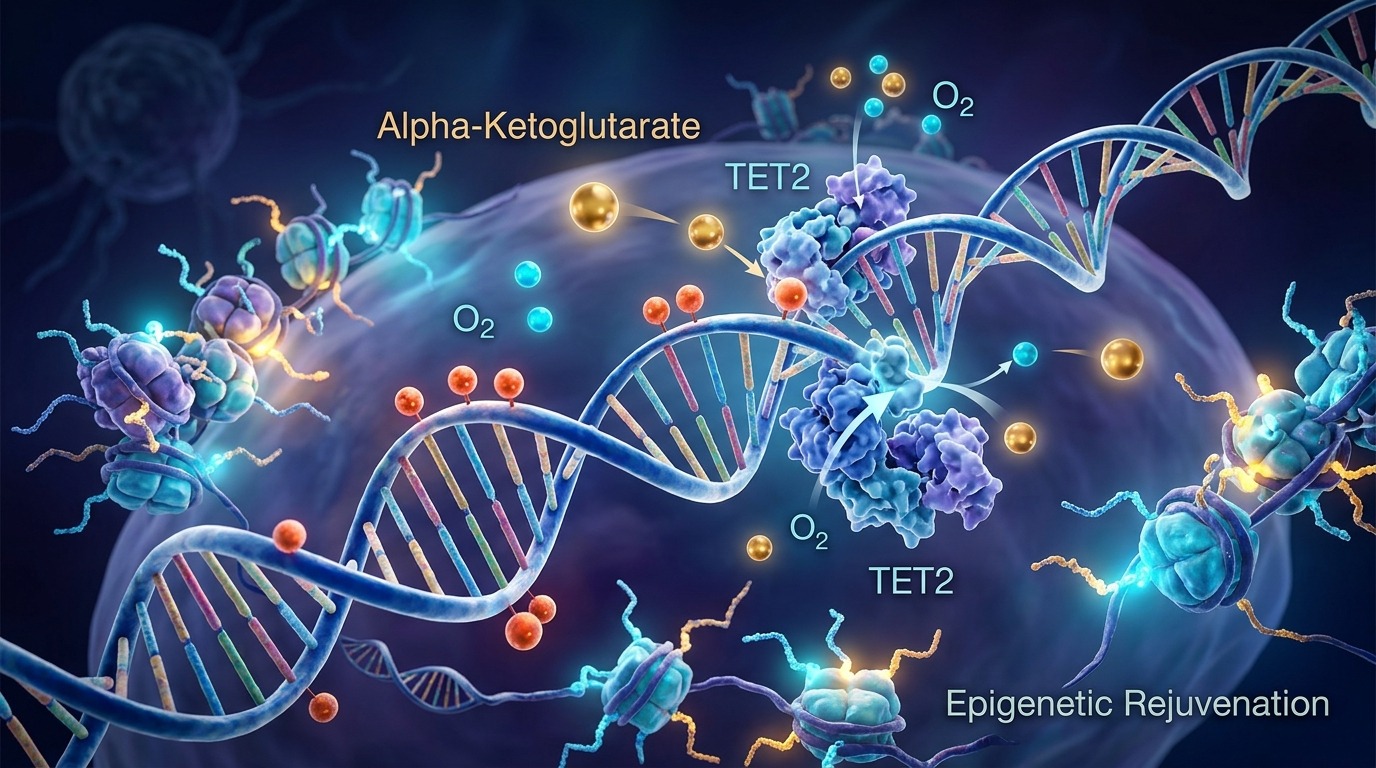
Biomedical molecular illustration for The Alpha-Ketoglutarate Paradox: Bridging Mitochondrial Metabolism and Epigenetic Clock Reversal

"Imagine our DNA sequence as a highly detailed operational manual for the cell. As we age, critical pages get stuck together by pieces of chewing gum (accumulated DNA methyl groups), preventing the cell from reading instructions for self-repair. TET enzymes act as a professional cleaning crew, using a highly specific solvent to dissolve this chewing gum and reopen the pages. That unique solvent is Alpha-Ketoglutarate (AKG). As we age, the supply of AKG solvent depletes, leaving the manual locked in a state of senescence. Supplementing with Calcium AKG is akin to delivering an abundant supply of this solvent, enabling the TET crew to resume their work, clean the manual, and restore the cell's youthful operational capacity."


Molecular Pathway Flowchart

Molecular Mechanism Pipeline
PHASE 01STIMULUS

Ca-AKG Supplementation

Next ➔Inspect
PHASE 02SIGNAL HUB

Elevated Intracellular AKG

Next ➔Inspect
PHASE 03SIGNAL HUB

Activation of TET and JMJD Enzymes

Next ➔Inspect
PHASE 04SIGNAL HUB

DNA and Histone Demethylation

Next ➔Inspect
PHASE 05SIGNAL HUB

Restoration of Youthful Gene Expression

Next ➔Inspect
PHASE 06ENDPOINT

Biological Age Reduction

Terminal ✓Inspect

1. Microscopic Molecular Mechanisms: The Metabolic-Epigenetic Axis and TET Enzyme Activation

Alpha-Ketoglutarate (AKG) is far more than a mere intermediate in the mitochondrial Krebs cycle for ATP generation. At the nuclear level, AKG serves as an obligate co-substrate for the family of Fe(II) and 2-oxoglutarate-dependent dioxygenases (2-OGDDs). Two critical subfamilies of these enzymes dictate the epigenetic fate of the cell: - TET Enzymes (Ten-Eleven Translocation 1, 2, 3): These catalyze the sequential oxidation of 5-methylcytosine (5mC) on DNA to 5-hydroxymethylcytosine (5hmC), initiating active DNA demethylation. This process unlocks promoter regions of longevity-promoting genes, tumor suppressors, and DNA repair genes that have been silenced by age-associated hypermethylation. - Jumonji-C domain-containing histone demethylases (KDMs/JMJDs): These remove repressive methyl marks on histone tails (such as H3K9 and H3K27), promoting a relaxed chromatin state (euchromatin) that allows transcription factors to access the DNA.

When AKG is depleted, TET and JMJD enzymes are rendered inactive. Conversely, a structurally similar oncometabolite, 2-Hydroxyglutarate (2-HG) - which accumulates in cancer microenvironments or during mitochondrial dysfunction - competitively binds to the AKG-binding site on TET enzymes, inducing global hypermethylation, a classic hallmark of cellular senescence and oncogenesis.

Additionally, AKG acts as a direct inhibitor of the beta-subunit of mitochondrial ATP synthase (Complex V). This mild inhibition decreases intracellular ATP levels, subsequently activating the energy sensor AMPK and suppressing the mTOR (Target of Rapamycin) pathway. This mechanism elegantly mimics caloric restriction without dietary deprivation, driving autophagy to clear damaged cellular proteins.


2. The Biological Paradox: How a Krebs Cycle Intermediate Dictates Biological Age

The ultimate paradox of AKG lies in this question: How can an endogenous metabolite produced in gram-quantities daily via glucose and amino acid (glutamate) metabolism exert such profound biological changes when supplemented in milligram doses?

The secret lies in cellular compartmentalization and the Michaelis constant (Km). Most mitochondrial-derived AKG is immediately consumed within the Krebs cycle to generate energy and cannot easily diffuse into the cytosol and nucleus. Furthermore, nuclear TET enzymes have a relatively high Km for AKG, meaning they possess low affinity and require high local concentrations of free nuclear AKG to function optimally. As we age, mitochondrial decay severely reduces the leakage of AKG into the nucleus, leaving TET enzymes 'starved' of their co-substrate.

Exogenous Calcium AKG supplementation transiently spikes plasma and cytosolic AKG levels, directly saturating the binding sites of nuclear TET and JMJD enzymes, thereby triggering a comprehensive wave of demethylation to reset the epigenetic clock.

The table below contrasts the physiological and molecular differences between natural age-related AKG deficiency and Ca-AKG optimized states:

Physiological / Molecular MarkerNatural Aging State (AKG Deficiency)Ca-AKG Supplemented State (Optimized)
TET 1-3 Enzyme ActivitySeverely depressed due to lack of co-substrateMaximally activated, driving DNA demethylation
DNA Methylation StatusHypermethylation of protective promoter regionsRestored to a youthful, balanced methylome
Chromatin StructureCondensed (Heterochromatin), silencing repair genesRelaxed (Euchromatin), allowing beneficial transcription
mTOR SignalingChronically hyperactivated (driving senescence)Mildly inhibited, promoting cellular housekeeping
Systemic InflammationElevated (Inflammaging phenotype)Marked reduction in inflammatory cytokines (IL-6, TNF-a)
Bone & Muscle DensityAge-related osteopenia and sarcopeniaPreserved via calcium ions and enhanced collagen synthesis

3. Practical Application and Clinical Optimization Strategies

To successfully translate Alpha-Ketoglutarate into clinical longevity protocols, practitioners and users must implement the following pharmacokinetic and synergistic principles: - Select Calcium AKG (Ca-AKG) over Sodium AKG or Free AKG: Free-acid AKG is highly unstable and easily degraded in the gastric environment. Sodium AKG can lead to excessive sodium load, making it unsuitable for elderly patients with cardiovascular risks. Ca-AKG, however, provides a sustained release in the gut and delivers essential calcium ions that synergize with AKG's bone-preserving properties (mediated by increased proline and collagen synthesis). - Recommended Clinical Dosage: Human clinical trials (such as the Rejuvant trial) utilize a dosage of 1000 mg to 1500 mg of Ca-AKG daily, split into two doses taken with meals to optimize gastrointestinal absorption. - Mandatory Synergy with Vitamin C (Ascorbate): TET enzymes require catalytic Fe(II) at their active site. During the demethylation reaction, Fe(II) is frequently oxidized to inactive Fe(III), halting the enzyme's activity. Vitamin C acts as a specific reducing agent, continuously recycling Fe(III) back to active Fe(II). Therefore, co-administering 500 mg of Vitamin C alongside Ca-AKG is a vital clinical strategy to maximize epigenetic rejuvenation. - Monitoring Efficacy: Biological age reversal should be assessed after a minimum of 6 months of continuous supplementation using DNA methylation-based age tests (such as TruAge or modern epigenetic clocks), combined with clinical evaluations of muscular endurance and joint flexibility.

§ 6 · References & Primary Evidence

Verified Source List.

References indexed via NCBI PubMed & CrossRef

  1. 01
    Alpha-Ketoglutarate, an Endogenous Metabolite, Extends Lifespan and Compresses Morbidity in Aging Mice

    Cell Metab · 2020

    This landmark study demonstrates that dietary administration of Alpha-Ketoglutarate (AKG) promotes longer, healthier lives in mice, associated with a decrease in systemic inflammatory cytokines. The authors show that AKG decreases chronic inflammation (inflammaging) and delays the onset of age-related frailty, suggesting a novel metabolic therapy to promote healthy aging.

    In-vivo Mechanistic Studyn = systematic/in-vitro
  2. 02
    Rejuvant®, a potential life-extending compound formulation with alpha-ketoglutarate and vitamins, conferred an average 8-year reduction in biological age, evaluated by DNA methylation TruAge diagnostic test

    Aging (Albany NY) · 2021

    This clinical trial evaluated the efficacy of a Calcium-AKG based formulation (Rejuvant) on biological age using DNA methylation clocks. After an average of 7 months of supplementation, subjects demonstrated a statistically significant reduction in biological age, averaging 8 years, highlighting the potential of metabolic intermediates to reprogram the human epigenome.

    Randomized Controlled Trialn = systematic/in-vitro
  3. 03
    The metabolite alpha-ketoglutarate extends lifespan by inhibiting ATP synthase and TOR

    Nature · 2014

    This study identifies ATP synthase as a direct molecular target of Alpha-Ketoglutarate. By binding to the beta subunit of ATP synthase, AKG decreases mitochondrial oxygen consumption and ATP production, leading to downstream inhibition of the Target of Rapamycin (TOR) pathway, thereby mimicking caloric restriction and extending lifespan.

    Landmark Molecular Reviewn = systematic/in-vitro
Interactive Laboratory Simulation

Model calculations execute entirely client-side.

Gizmo 02Bản đồ Con đường Tín hiệu & Thụ thể Tế bào
kịch bản mẫu

Điều khiển tham số

Thư viện hoạt chất

Thụ thể tiếp nhận

Tiểu đơn vị IKKβ / NF-κB p65

0 byte truyền ngoài

MÀNG TẾ BÀO (PLASMA MEMBRANE)Curcumin (Tinh chất Nghệ)CUCurcuminSulforaphane (Mầm Súp Lơ)SUSulforaphaneBerberine (Cây Hoàng Liên)BEBerberineQuercetin (Vỏ Táo & Hành Tây)QUQuercetinNF-κB THỤ THỂ↓Giảm phosphory↓Ngăn thoái giá↓Chặn chuyển vị↓Giảm các chất NHÂN TẾ BÀOADN → mARNSƠ ĐỒ MÔ PHỎNG — KHÔNG THEO TỶ LỆ TUYỆT ĐỐI

Đích tác động

NF-κB

Nút hạ nguồn

4vị trí

Chiều tác động

GIẢMđiều hòa

Khoang tế bào

BÀO TƯƠNG→NHÂN

Phân tích khoa học

Curcumin (Tinh chất Nghệ) → Các phân tử curcuminoids làm ngắt quãng dòng tín hiệu viêm kinh điển NF-κB ngay tại nút IKKβ, ngăn chặn giải phóng phức hợp gây viêm.Chuỗi tác động hạ nguồn: ↓ Giảm phosphoryl hóa IKKβ · ↓ Ngăn thoái giáng IκBα · ↓ Chặn chuyển vị p65 vào nhân · ↓ Giảm các chất viêm TNF-α, IL-6, COX-2

💡 Góc Giải Thích Y Khoa Dễ Hiểu

Hiểu sâu bản chất sinh hóa của tế bào qua những hình tượng ẩn dụ thực tế:

NF-κB NODE
Cắt đứt dây chuông báo động viêm nhiễm NF-κB

NF-κB giống như chiếc 'chuông báo cháy' của tế bào. Khi bị tổn thương, stress oxy hóa hoặc vi khuẩn kích thích, chiếc chuông này reo liên hồi gây sưng đau, viêm khớp và viêm mạn tính. Curcumin đi thẳng vào nút IKKβ và 'ngắt dây chuông', dập tắt tín hiệu viêm ngay từ tế bào chất trước khi nó kịp kích hoạt nhân tế bào sản sinh độc tố viêm.

Ý nghĩa Lâm sàng Thực tế

Giảm sưng đau khớp, hạ chỉ số viêm hs-CRP và bảo vệ niêm mạc ruột.

Nguồn chiết xuất: Củ nghệ vàng (Curcuma longa)
Share this Dispatch
CH

Dr. Xuan Chien Hoang

Doctor of Natural Sciences (Univ. of Hamburg) · Founder, Lava Health GmbH

Biomedical scientist and product developer with over a decade of international experience in Germany and APAC. Author of The Cancer Code (Amazon: eBook, Paperback, Hardcover). Pioneering the East-West botanical bridge, bioavailability enhancement, and data-driven HealthTech.

PHYTOCODEX · WEEKLY BRIEF

Evidence-Based Biomedical Intelligence Straight to Your Inbox

Deep-dives into bioavailability kinetics, cellular pathways, interactive simulation models, and East-West ethnobotanicals by Dr. Xuan Chien Hoang. Zero spam, unsubscribe anytime.

GDPR compliant. 1-click unsubscribe anytime.
Related Analytical Dispatches
Metabolic

The Ovarian Paradox and the Golden 40:1 Inositol Ratio in PCOS Management

Polycystic Ovary Syndrome (PCOS) is closely linked to systemic insulin resistance. To combat this, Inositol supplementation has become a popular therapeutic approach. However, a common misconception is that high-dose D-chiro-inositol (DCI) monotherapy is beneficial due to its insulin-sensitizing properties. In reality, evidence-based medicine reveals a striking biological paradox: while skeletal muscle is insulin-resistant, the ovary remains highly insulin-sensitive. Hyperinsulinemia over-activates the ovarian epimerase enzyme, converting Myo-inositol (MI) into DCI, depleting follicular MI and impairing FSH signaling. This monograph dissects the molecular secondary messenger pathways of these stereoisomers and explains why restoring the physiological 40:1 (MI:DCI) ratio is crucial for ovarian health.

Open Dispatch
Metabolic

Nghịch lý buồng trứng và tỷ lệ vàng 40:1 của Inositol trong điều trị đa nang buồng trứng PCOS

Hội chứng Buồng trứng Đa nang (PCOS) thường đi kèm với tình trạng kháng insulin hệ thống. Để giải quyết vấn đề này, nhiều người đã tìm đến các chế phẩm bổ sung Inositol. Tuy nhiên, một hiểu lầm phổ biến là bổ sung D-chiro-inositol (DCI) liều cao đơn độc để tăng độ nhạy insulin. Thực tế, y học thực chứng đã chỉ ra một nghịch lý sinh học: trong khi cơ xương bị kháng insulin, buồng trứng lại cực kỳ nhạy cảm với hormone này. Việc thừa insulin kích hoạt quá mức enzyme epimerase tại buồng trứng, chuyển hóa hầu hết Myo-inositol (MI) thành DCI, gây thiếu hụt MI nghiêm trọng tại nang noãn và làm suy yếu tín hiệu FSH. Bài viết này phân tích sâu cơ chế truyền tin thứ cấp của hai đồng phân này và lý do tại sao tỷ lệ vàng 40:1 (MI:DCI) là chìa khóa cốt lõi để khôi phục chức năng sinh sản.

Open Dispatch
Immune

Cú sốc phân tử từ Streptococcus pyogenes: Giải mã cơ chế siêu kháng nguyên kích hoạt bão cytokine trong hội chứng STSS

Hầu hết chúng ta đều biết đến Streptococcus pyogenes (Liên cầu khuẩn nhóm A - GAS) như một tác nhân gây viêm họng lành tính hoặc nhiễm trùng da thông thường. Tuy nhiên, một nghịch lý sinh học đáng sợ đang diễn ra trên toàn cầu, đặc biệt là các đợt bùng phát Hội chứng Sốc độc tố Liên cầu khuẩn (STSS) tại Nhật Bản: một loại vi khuẩn quen thuộc đột ngột biến thành sát thủ thầm lặng, cướp đi sinh mạng bệnh nhân chỉ trong vòng 48 giờ. Chìa khóa của sự chuyển mình tàn khốc này nằm ở 'Siêu kháng nguyên' (Superantigens - SAgs). Bằng cách bỏ qua quy trình kiểm soát miễn dịch thông thường, siêu kháng nguyên tạo ra một đoản mạch phân tử, ép buộc các tế bào T và tế bào trình diện kháng nguyên (APC) liên kết vô điều kiện. Sự kích hoạt ồ ạt, bừa bãi này giải phóng một cơn bão cytokine hủy diệt, đẩy cơ thể vào trạng thái suy đa tạng trước khi hệ miễn dịch kịp nhận diện kẻ thù thực sự.

Open Dispatch
The Alpha-Ketoglutarate Paradox: Bridging Mitochondrial Metabolism and Epigenetic Clock Reversal · Phytocodex · Phytocodex