
Millions of women worldwide grapple with Polycystic Ovary Syndrome (PCOS), a complex endocrine and metabolic disorder characterized by insulin resistance, ovulatory dysfunction, and hyperandrogenism. In the search for natural therapeutic strategies, Inositol has emerged as a widely discussed supplement across health forums. Many individuals blindly purchase high-dose D-chiro-inositol (DCI) formulations, hoping to reverse their symptoms. However, modern evidence-based medicine has exposed an ironic biochemical truth: supplementing with isolated DCI or using incorrect ratios not only fails to heal the ovaries but can actively worsen infertility. This phenomenon is known as the Ovarian Paradox in metabolic medicine. To comprehend this clinical enigma, we must dissect the secondary messenger signaling pathways of insulin mediated by two stereoisomers: Myo-inositol (MI) and D-chiro-inositol (DCI). The delicate balance between these two molecules dictates insulin sensitivity in skeletal muscle and directly regulates aromatase enzyme activity in the ovaries, offering a revolutionary paradigm for metabolic optimization and fertility preservation.
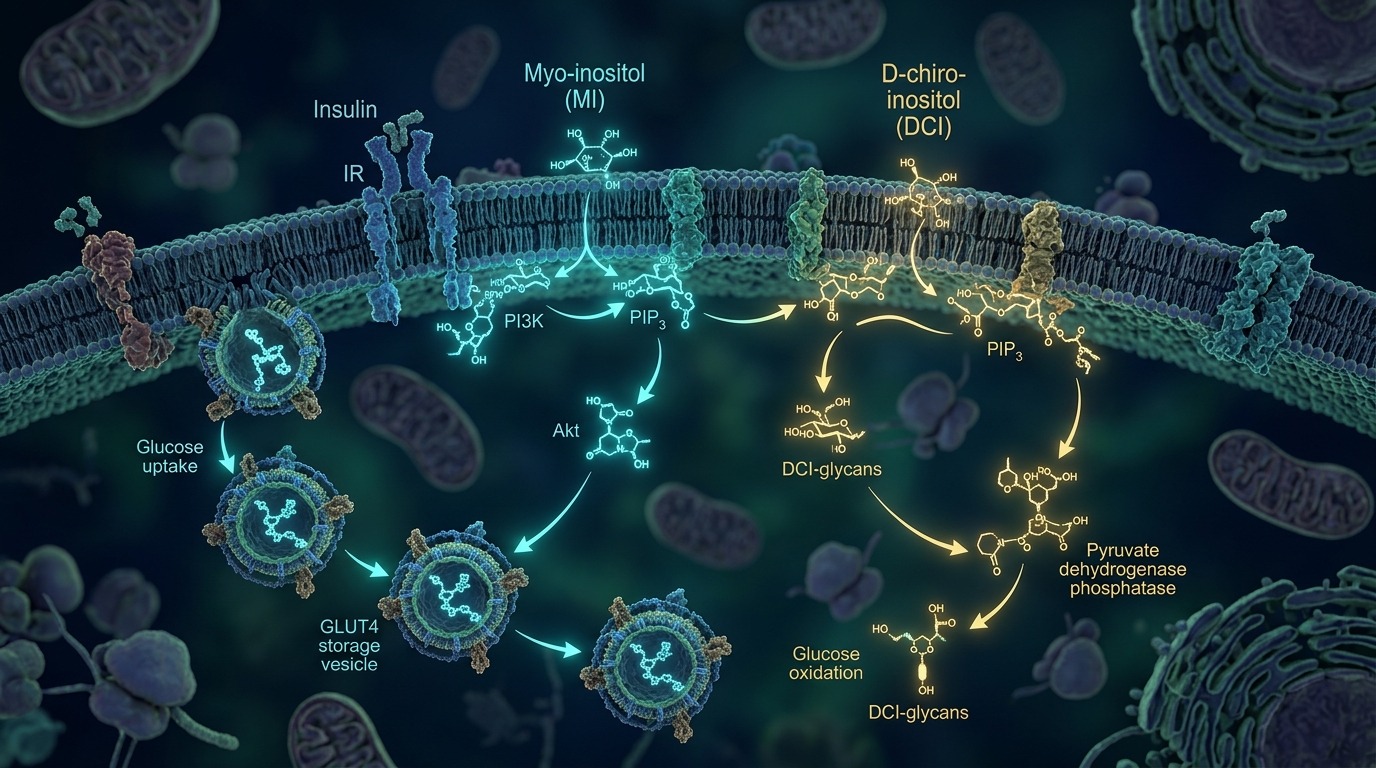
"Imagine the cell as a manufacturing plant requiring two distinct operational keys: Myo-inositol (MI) acts as the key to open the gates for raw materials (glucose) to enter the furnace, while D-chiro-inositol (DCI) is the switch that manages fuel storage and activates the hormone production line. In a healthy state, these two keys are distributed at a precise 40:1 ratio. However, in patients with PCOS, the body gets stuck in a hyperinsulinemia panic loop, like a frantic manager continuously forging DCI keys while discarding MI keys. Consequently, the glucose entry gates remain locked, while the androgen production line runs at maximum capacity, causing total chaos within the cellular factory."
Molecular Pathway Flowchart
Insulin binds IR Receptor
Activation of Inositol Phosphoglycans (IPGs)
MI-IPG triggers GLUT4 Glucose Translocation & DCI-IPG activates Glycogen Synthesis
Glucose Homeostasis restored
1. Molecular Mechanisms: The Secondary Messenger Pathways of Inositols
Inositol is a hexahydroxycyclohexane (cyclohexane-1,2,3,4,5,6-hexol) that exists as nine distinct stereoisomers, among which Myo-inositol (MI) and D-chiro-inositol (DCI) are the most biologically active in metabolic signaling. Upon insulin binding to its extracellular receptor (Insulin Receptor - IR) on the cell membrane, it triggers receptor autophosphorylation on tyrosine residues. This signaling cascade induces the cleavage of glycosylphosphatidylinositol-anchored proteins on the cell membrane, liberating two distinct secondary messengers: MI-phosphoglycan (MI-IPG) and DCI-phosphoglycan (DCI-IPG).
MI-IPG is primarily responsible for activating protein kinase B (Akt) and phosphoinositide 3-kinase (PI3K) pathways, which stimulate the translocation of glucose transporter 4 (GLUT4) vesicles from intracellular compartments to the plasma membrane. This process facilitates cellular glucose uptake from the bloodstream for energy production. Conversely, DCI-IPG activates pyruvate dehydrogenase phosphatase, which dephosphorylates and activates glycogen synthase, promoting the conversion of excess glucose into glycogen storage within the liver and skeletal muscle.
The conversion of MI to DCI is tightly regulated by an insulin-dependent enzyme known as epimerase (NADH-dependent epimerase). In insulin-sensitive tissues such as skeletal muscle and liver, the physiological ratio of MI to DCI typically ranges from 40:1 to 100:1. This ratio ensures that the majority of glucose is immediately utilized for energy via GLUT4 (driven by MI) while a smaller fraction is stored as glycogen (driven by DCI). When epimerase activity is impaired due to systemic insulin resistance, this conversion is blocked, leading to a localized DCI deficiency in peripheral tissues.
2. The Ovarian Paradox and MI:DCI Ratio Dysregulation
While peripheral tissues like skeletal muscle and liver exhibit profound insulin resistance in PCOS, the ovaries remain highly sensitive to insulin. This clinical phenomenon is known as the Ovarian Paradox. When circulating insulin levels rise (hyperinsulinemia) to compensate for peripheral insulin resistance, the ovaries are continuously bombarded by high concentrations of insulin.
This persistent stimulation over-activates the ovarian epimerase enzyme, accelerating the conversion of MI to DCI within follicular tissue. Consequently, the physiological MI:DCI ratio in the ovary (normally maintained at 40:1) drops drastically, sometimes reaching ratios as low as 5:1 or lower. The depletion of MI within the follicular fluid severely impairs Follicle-Stimulating Hormone (FSH) signaling, as FSH relies on MI-IPG as its primary secondary messenger. Without adequate MI, oocyte maturation is arrested, leading to anovulation and follicular cysts.
Simultaneously, the excess of ovarian DCI stimulates theca cells to upregulate androgen (testosterone) synthesis by activating cytochrome P450c17 enzymes. This explains why high-dose isolated DCI supplementation is a critical clinical error in PCOS management, as it directly promotes hyperandrogenism and degrades oocyte quality.
| Physiological State | Serum MI:DCI Ratio | Ovarian Epimerase Activity | Clinical Endpoint |
|---|---|---|---|
| Healthy Homeostasis | 40:1 | Normal physiological activity | Regular ovulation, balanced hormones |
| Polycystic Ovary Syndrome (PCOS) | Severely reduced (down to 5:1) | Over-activated due to hyperinsulinemia | Follicular arrest, hyperandrogenism |
| Incorrect High-Dose DCI Supplementation | Extremely low (severe imbalance) | Feedback inhibition or saturated | Impaired oocyte quality, elevated testosterone |
| Golden 40:1 Ratio Therapy | Restored to 40:1 | Re-established homeostasis | Restored ovulatory cycles, improved insulin sensitivity |
This comparative analysis demonstrates that maintaining the golden 40:1 ratio between MI and DCI is the core therapeutic mechanism for restoring normal reproductive and metabolic functions in PCOS patients, rather than focusing on a single isomer.
3. Clinical Strategies and Metabolic Optimization Guidelines
To translate these molecular findings into clinical practice, the selection of the correct inositol formulation and ratio is paramount. Large-scale randomized controlled trials (RCTs) have demonstrated that combined supplementation of Myo-inositol and D-chiro-inositol at the physiological 40:1 ratio yields vastly superior clinical outcomes compared to monotherapy with either isomer.
The standard clinical recommendation for patients with PCOS and insulin resistance is a daily dose of 4000 mg of Myo-inositol combined with 100 mg of D-chiro-inositol (administered in two divided doses, 30 minutes before major meals). This dosing regimen optimizes gastrointestinal absorption, as both stereoisomers compete for the same sodium-dependent glucose cotransporter (SGLT) system. Dividing the dose and maintaining the strict 40:1 ratio prevents transport system saturation and ensures efficient delivery to target tissues.
Furthermore, to optimize epimerase activity and systemic insulin sensitivity, clinicians should consider combining inositol therapy with insulin-sensitizing bioactives such as Alpha-lipoic acid (ALA) at 400-600 mg/day or Chromium picolinate at 200 mcg/day. Lifestyle modifications must focus on restricting high-glycemic index (High-GI) carbohydrates to minimize postprandial insulin spikes, thereby preventing the over-activation of ovarian epimerase. Periodic monitoring of glycated hemoglobin (HbA1c), fasting insulin, and HOMA-IR index every 3 months is highly recommended to evaluate metabolic progress and adjust therapeutic dosages accordingly.