
In recent years, global public health authorities have raised alarms over a sharp, unexplained spike in Streptococcal Toxic Shock Syndrome (STSS) cases, often sensationalized in the media as the flesh-eating bacteria crisis. From a clinical and epidemiological standpoint, the pathogen responsible is none other than Streptococcus pyogenes (Group A Streptococcus), a ubiquitous bacterium that most people encounter as a self-limiting sore throat during childhood. The terrifying transition from a benign mucosal colonizer to a hyper-invasive, life-threatening systemic killer with a 30% to 40% mortality rate represents one of the most profound paradoxes in modern infectious biology. A patient might present with a minor skin abrasion or mild pharyngitis, only to deteriorate within 24 to 48 hours into refractory hypotension, rapid necrotizing fasciitis, and multi-organ failure. To comprehend this clinical catastrophe, we must look beyond basic bacterial replication and delve into the molecular pharmacology of bacterial toxins, where a single class of proteins can completely hijack human immunological signaling.
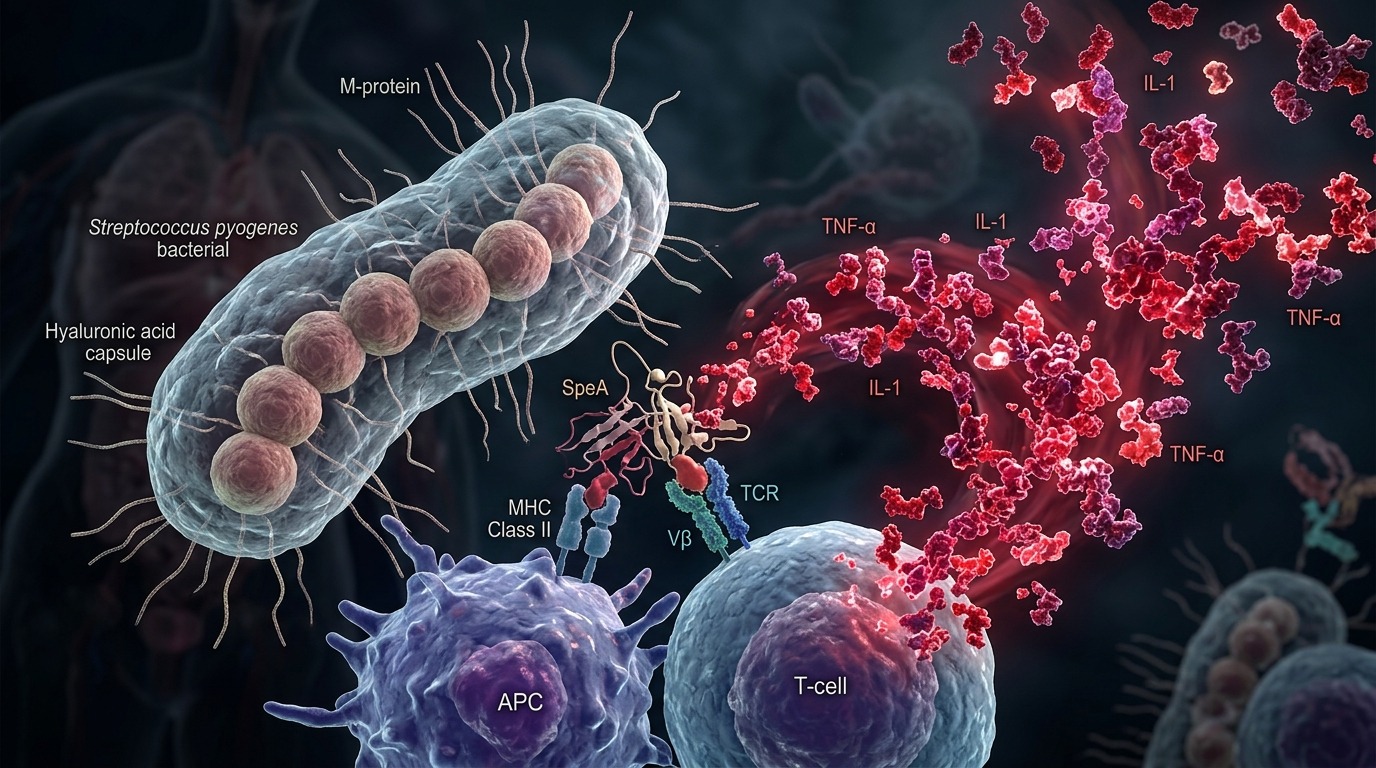
"Imagine normal immune activation as a highly secure bank vault system: to open the vault (activate a T-cell), a customer's key (antigen) must perfectly fit the intricate tumblers of the guard's lock (MHC-II and TCR). Only a 100% precise match grants access. A superantigen, however, acts like a brutal, external steel clamp. Instead of fitting inside the keyhole, it violently clamps the guard's hand and the customer's wrist together from the outside, forcing the lock open regardless of fit. This catastrophic molecular short-circuit forces up to 20% of all vaults to swing open simultaneously, triggering a chaotic, city-wide false alarm that overloads and burns down the entire electrical grid."
Molecular Pathway Flowchart
Streptococcus pyogenes secretes SpeA/SpeC
Superantigen cross-links MHC-II & TCR Vβ externally
Non-specific activation of 20% T-cells
Cytokine Storm: TNF-alpha, IL-1beta, IFN-gamma
Systemic vasodilation, vascular leakage & STSS
1. Molecular Machinery: How Superantigens Bypass Immune Gates
In a standard immune response, an Antigen-Presenting Cell (APC) such as a macrophage or dendritic cell engulfs the invading pathogen, processes its proteins into short peptide fragments (12 to 15 amino acids), and presents them within the peptide-binding groove of Major Histocompatibility Complex Class II (MHC-II) molecules. Helper T-cells (CD4+) bearing highly specific T-Cell Receptors (TCRs) scan these complexes. T-cell activation occurs only when the TCR recognizes both the specific MHC-II molecule and the unique peptide nestled inside the groove. Because of this extreme specificity, only about 1 in 10,000 to 1 in 100,000 T-cells (0.01% to 0.001%) are activated during a normal infection.
However, Streptococcus pyogenes has evolved a potent family of pyrogenic exotoxins, primarily SpeA, SpeB, SpeC, SpeG-M, and SmeZ, which function as Superantigens (SAgs). These toxins entirely bypass classical intracellular antigen processing. Instead of fitting inside the MHC-II groove, SAgs bind directly to the outer lateral surface of the MHC-II molecule and the variable region of the beta chain of the T-Cell Receptor (TCR Vβ).
This lateral binding is completely independent of the peptide sequence in the groove. It acts as a crude molecular clamp, forcing the APC and T-cell into close contact and initiating intracellular signaling. Consequently, instead of a select few specific T-cells, up to 20% of the entire systemic T-cell pool is activated simultaneously. This massive, uncontrolled activation triggers an immediate, catastrophic release of pro-inflammatory cytokines, including Tumor Necrosis Factor-alpha (TNF-α), Interleukin-1 beta (IL-1β), Interleukin-6 (IL-6), and Interferon-gamma (IFN-γ), culminating in a systemic cytokine storm.
2. The Virulence Paradox and Clinical Comparison Matrix
The primary paradox of Streptococcus pyogenes lies in the stark disconnect between bacterial load and clinical severity. In many fatal STSS cases, the systemic bacterial count is not exceptionally high, yet the host's inflammatory response is overwhelming. This explains why young individuals with highly robust immune systems are often the most severely affected: a stronger immune system provides more fuel for the superantigen-mediated fire.
An individual's susceptibility to STSS is heavily dictated by their Human Leukocyte Antigen class II (HLA-II) genotype. Patients carrying specific alleles, such as HLA-DQB106:02 or DRB115:01, exhibit an exceptionally high binding affinity for SpeA, rendering them far more susceptible to rapid, refractory toxic shock compared to the general population.
The following matrix contrasts the physiological differences between standard streptococcal infections and acute STSS:
| Physiological Marker / Clinical Parameter | Standard Streptococcal Infection (Pharyngitis/Cellulitis) | Streptococcal Toxic Shock Syndrome (STSS) |
|---|---|---|
| T-Cell Activation Fraction | Extremely low (0.001% - 0.01%) | Massive (5% - 20%) |
| Serum Cytokine Levels | Baseline or localized elevation | Acute systemic surge (TNF-a, IL-1, IFN-g storm) |
| Mean Arterial Pressure (MAP) | Stable (70 - 100 mmHg) | Refractory hypotension (< 60 mmHg) |
| Coagulation Profile | Normal | Disseminated Intravascular Coagulation (DIC) |
| Soft Tissue Pathology | Localized inflammation (erythema, mild pain) | Rapidly progressive Necrotizing Fasciitis |
| Mortality Rate | Under 1% | 30% - 45% (despite aggressive critical care) |
Practical Takeaways & Clinical Translation: 3. Clinical Strategies: Anti-Toxin Pharmacotherapy & Neutralization
Unraveling the molecular pharmacology of superantigens has fundamentally reshaped the clinical management of STSS. Historically, clinicians relied solely on Beta-lactam antibiotics (such as Penicillin) to eradicate the bacteria. However, this monotherapy often fails due to the Eagle effect: when bacterial density is high during the stationary growth phase, bacteria cease active division, rendering cell-wall-active agents like Penicillin highly ineffective. Furthermore, rapid cell wall lysis induced by Beta-lactams can cause a massive release of pre-formed intracellular toxins (SpeA/SpeC) into the bloodstream, worsening the shock state.
To maximize patient survival, modern critical care protocols mandate three core therapeutic pillars:
First, mandatory combination with Clindamycin: Clindamycin, a lincosamide antibiotic, binds to the 50S ribosomal subunit of the ribosome. Rather than merely lysing the bacterial cell wall, Clindamycin directly halts protein synthesis. This immediately shuts down the production of superantigens (SpeA, SpeC) and the anti-phagocytic M protein at the translational level.
Second, Intravenous Immunoglobulin (IVIG) therapy: IVIG contains a diverse pool of neutralizing IgG antibodies harvested from thousands of healthy donors. These antibodies bind directly to circulating streptococcal superantigens, preventing them from cross-linking MHC-II and TCR molecules, thereby neutralizing the cytokine storm.
Third, aggressive surgical debridement: In cases of STSS presenting with necrotizing fasciitis, prompt and thorough surgical removal of necrotic tissue is vital to eliminate the primary reservoir of replicating bacteria and active toxins.