
For decades, clinical medicine has viewed obesity and metabolic decline through the simplistic lens of energy intake versus energy expenditure. Conventional guidelines focused almost exclusively on caloric restriction or physical exercise to burn energy via ATP-dependent pathways. However, groundbreaking discoveries in mitochondrial biology have unveiled a radically different truth: our bodies possess an incredibly sophisticated active energy dissipation system that bypasses muscle contraction entirely: non-shivering thermogenesis in Brown Adipose Tissue (BAT). The prevailing misconception was that any energy leak within the cell represents pathology or metabolic inefficiency. In reality, actively dissipating the proton gradient through the Uncoupling Protein 1 (UCP1) channel is not just a primitive mechanism to survive cold exposure, but a vital biological safety valve. Upon UCP1 activation, brown adipocytes siphon massive amounts of glucose and free fatty acids directly from the circulation to fuel this molecular furnace, dramatically restoring insulin sensitivity independent of pancreatic insulin secretion. This monograph explores the precise molecular architecture of UCP1, the therapeutic paradox of mitochondrial uncoupling, and cutting-edge clinical strategies to harness brown fat activation for reversing metabolic aging.
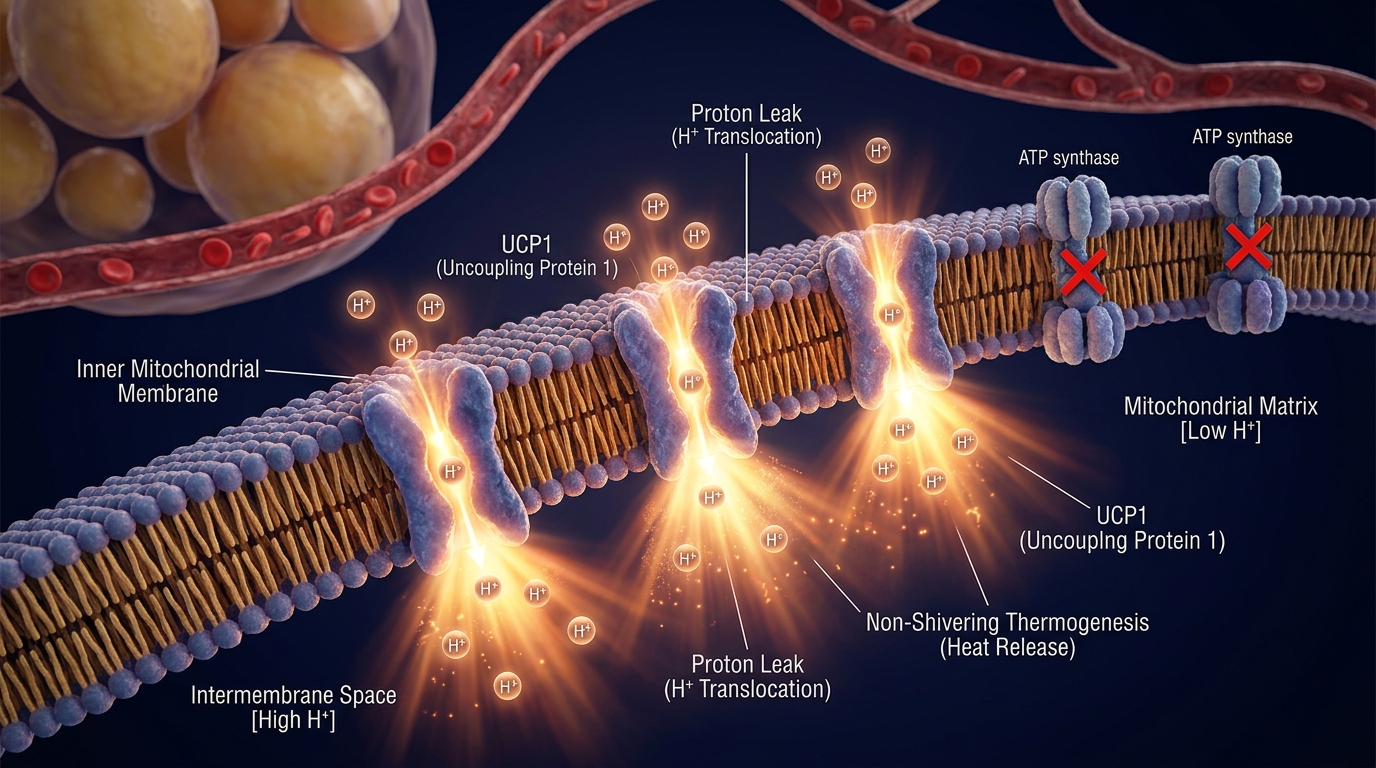
"Imagine the mitochondrion as a massive hydroelectric dam. The water flow (protons) spins the turbines (ATP synthase) to generate electricity (ATP). When the dam is overloaded due to excessive water influx (nutrient overload in obesity), the turbines seize up, water pressure spikes, causing structural damage and leakage (oxidative stress and ROS accumulation). Uncoupling Protein 1 (UCP1) acts as an intelligent emergency spillway. It allows water to bypass the turbine and flow safely downstream. Although it generates no electricity (ATP), this spillway relieves the immense pressure on the dam structure, preventing a catastrophic failure (cellular damage) while releasing the excess energy harmlessly as heat."
Molecular Pathway Flowchart
Cold Exposure / ADRB3 Receptor
Adenylate Cyclase Activation
Elevated cAMP & PKA
Lipolysis & FFA Release
Direct UCP1 Activation in Inner Mitochondrial Membrane
Proton H+ Leak
Electrochemical Gradient Dissipation & Thermogenesis
1. Molecular Architecture of UCP1 and the Thermogenic Signaling Cascade
UCP1 (Uncoupling Protein 1, historically known as thermogenin) is an inner mitochondrial membrane protein belonging to the mitochondrial carrier family (SLC25A9). Under basal conditions, UCP1 activity is potently inhibited by purine nucleotides (such as ATP, ADP, GTP, GDP) binding to its active pocket on the intermembrane space side. The activation of UCP1 is initiated upon cold exposure, which triggers the sympathetic nervous system to release Norepinephrine (NE). NE binds to Beta-3 Adrenergic Receptors (ADRB3) on the brown adipocyte membrane, stimulating Adenylate Cyclase (AC) to convert ATP into cAMP (cyclic Adenosine Monophosphate). Elevated intracellular cAMP activates Protein Kinase A (PKA), which subsequently phosphorylates and activates Hormone-Sensitive Lipase (HSL) and Perilipin. HSL hydrolyzes stored triglycerides into Free Fatty Acids (FFAs). These FFAs play a dual role: they serve as substrates for mitochondrial beta-oxidation and bind directly to UCP1, inducing a conformational change that ejects the inhibitory purine nucleotides and opens the proton channel. Protons (H+) from the intermembrane space are then translocated back into the mitochondrial matrix, bypassing ATP Synthase (Complex V) and converting the electrochemical gradient potential directly into thermal energy.
2. The Mitochondrial Uncoupling Paradox: From Energy Dissipation to Cytoprotection and Longevity
A profound biological paradox of UCP1 is that intentionally leaking protons, which seemingly compromises cellular ATP production efficiency, serves as the ultimate mitochondrial defense mechanism. When the Electron Transport Chain (ETC) is overloaded with nutrient substrates, the mitochondrial membrane potential (ΔΨm) spikes, causing electron stagnation at Complex I and Complex III. This stagnation forces electrons to leak prematurely to oxygen, forming superoxide radicals (O2.-), the root cause of oxidative stress and mitochondrial DNA damage. By opening the UCP1 channel, the mitochondrial membrane potential is gently lowered (mild uncoupling). This slight reduction in ΔΨm accelerates electron flow through the ETC, preventing electron backing up and reducing ROS production by up to 90%. Furthermore, succinate accumulation in brown adipocytes during cold exposure acts as a potent driver, fueling succinate oxidation via Complex II to generate a controlled, localized burst of ROS that functions as a retrograde signaling molecule to activate mitochondrial biogenesis pathways via PGC-1alpha. Below is a detailed comparison table between the two mitochondrial physiological states:
| Physiological Parameter | Coupled State (UCP1 Closed) | Uncoupled State (UCP1 Open) |
|---|---|---|
| Mitochondrial Membrane Potential (ΔΨm) | Extremely high (straining the ETC) | Low to moderate (stabilized) |
| Reactive Oxygen Species (ROS) Generation | High (especially during nutrient overload) | Very low (mitigated oxidative stress) |
| Substrate Consumption Rate | Conserved (leads to ectopic lipid storage) | Highly accelerated (rapid clearance) |
| ATP Synthesis Efficiency | Maximal | Low (prioritizes thermogenesis) |
| Impact on Insulin Sensitivity | Promotes insulin resistance via lipotoxicity | Enhances insulin sensitivity and lipid clearance |
| Mitochondrial Integrity | Vulnerable to damage and degradation | Protected, stimulates mitochondrial biogenesis |
3. Translational Protocols and Clinical Strategies for UCP1 Activation
Translating basic science into clinical practice offers groundbreaking therapeutic avenues for treating obesity, type 2 diabetes, and delaying systemic aging. Viable clinical strategies include:
-
Cyclic Cold Exposure Protocols: Exposure to mild cold (14 to 16 degrees Celsius) for 2 hours daily has been clinically shown to increase active brown fat volume and significantly enhance peripheral glucose clearance. A practical protocol involves taking a cold shower (15 degrees Celsius) for 2 to 3 minutes each morning to stimulate the sympathetic-BAT axis.
-
Phytochemical Activators of Browning: Natural compounds such as Capsaicin (from chili peppers), Resveratrol (from red grapes), and Curcumin indirectly activate UCP1 by stimulating the TRPV1 receptor or activating Sirtuin 1 (SIRT1) to deacetylate PGC-1alpha, thereby promoting the browning of white adipose tissue into beige adipocytes.
-
Circadian Alignment and Melatonin: Brown adipose tissue activity is tightly regulated by the circadian clock via Melatonin. Ensuring deep sleep in complete darkness optimizes nocturnal Melatonin secretion, which stimulates brown adipocyte proliferation and maintains the sensitivity of ADRB3 receptors.
-
Next-Generation Pharmacological Interventions: Selective Beta-3 Adrenergic receptor agonists (such as Mirabegron) or multi-target GLP-1/GIP/Glucagon receptor co-agonists are being actively investigated for their ability to potently upregulate UCP1 expression without the adverse cardiovascular side effects associated with older sympathetic stimulants.