
In the global pursuit of natural anti-aging compounds, the pomegranate has long been elevated to near-mythical status. Millions of health-conscious individuals consume pomegranate juice daily, hoping to erase wrinkles, boost vitality, and shield their cardiovascular systems. However, modern evidence-based medicine offers a stark reality check: drinking pomegranate juice does not guarantee cellular rejuvenation. The true therapeutic magic lies not in the fruit itself, but in a tiny metabolite called Urolithin A. When we consume pomegranates, complex polyphenols known as ellagitannins enter the digestive tract, where they must be meticulously metabolized by specific gut microbes to produce Urolithin A. Crucially, clinical trials reveal that over 60% of the global population lacks the specific microbiome profile required for this transformation, rendering pomegranate consumption biologically ineffective for mitochondrial rescue. Furthermore, groundbreaking studies published in Nature Medicine and Cell Reports have unveiled a stunning molecular reality: Urolithin A is a first-in-class natural compound capable of directly triggering mitophagy (the selective clearance of dysfunctional mitochondria) via a pathway completely independent of the NAD+ or AMPK axes, opening a revolutionary chapter in regenerative medicine and muscle longevity.
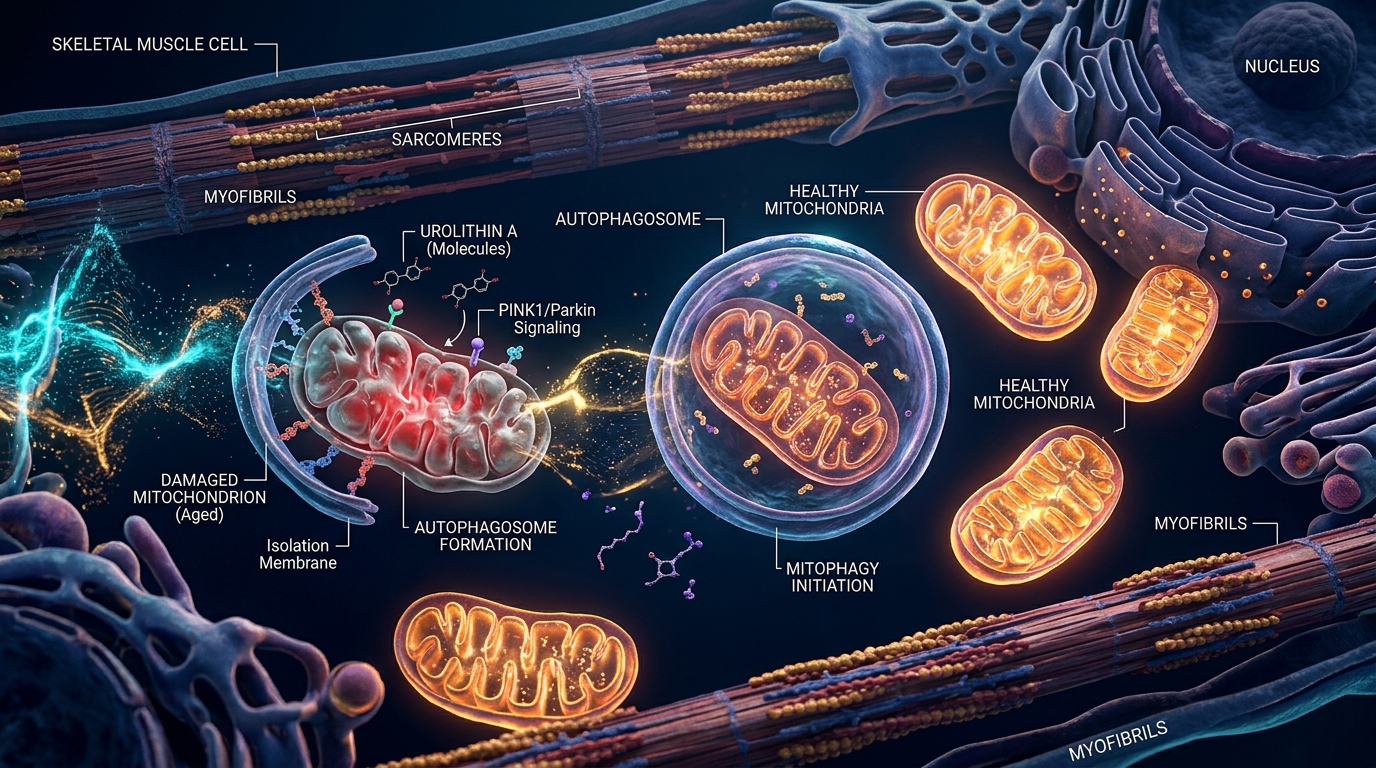
"Imagine the mitochondria in your muscle cells as miniature nuclear reactors powering a bustling city. Over time, these reactors rust, leak toxic waste (reactive oxygen species or ROS), and lose efficiency. Typically, to decommission and clean them, the cell must spend an enormous amount of its raw fuel (such as NAD+). Urolithin A acts like an autonomous, intelligent maintenance drone team. Instead of draining the city's main power grid (operating independently of NAD+), these drones directly tag the damaged reactors with red flags, triggering a safe self-destruction sequence (mitophagy) and recycling the scrap metal to build brand-new, highly efficient reactors, restoring full power without causing a brownout."
Molecular Pathway Flowchart
Dietary Ellagitannins
Gut Microbiota (Eggerthellaceae)
Systemic Urolithin A Absorption
Activation of PTEN-induced kinase 1 (PINK1) / Parkin
Ubiquitination of Damaged Mitochondria
Autophagosome Formation
Mitophagy Clearance
Mitochondrial Biogenesis & ATP Restoration
1. Molecular Mechanisms: The NAD+ Independent Mitophagy Pathway
Mitochondria serve as the cellular powerplants generating ATP, but as they age or suffer from oxidative stress, they become major sources of reactive oxygen species (ROS) that damage cellular components. To maintain cellular homeostasis, cells employ a specialized quality-control mechanism called Mitophagy (mitochondrial autophagy). The classical pathway of mitophagy induction typically relies on the NAD+:Sirtuin:AMPK axis, which requires significant intracellular energy expenditure and high NAD+ concentrations to function.
Urolithin A (UA) represents a biological breakthrough due to its ability to trigger mitophagy via a pathway completely independent of the cell's energy status and without requiring NAD+. Upon entering muscle cells, UA directly promotes the stabilization of PINK1 (PTEN-induced kinase 1) on the outer mitochondrial membrane (OMM) of depolarized, damaged mitochondria. Under basal conditions, PINK1 is rapidly degraded by intracellular proteases: however, under UA stimulation, PINK1 accumulates on the OMM. Accumulated PINK1 then phosphorylates both ubiquitin and Parkin (an E3 ubiquitin ligase), recruiting Parkin from the cytosol to the damaged mitochondria. Parkin subsequently ubiquitinates OMM proteins such as VDAC1 and Mfn1/2, creating a powerful red flag signal that recruits autophagy receptors like p62/SQSTM1, OPTN, and NDP52. These receptors bind directly to LC3 proteins on the autophagosome membrane, engulfing the damaged mitochondria and delivering them to lysosomes for degradation. This process is highly selective, rapid, and does not deplete the cell's metabolic energy reserves.
2. The Microbiome Paradox and Clinical Comparative Analysis
The primary biological paradox of Urolithin A lies in its synthesis: although it is a master regulator of muscle health, the human body cannot synthesize it from dietary sources without specific gut microbiota, primarily belonging to the Eggerthellaceae family (such as Gordonibacter pamelaeae and Gordonibacter urolithinfaciens). Individuals capable of efficiently converting ellagitannins from pomegranates, berries, or walnuts into Urolithin A are classified as 'Metabotype A'. Conversely, over 60% of the global population are 'Non-producers' who lack these specific microbes, meaning that consuming large volumes of pomegranate juice only yields excess sugar and calories without generating any therapeutic Urolithin A in the bloodstream.
To better understand the mechanistic and clinical differences between Urolithin A and other mitochondrial enhancers, review the following detailed comparative table:
| Comparative Metric | Urolithin A (UA) | NAD+ Precursors (NMN/NR) | Classic Antioxidants (CoQ10/Resveratrol) |
|---|---|---|---|
| Primary Mechanism | Direct mitophagy activation via PINK1/Parkin | Boosts ATP synthesis via the Sirtuin-1 axis | Directly or indirectly neutralizes reactive oxygen species |
| Energy Dependence | No (Operates independently of NAD+ levels) | Yes (Requires ATP to metabolize precursors) | No |
| Microbiome Dependence | Extremely High (Only 30-40% of humans can synthesize) | Low (Direct absorption via specific transporters) | Moderate (Primarily dependent on solubility) |
| Mitophagy Selectivity | Exceptionally High (Selectively targets damaged organelles) | Low (Boosts both healthy and dysfunctional mitochondria) | No selective clearance capability |
| Clinical Muscle Endpoints | Significantly improves muscle endurance and grip strength | Increases peak oxygen consumption (VO2 max) but inconsistent strength gains | Primarily reduces exercise-induced muscle fatigue, no direct strength increase |
| Recommended Clinical Dose | 500 mg to 1000 mg of purified compound | 250 mg to 1000 mg | 100 mg to 500 mg |
This comparative analysis demonstrates that while NAD+ precursors focus on fueling existing mitochondria, Urolithin A executes a more radical strategy: clearing out the damaged reactors before rebuilding the system, thereby preventing bioenergetic leakage.
3. Clinical Strategies and Practical Applications for Mitochondrial Optimization
Based on double-blind, randomized, placebo-controlled clinical trials published in JAMA Network Open (2022) and Cell Reports Medicine (2022), the clinical application of Urolithin A for lifestyle and mitochondrial optimization should adhere to the following scientific guidelines: - Targeting and Standardized Dosing: Because the majority of the population cannot synthesize Urolithin A from food, direct oral supplementation of standardized, purified Urolithin A is the most reliable method to achieve therapeutic serum concentrations. The clinically validated dosage is 500 mg/day for general mitochondrial maintenance and 1000 mg/day for older adults experiencing sarcopenia or athletes requiring advanced muscle recovery. - Nutritional Synergy for Microbiome Modulation: For individuals classified as partial responders (Metabotype A or B), supplementing with soluble prebiotic fibers (such as inulin and FOS) alongside polyphenols from pomegranates, blueberries, and walnuts can cultivate a favorable gut environment to nourish Gordonibacter species, thereby optimizing endogenous Urolithin A production. - Chronobiology and Administration: Urolithin A should ideally be administered in the morning, approximately 30 minutes before breakfast or alongside a light meal containing healthy fats (such as avocado or olive oil) to enhance its solubility and gastrointestinal bioavailability. - Clinical Monitoring and Endpoint Assessment: The benefits of mitochondrial clearance and muscle endurance restoration typically manifest within 8 to 12 weeks of continuous use. Key clinical markers to monitor include grip strength, 6-minute walk distance, subjective muscle fatigue scores, and systemic inflammatory markers such as hs-CRP (high-sensitivity C-reactive protein), which typically decrease as mitochondrial waste is cleared.