
Introduction: The 38-Trillion Microbial Paradox
Have you ever wondered how the human body maintains profound immunological peace while hosting over 38 trillion microorganisms inside the lumen of the gastrointestinal tract?
If even a fraction of these microbes escaped into systemic blood circulation, a catastrophic septic cascade would ensue within hours. Yet, within the colon, a sprawling microbial ecosystem outnumbering our own somatic cells resides immediately adjacent to dense capillary networks, separated by a microscopic epithelial barrier no thicker than a single layer of cells measuring less than one-tenth the width of a human hair.
What prevents this delicate anatomical rampart from collapsing under the relentless biochemical pressure of trillions of bacterial taxa?
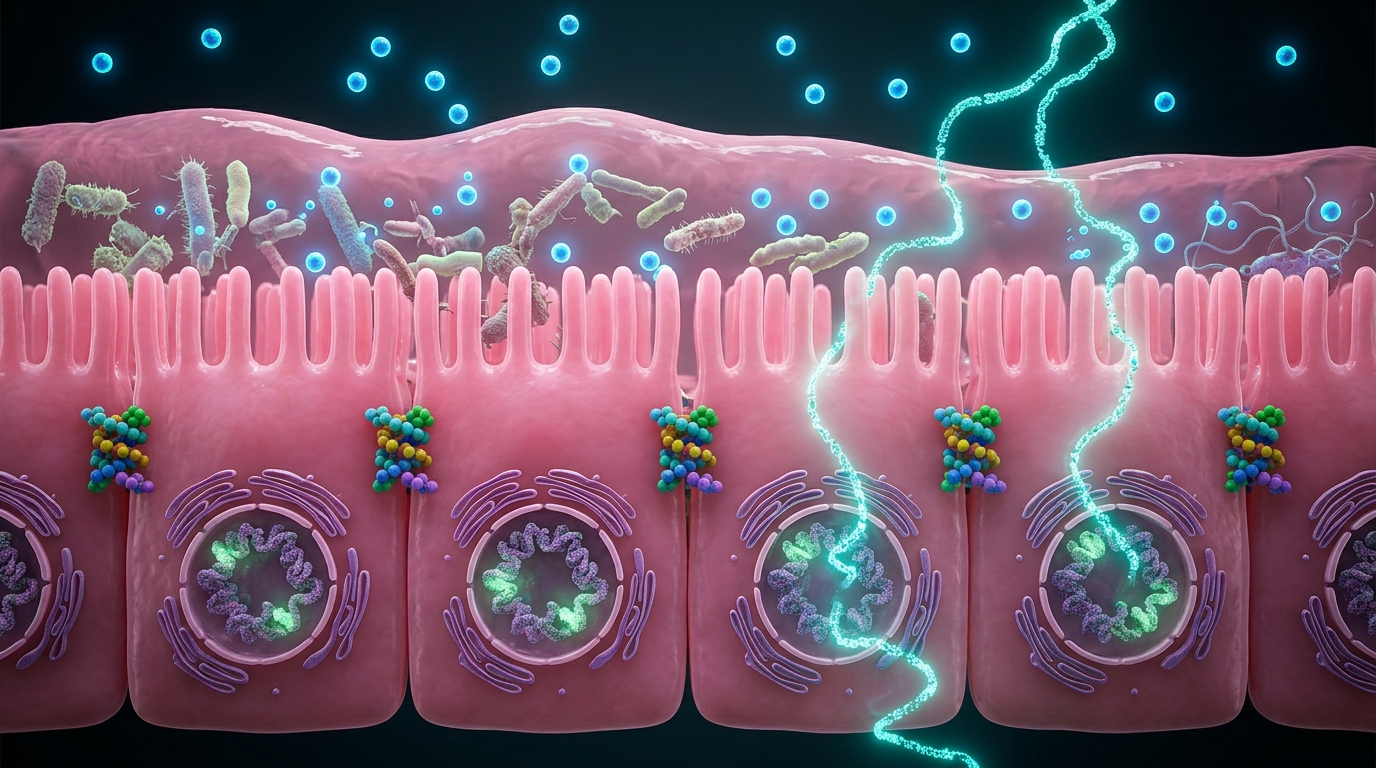
"The gut epithelial lining acts as the rampart of an ancient fortress. A wall constructed of bare stone will inevitably crack under mechanical tension without high-grade mortar. The Butyrate molecule serves both as the resilient mortar sealing microscopic fissures between cellular bricks (Tight Junctions), and as the royal diplomat bearing a peaceful decree that instructs mucosal garrison troops to lower their weapons in the presence of harmless civilian antigens (immune tolerance)."
The definitive molecular answer lies in an unassuming four-carbon carboxylic acid: Short-Chain Fatty Acid Butyrate (C4H8O2).
Molecular Pathway Flowchart
Soluble Fiber & Resistant Starch
Anaerobic Fermentation by Faecalibacterium
Butyrate Production (C4H8O2)
Beta-Oxidation Supplying 70% ATP to Colonocytes
Inhibition of Histone Deacetylases (HDACs)
Induction of Foxp3 & Regulatory T-Cell (Treg) Differentiation
Upregulation of Claudin-1, Occludin & ZO-1
Sealing of Gut Barrier & Extinction of Endotoxemia
1. Exclusive Fuel Kinetics: Colonocytes Do Not Burn Glucose; They Drink Butyrate!
Conventional biochemistry textbooks teach us that glucose is the universal cellular currency. The human brain depends on glucose, skeletal muscle burns glycogen and glucose, and cardiomyocytes oscillate between fatty acids and carbohydrates.
Yet the epithelial colonocytes lining the large intestine represent one of the most remarkable bioenergetic anomalies in mammalian physiology. They largely ignore blood glucose, evolving instead to derive more than 70% of their total metabolic ATP demands directly from the luminal beta-oxidation of short-chain fatty acid Butyrate.
The Starvation Crisis of Modern Dysbiosis
Under the modern ultra-processed Western diet—saturated with refined sucrose, seed oils, and devoid of fermentable plant fiber—obligate anaerobic commensals are starved of fermentable substrates. Luminal Butyrate concentrations plunge precipitously.
This bioenergetic deficit initiates a silent pathophysiological domino effect:
- Cellular Bioenergetic Collapse (Energy Starvation): Deprived of Butyrate fuel, colonocyte mitochondria malfunction, stalling ATP-dependent active transport pumps and triggering localized metabolic exhaustion.
- Compensatory Autophagy: Desperate epithelial cells initiate self-digestion of endogenous organelles in an attempt to survive.
- Degradation of the Protective Hydrogel Mucus Layer: Starved opportunistic bacteria begin consuming host glycoprotein mucins (MUC2) for survival. The protective barrier thins, exposing underlying colonocytes to direct bacterial endotoxin attack.
2. Epigenetic Mastery: Endogenous HDAC Inhibition Re-establishes Immune Tolerance
Were Butyrate merely an energetic substrate, it would not command the fascination of researchers in Nature, Science, and Cell. The supreme biological elegance of this short-chain metabolite rests on its capacity to directly reprogram Host Epigenetics.
Chromatin Decondensation Through HDAC Suppression
Inside the mammalian nucleus, DNA double helices wrap tightly around octameric histone protein spools. When histone tails are deacetylated, chromatin condenses into a closed, inaccessible conformation that silences vital homeostatic gene promoters:
- Cells express Histone Deacetylases (HDACs) to strip acetyl groups from histone lysine residues, keeping chromatin tightly wound.
- Intracellular Butyrate readily enters the nucleus, acting as a potent endogenous Class I and Class II HDAC inhibitor.
- By preventing deacetylation, Butyrate sustains core histones in an acetylated, open chromatin state (Euchromatin), allowing transcriptional complexes immediate genomic access.
Two Molecular Miracles Unlocked by Open Chromatin:
- Activation of the Foxp3 Master Locus (Treg Induction): Decondensing the Foxp3 promoter drives the rapid differentiation of naive CD4+ T cells into immunosuppressive Regulatory T cells (Tregs). These cells secrete anti-inflammatory cytokines (IL-10 and TGF-beta), extinguishing inappropriate autoimmune hyper-reactivity throughout the mucosal lamina propria.
- Transcriptional Rebuilding of Claudin-1, Occludin, and ZO-1: Butyrate triggers immediate mRNA expression of essential paracellular Tight Junction proteins. Microscopic junctional pores are hermetically resealed, blocking bacterial Lipopolysaccharide (LPS) leakage into portal and systemic circulation.
| Biomarker & Physiologic Marker | Butyrate Depletion (Leaky Gut Syndrome) | Optimized Physiologic Homeostasis | Clinical Mechanism & Significance |
|---|---|---|---|
| Colonic Luminal Butyrate | < 5 mmol/L (Severe subclinical deficit) | 15 - 25 mmol/L (Optimal physiological peak) | Sustained anaerobic fermentation of resistant starch |
| Circulating Serum Endotoxin (LPS) | Significantly elevated (Translocated) | Suppressed to basal harmless trace | Resolution of low-grade systemic endotoxemia |
| Circulating Serum Zonulin | High (> 45 ng/mL, pore dilation) | Low and stable (< 20 ng/mL) | Structural restoration of Claudin-1 and Occludin |
| Regulatory Treg to Th17 Balance | Skewed toward inflammatory Th17 | Harmonious immune tolerance | Epigenetic HDAC inhibition freeing Foxp3 loci |
| Mucus Layer Thickness (MUC2) | Severely degraded (< 30 µm) | Robust protective hydrogel (100 - 150 µm) | Sustained barrier protection against luminal shear stress |
3. The Oral Supplement Paradox: Why Free Butyrate Salts Fail
Encountering the clinical literature on Butyrate, patients and biohackers frequently purchase oral sodium or calcium butyrate capsules. From a pharmacokinetic perspective, this unformulated approach yields deeply disappointing results:
- Premature Proximal Absorption: Free butyrate is a small, water-soluble carboxylic acid. It is almost completely absorbed across gastric and duodenal enterocytes directly into the hepatic portal vein.
- Failure to Reach Distal Target Sites: The actual anatomical arena where Butyrate is needed—the cecum and colon—receives virtually none of the oral dose.
- Pungent Palatability: Free butyric acid carries an intensely unpleasant rancid-butter aroma that causes gastric reflux unless packaged in specialized enteric-coated microcapsules.
4. Translational Clinical Protocols & Practical Dietary Action Plan
The most potent and physiological strategy is to nurture your endogenous anaerobic butyrate-producing consortium (Faecalibacterium prausnitzii, Roseburia intestinalis, Eubacterium rectale).
Here are 4 evidence-based dietary interventions to turn your colon into a 24/7 autonomous Butyrate manufacturing engine:
1. Retrograded Resistant Starch (RS3): Cook, Chill, and Ferment
Standard amylose starch in freshly cooked white rice, potatoes, or rolled oats is rapidly digested into glucose by upper intestinal salivary and pancreatic amylases.
However, if you take cooked starchy foods and refrigerate them at 4°C for 12 to 24 hours, the amylose polymer chains re-align into crystalline helices through retrogradation, producing Resistant Starch Type 3 (RS3). This crystalline structure resists upper intestinal enzymatic cleavage completely. It travels intact into the large bowel, providing a premier fermentation substrate for native butyrogenic species. Even upon gentle reheating, the retrograded crystal matrix remains intact.
2. Diverse Prebiotic Fructans (Inulin and FOS)
Integrate diverse natural sources of fructo-oligosaccharides and inulin: chicory root, leeks, garlic, onions, slightly green bananas, and Jerusalem artichokes. This feeds beneficial Bifidobacteria, which produce acetate and lactate that act as substrates for secondary Faecalibacterium cross-feeding to synthesize Butyrate.
3. Natural Tributyrin from Grass-Fed Clarified Butter (Ghee)
Unlike free butyrate salts, Tributyrin comprises three butyrate molecules esterified to a glycerol backbone. High-quality grass-fed ghee represents the richest culinary source of natural tributyrin. This lipid matrix releases butyrate progressively through lipase activity, offering gentle mucosal nourishment for upper and lower intestinal tissues.
4. Antibiotic Stewardship and Elimination of Emulsifiers
Crucial butyrate-producing commensals such as Faecalibacterium prausnitzii are obligate anaerobes that die instantly upon oxygen exposure and are easily wiped out by broad-spectrum antibiotic courses or synthetic food emulsifiers (Polysorbate 80, Carboxymethylcellulose). Preserving this microbial treasury is foundational to lifelong systemic health.