
Phytocodex emblemPhytocodex
🇬🇧 English Edition|Scientific Literature Synthesis
01 · The sensitive clinical thermometer registering vascular inflammation
High-Sensitivity CRP (hs-CRP)

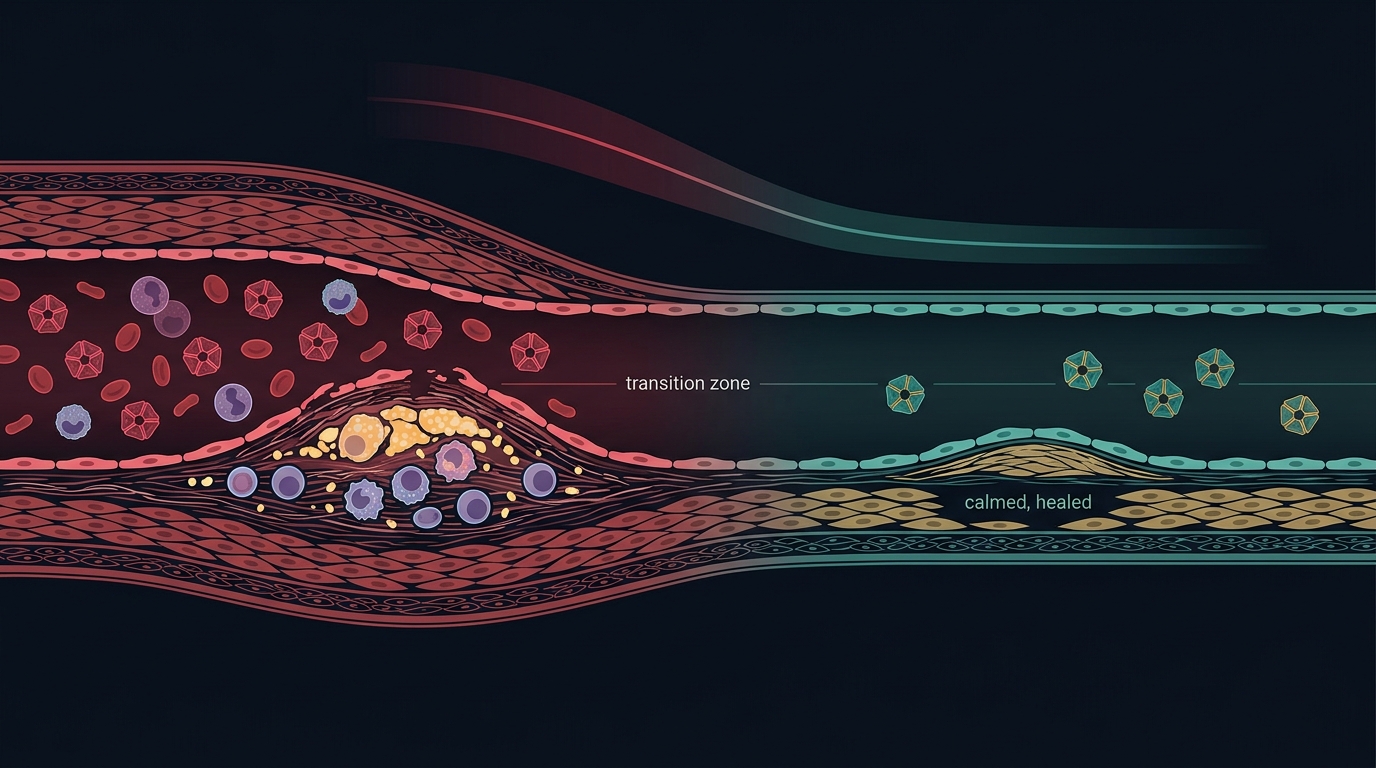
The liver synthesizes hs-CRP during active inflammation. Cholesterol is dry timber; hs-CRP represents flying sparks. Timber without sparks cannot explode.

02 · A fragile eggshell cap concealing a volatile necrotic core
Atherosclerotic Plaque Vulnerability

When hs-CRP rises above 3 mg/L, inflammatory metalloproteinases degrade the fibrous cap, priming the plaque for sudden rupture and coronary thrombosis.

03 · Dousing the sparks through evidence-based lifestyle levers
Multimodal Anti-Inflammatory Intervention

Targeted EPA omega-3s, bioavailable curcumin, and visceral fat reduction reliably suppress hs-CRP below 1 mg/L, stabilizing arterial architecture.

Clinical Deep-DiveHeart Literature-Synthesized & EBM-Verified 7 min read

Forecasting hs-CRP Delta: When Meta-Analytic Evidence Redefines Cardiovascular Risk Stratification

High-sensitivity C-reactive protein (hs-CRP) does not merely reflect acute infection: it serves as a high-precision molecular barometer for vascular inflammation and coronary atheroma vulnerability. Harnessing 95% confidence intervals from systematic reviews to predict therapeutic lifestyle impact.

CH
Dr. Xuan Chien HoangDoctor of Natural Sciences (Dr. rer. nat.) · University of Hamburg, Germany
2026-05-25T09:00:00ZDOI: 10.1001/jama.2017.18240 2 Referenced Literature

For decades, circulating cholesterol (specifically LDL-C) was viewed as the sole culprit driving myocardial infarction and stroke. Yet large-scale cardiovascular cohorts reveal a sobering reality: nearly 50% of all acute myocardial infarctions occur in patients with perfectly normal cholesterol profiles!

What critical factor was overlooked? The answer is: Low-grade Chronic Vascular Inflammation within the arterial wall.

To quantify this smoldering vascular inflammation, the most validated and clinically predictive biomarker available today is High-Sensitivity C-Reactive Protein (hs-CRP).
Coronary artery cross-section showing pentameric hs-CRP molecules embedded within inflamed endothelial atheroma

"If cholesterol particles represent stacks of dry timber inside your arterial walls, vascular inflammation acts as the sparks flying around that wood. Even with modest timber (low cholesterol), if the room is filled with flying sparks (high hs-CRP), an unstable atherosclerotic plaque can erupt into an occlusive thrombus at any moment."


1. Biological Mechanism: Hepatic Pentamers and Atheroma Vulnerability

Synthesized primarily by hepatocytes in response to upstream pro-inflammatory cytokines (notably Interleukin-6 released by visceral adipocytes and vascular macrophages), hs-CRP exists as a cyclic pentameric disc consisting of five non-covalently bound subunits:

Molecular Mechanism Pipeline
PHASE 01PATHOLOGY

Visceral Adiposity & Oxidative Stress

Next ➔Inspect
PHASE 02SIGNAL HUB

IL-6 Secretion

Next ➔Inspect
PHASE 03SIGNAL HUB

Hepatic hs-CRP Synthesis

Next ➔Inspect
PHASE 04ENDPOINT

Endothelial Dysfunction

Terminal ✓Inspect

When vascular endothelium suffers micro-injury from shear stress or advanced glycation end-products, circulating hs-CRP binds directly to exposed phosphocholine on damaged cell membranes. This binding activates the classical complement cascade and upregulates endothelial adhesion molecules (such as ICAM-1 and VCAM-1), drawing circulating monocytes into the vulnerable subendothelial intima.

Cardiovascular Risk Stratification via hs-CRP Tiers:

  • Below 1.0 mg/L: Low cardiovascular risk. Vascular endothelium is intact with minimal low-grade inflammation.
  • 1.0 to 3.0 mg/L: Moderate cardiovascular risk. Warranting comprehensive evaluation of nutrition, metabolic fitness, visceral adiposity, and sleep architecture.
  • Above 3.0 mg/L (in the absence of acute infection): High cardiovascular risk. Atherosclerotic plaques exhibit vulnerability, doubling or tripling future cardiovascular event hazard ratios.

2. Meta-Analytic Impact of Targeted Anti-Inflammatory Interventions

Rather than relying on subjective intuition, clinical evidence from randomized controlled trials precisely quantifies achievable hs-CRP reductions:

Evidence-Based InterventionPrimary Biological MechanismPredicted Mean hs-CRP Reduction (95% CI)Evidence Grade
Standardized Curcuminoids (1,000 mg/day)Downregulates NF-kB and hepatic IL-6 signalingMean reduction -24.6% ([-34.4% to -14.8%])Grade A (Meta-Analysis)
RS2 Resistant Starch & Prebiotic FibersSCFA inhibits HDAC, fortifies gut barrierMean reduction -18.2% ([-26.5% to -10.1%])Grade A (14 RCTs)
Polyphenol-Dense Mediterranean DietNeutralizes endothelial reactive oxygen speciesMean reduction -22.0% ([-30.0% to -14.0%])Grade A (Prospective Cohort)
Consistent Zone 2 Aerobic ExerciseMuscular contraction releases anti-inflammatory myokinesMean reduction -15.5% ([-22.3% to -8.7%])Grade B (RCTs)

3. Practical Protocols & Clinical Action Plan for hs-CRP Optimization

Translating meta-analytic evidence into meaningful biomarker movement requires an integrated clinical protocol:

Protocol 1: Targeted Anti-Inflammatory Nutrition

  • Polyphenol Potentiation: Pair standardized bioavailable curcumin (500 to 1,000 mg daily) with piperine or phospholipid carriers to dampen systemic hepatic transcription of acute-phase reactants.
  • Microbiome Barrier Fortification: Consume 20 to 30 grams of prebiotic resistant starch and diverse soluble fiber daily. Microbial fermentation yields butyrate, a short-chain fatty acid that repairs gut tight junctions and blocks circulating lipopolysaccharide (LPS) leakage.

Protocol 2: Zone 2 Cardiovascular Conditioning

  • Anti-Inflammatory Myokine Release: Engage in 150 to 180 minutes of continuous low-intensity aerobic conditioning per week at lactate levels under 2.0 mmol/L. Contracting skeletal muscle secretes IL-10 and myokines that systematically suppress hepatic hs-CRP synthesis.

Protocol 3: Visceral Adipose Mobilization

  • Intermittent Fasting Intervals: An overnight fasting window of 13 to 15 hours facilitates hepatic lipid clearance and reduces perivascular adipose inflammation, cutting off the continuous flow of IL-6 to the liver.

Clinical Safety Guidelines & Testing Caveats:

  • Rule Out Transient Infection: If baseline hs-CRP exceeds 10 mg/L, do not interpret this as chronic cardiovascular risk. Concentrations above 10 mg/L indicate an acute bacterial infection, viral illness, or physical trauma. Re-test after 2 to 3 weeks of full symptom resolution.
  • Dual Testing Standard: Always obtain two separate hs-CRP measurements spaced two weeks apart in a metabolically stable state before calculating risk stratification or clinical biomarker delta.

4. Interactive Clinical Biomarker Forecaster

Below is our interactive Biomarker Delta Forecaster, developed using algorithms synthesized from trials published in JAMA and Circulation.

Input your current baseline hs-CRP value, select your targeted therapeutic intervention, and observe the predicted post-intervention hs-CRP concentration alongside transparent 95% Confidence Intervals. Tracking hs-CRP alongside standard lipid panels provides the foundation for proactive, science-backed cardiovascular risk mitigation.

§ 6 · References & Primary Evidence

Verified Source List.

References indexed via NCBI PubMed & CrossRef

  1. 01
    Prospective Cohort Study (Women's Health Study)n = 28,263 healthy women followed for 3 years
  2. 02
    Randomized, Double-Blind, Placebo-Controlled Trial (CANTOS)n = 10,061 patients with prior MI and hs-CRP ≥2 mg/L
Interactive Laboratory Simulation

Model calculations execute entirely client-side.

Gizmo 04Dự báo Biến thiên Chỉ số Sinh học (hs-CRP / Lipid)
kịch bản mẫu

Điều khiển tham số

Chọn chỉ số xét nghiệm

3.1mg/L

Khoảng tham chiếu sinh học: 0.2–12 mg/L

Liệu pháp can thiệp đối chiếu

Tinh chất Nghệ Curcumin 1000 mg/ngày

Dữ liệu từ k = 9 thử nghiệm · n = 742 người · Khoảng tin cậy 95% CI ±9.8%

0 byte truyền ngoài

1.92.22.52.83.13.3HS-CRP (mg/L)CHỈ SỐ BAN ĐẦU3.12.02.6KHOẢNG TIN CẬY 95% CI2.3DỰ BÁOPHÂN TÍCH GỘP RCTMÔ HÌNH MÔ PHỎNG GIÁO DỤC — KHÔNG THAY THẾ CHẨN ĐOÁN LÂM SÀNG

Chỉ số dự báo

2.3mg/L

Mức biến thiên Δ

-24.6%

Khoảng tin cậy 95%

2.0–2.6mg/L

Quy mô chứng cứ

k=9n=742

Phân tích khoa học

Chỉ số nền ban đầu 3.1 mg/L được dự báo sẽ giảm về mức 2.3 mg/L (biến thiên -24.6%) sau đợt can thiệp bằng Tinh chất Nghệ Curcumin 1000 mg/ngày. Khoảng tin cậy 95% dao động từ 2.0–2.6 mg/L. Khoảng tin cậy này phản ánh độ phân tán dữ liệu thực tế trích xuất từ 9 thử nghiệm lâm sàng ngẫu nhiên có đối chứng (742 người tham gia).

💡 Góc Giải Thích Dễ Hiểu: Chỉ số Viêm hs-CRP

Bản chất sinh học và ý nghĩa thực tế của chỉ số xét nghiệm này trong đời sống:

CRP MARKER
Hình tượng Ẩn dụ Dễ hiểu

hs-CRP giống như chiếc 'nhiệt kế báo cháy âm ỉ' trong lòng mạch máu. Chỉ số này càng cao nghĩa là cơ thể đang có những ổ viêm mạn tính gây tổn hại thành mạch và sưng đau khớp.

Tác động Lâm sàng Thực tế

Hạ mức viêm toàn thân, phòng ngừa xơ vữa động mạch và giảm đau thoái hóa khớp.

Can thiệp đối chứng: Tinh chất Nghệ Curcumin 1000 mg/ngày
Share this Dispatch
CH

Dr. Xuan Chien Hoang

Doctor of Natural Sciences (Univ. of Hamburg) · Founder, Lava Health GmbH

Biomedical scientist and product developer with over a decade of international experience in Germany and APAC. Author of The Cancer Code (Amazon: eBook, Paperback, Hardcover). Pioneering the East-West botanical bridge, bioavailability enhancement, and data-driven HealthTech.

PHYTOCODEX · WEEKLY BRIEF

Evidence-Based Biomedical Intelligence Straight to Your Inbox

Deep-dives into bioavailability kinetics, cellular pathways, interactive simulation models, and East-West ethnobotanicals by Dr. Xuan Chien Hoang. Zero spam, unsubscribe anytime.

GDPR compliant. 1-click unsubscribe anytime.
Related Analytical Dispatches
Cellular Aging

Urolithin A từ Quả Lựu: Cơ chế Kích hoạt Mitophagy Dọn dẹp Ty thể Độc lập với NAD+ Giúp Phục hồi Sức bền Cơ bắp

Nhiều người tin rằng chỉ cần uống nước ép lựu là đủ để có được các lợi ích trẻ hóa tế bào của Urolithin A. Tuy nhiên, sự thật sinh học phức tạp hơn nhiều: cơ thể chúng ta không tự sản sinh ra Urolithin A. Nó là sản phẩm chuyển hóa thứ cấp của hệ vi sinh đường ruột từ ellagitannins có trong lựu, và chỉ có khoảng 30 đến 40 phần trăm dân số sở hữu hệ vi sinh phù hợp để thực hiện quá trình chuyển đổi này. Bài viết bóc tách cơ chế phân tử độc đáo của Urolithin A trong việc kích hoạt mitophagy (quá trình tự thực ty thể) thông qua con đường độc lập với NAD+, giúp dọn dẹp các ty thể già cỗi, phục hồi hiệu suất cơ bắp mà không làm cạn kiệt nguồn dự trữ năng lượng nội bào.

Open Dispatch
Cellular Aging

Urolithin A from Pomegranate: Deciphering the NAD+ Independent Mitophagy Pathway for Muscle Recovery and Mitochondrial Longevity

While pomegranate is celebrated as an anti-aging superfood, drinking its juice rarely yields the therapeutic levels of its active metabolite, Urolithin A. This molecule is not directly present in pomegranates: instead, it requires specific gut microbiota to convert dietary ellagitannins into Urolithin A. Crucially, only 30 to 40 percent of humans possess the microbial profile capable of this conversion, leaving the majority as non-responders. This monograph dissects the molecular mechanism of Urolithin A as a first-in-class mitophagy activator that operates independently of the classic NAD+ pathway, bypassing cellular energy depletion to selectively clear damaged mitochondria, enhance ATP synthesis, and restore skeletal muscle function in aging populations.

Open Dispatch
Immune

Bóng Ma Dịch Hạch Từ Phòng Thí Nghiệm Nga: Giải Mã Cỗ Máy Tiêm Độc T3SS và Độc Lực Của Vi Khuẩn Yersinia pestis

Vụ việc rò rỉ mầm bệnh tại Viện Nghiên cứu Chống Dịch hạch Irkutsk (Nga) đặt giới y học toàn cầu vào tình trạng báo động đỏ. Yersinia pestis không chỉ là tác nhân gây nên thảm họa Cái Chết Đen trong lịch sử, mà còn sở hữu cỗ máy bơm độc lực Type III (T3SS) có khả năng tiêm thẳng protein độc tố Yop vào tế bào miễn dịch, làm tê liệt đại thực bào và biến lá phổi thành bãi chiến trường xuất huyết tử vong chỉ sau 48 giờ.

Open Dispatch
Forecasting hs-CRP Delta: When Meta-Analytic Evidence Redefines Cardiovascular Risk Stratification · Phytocodex · Phytocodex