
For decades, clinical psychiatry has combated anxiety and depression by focusing almost exclusively on central neurotransmitters like Serotonin, Dopamine, and GABA, utilizing reuptake inhibitors or receptor agonists. However, high rates of treatment resistance and persistent side effects have forced researchers to look beyond the cranium. A striking clinical observation is that patients suffering from Irritable Bowel Syndrome (IBS) frequently present with severe comorbid anxiety, and when their gut dysbiosis is resolved, their psychiatric symptoms often vanish. This raises a fundamental question: How do microscopic organisms residing deep within the gut lumen exert such profound control over human emotion and behavior? A common misconception is that gut-derived GABA is absorbed into the bloodstream and directly penetrates the brain. In reality, GABA is highly polar and cannot readily cross the blood-brain barrier. The true mechanism lies in a sophisticated indirect communication network, where the vagus nerve acts as a high-speed bio-conduit, and G-protein coupled receptors (GPCRs) on gut immune cells serve as critical signal relay stations.
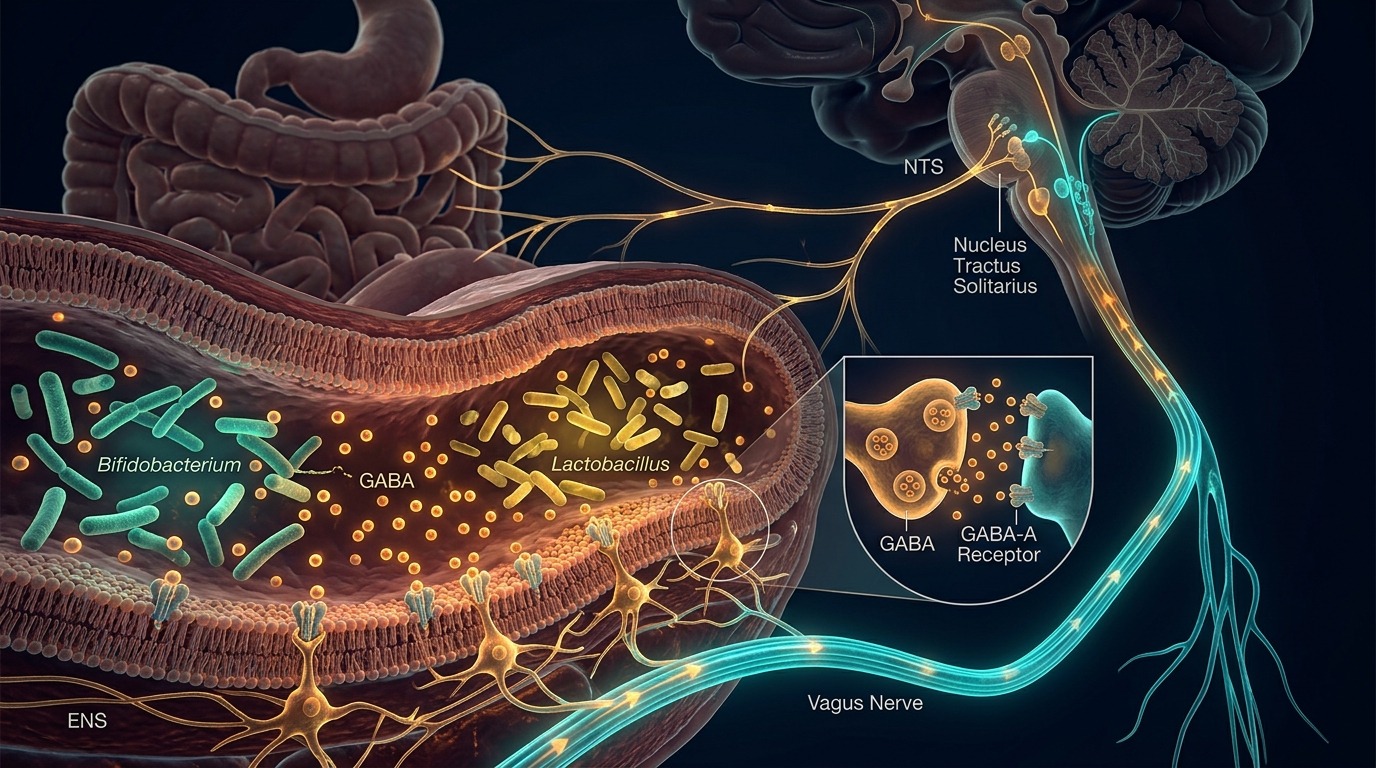
"Imagine the brain as a highly secured parliament building protected by a massive fortress wall (the blood-brain barrier), where external messengers are strictly barred from entering. Instead of trying to scale this wall, the suburban residents (the gut microbiota) utilize a direct, high-speed hotline connected straight to the main assembly hall: the vagus nerve. When these microbes produce signaling molecules like GABA or short-chain fatty acids, they do not need to cross into the brain physically. They simply press the call button on the receptor booths in the gut lining, sending electrical impulses at lightning speed along the vagus nerve to pacify the hyperactive security guards (microglia) inside the building, maintaining systemic peace and stability."
Molecular Pathway Flowchart
Gut Microbiota (Bacteroides, Bifidobacterium)
Production of GABA & SCFAs (Acetate, Propionate, Butyrate)
Activation of GPR43/GPR109A & GABA-A Receptors on Enteroendocrine Cells (EECs)
Stimulation of Afferent Vagus Nerve Fibers
Signal Transmission to Nucleus Tractus Solitarius (NTS)
Suppression of Pro-inflammatory Microglial Activation
Reduction of Neuroinflammation & Anxiety
1. Molecular Mechanisms: The Vagus-Mediated Indirect Signaling Pathway
The gut-brain axis is a bidirectional communication network linking the central nervous system (CNS) to the enteric nervous system (ENS). At the heart of this network is the metabolic capacity of the gut microbiota to synthesize neuroactive molecules. Specific bacterial genera, notably Bacteroides, Bifidobacterium, and Lactobacillus, possess the enzyme Glutamate Decarboxylase (GAD), which catalyzes the conversion of the excitatory neurotransmitter glutamate into Gamma-Aminobutyric Acid (GABA), the primary inhibitory neurotransmitter in the mammalian brain.
Although peripheral GABA is highly polar and cannot readily cross the blood-brain barrier (BBB), it exerts profound neuroactive effects by binding to GABA-A and GABA-B receptors expressed on enteroendocrine cells (EECs) and the sensory afferent fibers of the vagus nerve that densely innervate the intestinal mucosa. This binding triggers chloride ion (Cl-) influx in vagal afferents, generating action potentials that travel directly to the Nucleus Tractus Solitarius (NTS) in the brainstem.
Concurrently, bacterial fermentation of dietary fibers yields short-chain fatty acids (SCFAs) such as acetate, propionate, and butyrate. These SCFAs bind to G-protein coupled receptors GPR41 (FFAR3) and GPR43 (FFAR2) on gut epithelial and immune cells. Butyrate, in particular, acts as a potent Histone Deacetylase (HDAC) inhibitor, upregulating tight junction proteins (like claudins and occludin) to preserve gut barrier integrity. This prevents the translocation of bacterial Lipopolysaccharides (LPS) into systemic circulation. By neutralizing circulating LPS, the activation of Toll-like Receptor 4 (TLR4) on microglia in the brain is averted, thereby mitigating chronic neuroinflammation, a major driver of anxiety and depressive disorders.
2. Biological Paradox: The Truth of GABA Permeability & Comparative Metrics
A major paradox in neurobiology is the clinical efficacy of oral GABA supplementation in inducing calmness, despite pharmacokinetic evidence showing its inability to cross the blood-brain barrier (BBB). This paradox is resolved by the vagus-mediated indirect transmission pathway. Instead of acting directly on central synapses, gut-derived GABA acts as a peripheral trigger for the parasympathetic nervous system. In animal models, subdiaphragmatic vagotomy (cutting the vagus nerve) completely abolishes the anxiolytic effects of GABA-producing probiotics. This demonstrates that the brain does not require direct physical contact with gut-derived GABA to receive its calming signals.
Furthermore, chronic low-grade neuroinflammation triggered by gut dysbiosis creates a pathological feedback loop. When the gut barrier is compromised, LPS and pro-inflammatory cytokines (such as TNF-alpha and IL-6) enter the bloodstream, compromise the BBB, and polarize microglia from their resting, neuroprotective M2 state into the highly inflammatory M1 state. Active M1 microglia prune healthy synapses and suppress Brain-Derived Neurotrophic Factor (BDNF), impairing neuroplasticity and exacerbating emotional instability.
The following table contrasts physiological indices and clinical states across different gut-brain axis conditions:
| Physiological Index / Clinical State | Dysbiotic State (Gut Dysbiosis) | Homeostatic Baseline | Optimized Intervention State |
|---|---|---|---|
| Intestinal SCFA & GABA Levels | Extremely low (Deficient in Bacteroides/Bifido) | Stable moderate levels | High levels (Prebiotic/Probiotic optimized) |
| Microglial Activation Phenotype | M1 Pro-inflammatory (Synaptic pruning) | M2 Resting state (Debris clearance) | Neuroprotective phenotype (Enhanced BDNF) |
| Blood-Brain Barrier (BBB) Integrity | Compromised, high permeability (LPS leakage) | Tight, physiologically selective | Highly resilient, impervious to endotoxins |
| Vagus Nerve Activity & Tone | Suppressed vagal tone (Sympathetic dominance) | Balanced autonomic tone | High vagal tone (Enhanced relaxation response) |
| Psychiatric Symptom Presentation | Chronic anxiety, brain fog, depressive mood | Stable mood, normal stress resilience | Superior stress resilience, sharp focus, deep sleep |
3. Practical Takeaways: Clinical Protocols and Lifestyle Optimization
To translate these molecular insights into clinical protocols and lifestyle optimization, interventions must focus on cultivating GABA-producing microbiota and enhancing vagal tone through the following actionable steps:
-
Clinical Protocols using Psychobiotics and Prebiotics: Direct supplementation with specific bacterial strains known to produce high levels of GABA, such as Lactobacillus rhamnosus (JB-1) and Bifidobacterium longum, has been clinically shown to reduce systemic corticosterone levels and attenuate anxiety-like behaviors. To sustain these strains, providing prebiotic substrates such as Inulin, Fructooligosaccharides (FOS), and Resistant Starch is essential to maximize SCFA (especially butyrate) synthesis, thereby sealing the gut barrier and shielding the brain from systemic LPS-induced neuroinflammation.
-
Lifestyle Optimization for Vagus Nerve Stimulation: Vagal tone can be actively enhanced through diaphragmatic breathing exercises featuring prolonged exhalations (such as the 4-7-8 breathing technique), mindfulness meditation, and cold-water exposure. This physical stimulation increases acetylcholine release, which activates the cholinergic anti-inflammatory pathway to suppress systemic and central cytokine storms.
-
Dietary and Safety Guidelines: Minimize the consumption of ultra-processed foods, refined sugars, and saturated fats, which degrade the protective mucosal layer of the gut and promote intestinal permeability. Instead, incorporating naturally fermented foods like kimchi, kefir, and sauerkraut, which are rich in natural GABA-producing microbes, offers a highly effective, non-habit-forming alternative to synthetic sedatives.