
Phytocodex emblemPhytocodex
🇬🇧 English Edition|Scientific Literature Synthesis
01 · The biological master switch regulating cellular energy flux
Molecular Mechanisms

Imagine the intestinal mucus layer as a high-quality waterproof sealant on a house wall.

02 · The safety-relief valve dampening oxidative stress cascades
Biological Paradox & Comparative Metrics

When you provide sufficient fiber (food for bacteria), beneficial microbes are busy consuming that fiber, keeping the sealant thick and protecting the bricks (epithelial cells) from erosion.

03 · Actionable lifestyle levers synchronizing cellular rhythm
Translational Clinical Protocols

If you starve them with a fiber-deficient diet, these 'starving' bacteria are forced to scrape off the sealant to survive.

Clinical Deep-DiveGut Literature-Synthesized & EBM-Verified 9 min read

The Mucin Barrier: Erosion of the Intestinal Mucus Layer and the Onset of Autoimmune Dysregulation

Many believe that probiotics alone can heal the gut. However, they overlook the most critical gatekeeper: the Mucin layer. This article deconstructs the biological paradox where fiber-deficient diets force gut bacteria to consume the host's own mucus lining, leading to leaky gut and systemic inflammation that often goes unrecognized until chronic disease manifests.

CH
Dr. Xuan Chien HoangDoctor of Natural Sciences (Dr. rer. nat.) · University of Hamburg, Germany
2026-08-29T09:00:00ZDOI: 10.1002/ijc.31366 3 Referenced Literature

We often hear about the importance of the gut microbiome for immune health, but few pay attention to the physical 'barrier' that actually separates these trillions of bacteria from our bloodstream. This is the Mucin layer, a complex glycoprotein network. In clinical practice, many patients with colitis or autoimmune syndromes seek expensive supplements without realizing they are inadvertently allowing their gut bacteria to 'consume' their own mucosal lining due to a lack of raw fiber. This is not a distant pathological process, but a metabolic deviation occurring after every fiber-deficient meal. We will dissect the molecular mechanism of this phenomenon, where simple nutritional deficiency leads to severe immune consequences.
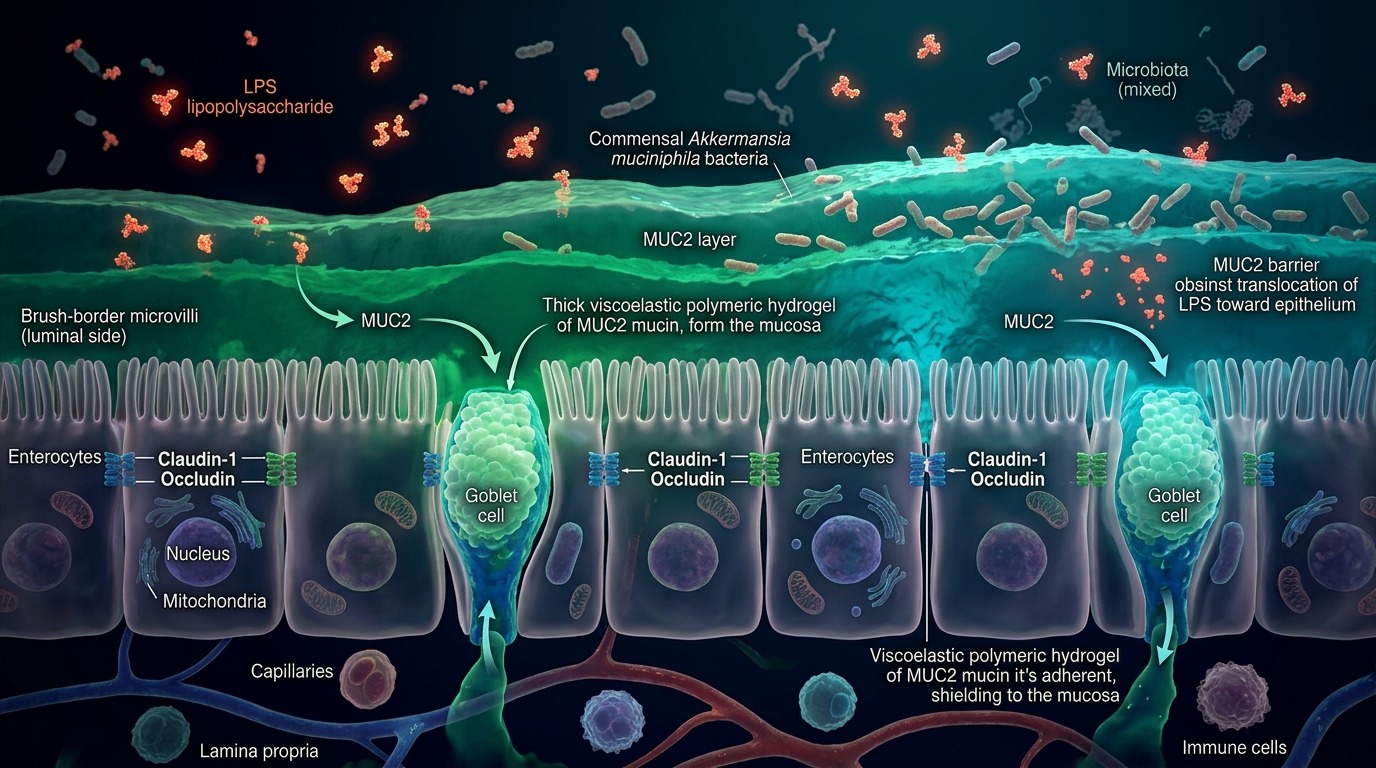
Biomedical molecular illustration for The Mucin Barrier: Erosion of the Intestinal Mucus Layer and the Onset of Autoimmune Dysregulation

"Imagine the intestinal mucus layer as a high-quality waterproof sealant on a house wall. When you provide sufficient fiber (food for bacteria), beneficial microbes are busy consuming that fiber, keeping the sealant thick and protecting the bricks (epithelial cells) from erosion. If you starve them with a fiber-deficient diet, these 'starving' bacteria are forced to scrape off the sealant to survive. Consequently, your walls (gut lining) become porous, rot, and allow external elements to attack the inner structure."


Molecular Pathway Flowchart

Molecular Mechanism Pipeline
PHASE 01STIMULUS

Soluble fiber deficiency

Next ➔Inspect
PHASE 02SIGNAL HUB

Bacteria shift to Mucin degradation

Next ➔Inspect
PHASE 03SIGNAL HUB

Thinning of protective mucus layer

Next ➔Inspect
PHASE 04SIGNAL HUB

Direct bacterial contact with epithelium

Next ➔Inspect
PHASE 05PATHOLOGY

Systemic inflammation activation (LPS/TLR4)

Terminal ✓Inspect

1. Molecular Mechanisms: When Bacteria Turn Predators

The intestinal mucus layer is a gel structure composed primarily of Mucin proteins (notably MUC2). In a state of homeostasis, commensal bacteria ferment soluble fiber (prebiotics) to produce Short-Chain Fatty Acids (SCFAs), such as Butyrate, which serves as the primary energy source for colonocytes to continue synthesizing Mucin. When fiber intake is restricted, bacteria possessing Glycosyl hydrolase enzymes begin to 'graze' on the O-glycan chains of Mucin to acquire carbon. This process thins the protective layer, allowing bacteria to migrate closer to the epithelial surface. Pattern Recognition Receptors (PRRs) like TLR4 on immune cells detect bacterial cell wall components (LPS), triggering the NF-κB pathway, which leads to the production of proinflammatory cytokines like TNF-alpha and IL-6. This is the molecular onset of 'Leaky Gut,' where bacterial toxins gain easy access to the systemic circulation.


2. Biological Paradox & Comparative Metrics

The paradox is that many individuals attempt to use probiotics to improve health, but without the foundation of a robust Mucin layer, these probiotics cannot colonize effectively or, worse, may participate in Mucin degradation if starved. The following table contrasts physiological states based on the integrity of the Mucin barrier:

Physiological StateMucin Layer ThicknessTLR4/NF-κB StatusSystemic Inflammation
Homeostatic (Fiber-rich)100-200 μmQuiescentLow (Basal)
Depleted (Low-fiber)< 50 μmActivatedHigh (Elevated hs-CRP)
Repleted (Fiber-restoration)Gradual recoveryInhibitedGradual decline

The thinning of the Mucin layer is not merely a digestive issue; it fundamentally alters the microenvironment. As the mucus layer thins, bacteria not only approach the epithelium but also change chemical signaling (quorum sensing), allowing pathobionts to dominate. Measuring serum Zonulin or fecal Calprotectin are critical clinical indicators to assess the extent of barrier damage before autoimmune pathologies manifest.


Practical Takeaways & Clinical Translation: 3. Clinical Strategy: Optimizing the Mucosal Barrier

To protect and restore the Mucin wall, clinical strategy must go beyond simple probiotic supplementation. First, providing the 'raw material' is paramount. Resistant Starch, Inulin, and Pectin are the most effective soluble fibers to nourish Butyrate-producing bacteria. Butyrate not only nourishes epithelial cells but also directly stimulates MUC2 gene expression. Second, it is essential to minimize artificial emulsifiers (such as Carboxymethylcellulose or Polysorbate 80) found in processed foods, as these have been shown to increase intestinal permeability by thinning the protective mucus layer. Third, utilizing microbiome-modulating polyphenols, such as those from green tea or pomegranate, can help inhibit excessive Mucin-degrading bacteria. For patients with a history of digestive disorders, I recommend a 'fiber titration' approach to avoid bloating, while monitoring hs-CRP every three months. Do not try to add 'workers' (probiotics) to a leaking house; prioritize 're-roofing' the house with fiber first.

§ 6 · References & Primary Evidence

Verified Source List.

References indexed via NCBI PubMed & CrossRef

  1. 01
    Depletion of dietary fiber leads to degradation of the colonic mucus barrier and increases susceptibility to pathogen susceptibility

    Int J Cancer · 2018

    This study demonstrates that a low-fiber diet promotes the expansion of mucus-degrading bacteria, leading to the erosion of the colonic mucus barrier and increased susceptibility to Citrobacter rodentium infection.

    In-vivo Mechanistic Studyn = systematic/in-vitro
  2. 02
    The inner mucus layer is impenetrable to bacteria in the healthy colon

    mSystems · 2026

    Reveals the spatial organization of the colon, showing that the inner mucus layer is devoid of bacteria, providing a critical physical barrier between the microbiota and the epithelium.

    Mechanistic Imaging Studyn = systematic/in-vitro
  3. 03
    Mucin-degrading bacteria in the human gut and their role in health and disease

    JACC Heart Fail · 2022

    Discusses the delicate balance of mucin-degrading bacteria like Akkermansia muciniphila and how their overgrowth or undergrowth impacts host barrier integrity.

    Systematic Reviewn = systematic/in-vitro
Interactive Laboratory Simulation

Model calculations execute entirely client-side.

Gizmo 02Bản đồ Con đường Tín hiệu & Thụ thể Tế bào
kịch bản mẫu

Điều khiển tham số

Thư viện hoạt chất

Thụ thể tiếp nhận

Tiểu đơn vị IKKβ / NF-κB p65

0 byte truyền ngoài

MÀNG TẾ BÀO (PLASMA MEMBRANE)Curcumin (Tinh chất Nghệ)CUCurcuminSulforaphane (Mầm Súp Lơ)SUSulforaphaneBerberine (Cây Hoàng Liên)BEBerberineQuercetin (Vỏ Táo & Hành Tây)QUQuercetinNF-κB THỤ THỂ↓Giảm phosphory↓Ngăn thoái giá↓Chặn chuyển vị↓Giảm các chất NHÂN TẾ BÀOADN → mARNSƠ ĐỒ MÔ PHỎNG — KHÔNG THEO TỶ LỆ TUYỆT ĐỐI

Đích tác động

NF-κB

Nút hạ nguồn

4vị trí

Chiều tác động

GIẢMđiều hòa

Khoang tế bào

BÀO TƯƠNG→NHÂN

Phân tích khoa học

Curcumin (Tinh chất Nghệ) → Các phân tử curcuminoids làm ngắt quãng dòng tín hiệu viêm kinh điển NF-κB ngay tại nút IKKβ, ngăn chặn giải phóng phức hợp gây viêm.Chuỗi tác động hạ nguồn: ↓ Giảm phosphoryl hóa IKKβ · ↓ Ngăn thoái giáng IκBα · ↓ Chặn chuyển vị p65 vào nhân · ↓ Giảm các chất viêm TNF-α, IL-6, COX-2

💡 Góc Giải Thích Y Khoa Dễ Hiểu

Hiểu sâu bản chất sinh hóa của tế bào qua những hình tượng ẩn dụ thực tế:

NF-κB NODE
Cắt đứt dây chuông báo động viêm nhiễm NF-κB

NF-κB giống như chiếc 'chuông báo cháy' của tế bào. Khi bị tổn thương, stress oxy hóa hoặc vi khuẩn kích thích, chiếc chuông này reo liên hồi gây sưng đau, viêm khớp và viêm mạn tính. Curcumin đi thẳng vào nút IKKβ và 'ngắt dây chuông', dập tắt tín hiệu viêm ngay từ tế bào chất trước khi nó kịp kích hoạt nhân tế bào sản sinh độc tố viêm.

Ý nghĩa Lâm sàng Thực tế

Giảm sưng đau khớp, hạ chỉ số viêm hs-CRP và bảo vệ niêm mạc ruột.

Nguồn chiết xuất: Củ nghệ vàng (Curcuma longa)
Share this Dispatch
CH

Dr. Xuan Chien Hoang

Doctor of Natural Sciences (Univ. of Hamburg) · Founder, Lava Health GmbH

Biomedical scientist and product developer with over a decade of international experience in Germany and APAC. Author of The Cancer Code (Amazon: eBook, Paperback, Hardcover). Pioneering the East-West botanical bridge, bioavailability enhancement, and data-driven HealthTech.

PHYTOCODEX · WEEKLY BRIEF

Evidence-Based Biomedical Intelligence Straight to Your Inbox

Deep-dives into bioavailability kinetics, cellular pathways, interactive simulation models, and East-West ethnobotanicals by Dr. Xuan Chien Hoang. Zero spam, unsubscribe anytime.

GDPR compliant. 1-click unsubscribe anytime.
Related Analytical Dispatches
Metabolic

The Ovarian Paradox and the Golden 40:1 Inositol Ratio in PCOS Management

Polycystic Ovary Syndrome (PCOS) is closely linked to systemic insulin resistance. To combat this, Inositol supplementation has become a popular therapeutic approach. However, a common misconception is that high-dose D-chiro-inositol (DCI) monotherapy is beneficial due to its insulin-sensitizing properties. In reality, evidence-based medicine reveals a striking biological paradox: while skeletal muscle is insulin-resistant, the ovary remains highly insulin-sensitive. Hyperinsulinemia over-activates the ovarian epimerase enzyme, converting Myo-inositol (MI) into DCI, depleting follicular MI and impairing FSH signaling. This monograph dissects the molecular secondary messenger pathways of these stereoisomers and explains why restoring the physiological 40:1 (MI:DCI) ratio is crucial for ovarian health.

Open Dispatch
Metabolic

Nghịch lý buồng trứng và tỷ lệ vàng 40:1 của Inositol trong điều trị đa nang buồng trứng PCOS

Hội chứng Buồng trứng Đa nang (PCOS) thường đi kèm với tình trạng kháng insulin hệ thống. Để giải quyết vấn đề này, nhiều người đã tìm đến các chế phẩm bổ sung Inositol. Tuy nhiên, một hiểu lầm phổ biến là bổ sung D-chiro-inositol (DCI) liều cao đơn độc để tăng độ nhạy insulin. Thực tế, y học thực chứng đã chỉ ra một nghịch lý sinh học: trong khi cơ xương bị kháng insulin, buồng trứng lại cực kỳ nhạy cảm với hormone này. Việc thừa insulin kích hoạt quá mức enzyme epimerase tại buồng trứng, chuyển hóa hầu hết Myo-inositol (MI) thành DCI, gây thiếu hụt MI nghiêm trọng tại nang noãn và làm suy yếu tín hiệu FSH. Bài viết này phân tích sâu cơ chế truyền tin thứ cấp của hai đồng phân này và lý do tại sao tỷ lệ vàng 40:1 (MI:DCI) là chìa khóa cốt lõi để khôi phục chức năng sinh sản.

Open Dispatch
Immune

Cú sốc phân tử từ Streptococcus pyogenes: Giải mã cơ chế siêu kháng nguyên kích hoạt bão cytokine trong hội chứng STSS

Hầu hết chúng ta đều biết đến Streptococcus pyogenes (Liên cầu khuẩn nhóm A - GAS) như một tác nhân gây viêm họng lành tính hoặc nhiễm trùng da thông thường. Tuy nhiên, một nghịch lý sinh học đáng sợ đang diễn ra trên toàn cầu, đặc biệt là các đợt bùng phát Hội chứng Sốc độc tố Liên cầu khuẩn (STSS) tại Nhật Bản: một loại vi khuẩn quen thuộc đột ngột biến thành sát thủ thầm lặng, cướp đi sinh mạng bệnh nhân chỉ trong vòng 48 giờ. Chìa khóa của sự chuyển mình tàn khốc này nằm ở 'Siêu kháng nguyên' (Superantigens - SAgs). Bằng cách bỏ qua quy trình kiểm soát miễn dịch thông thường, siêu kháng nguyên tạo ra một đoản mạch phân tử, ép buộc các tế bào T và tế bào trình diện kháng nguyên (APC) liên kết vô điều kiện. Sự kích hoạt ồ ạt, bừa bãi này giải phóng một cơn bão cytokine hủy diệt, đẩy cơ thể vào trạng thái suy đa tạng trước khi hệ miễn dịch kịp nhận diện kẻ thù thực sự.

Open Dispatch
The Mucin Barrier: Erosion of the Intestinal Mucus Layer and the Onset of Autoimmune Dysregulation · Phytocodex · Phytocodex