
We often hear of Serotonin as the 'happiness' neurotransmitter, and supplementing its precursors is frequently touted as a panacea for mood disorders. Yet, clinical reality shows that many depressed patients are non-responsive to SSRIs. Why? The answer lies not in Serotonin deficiency, but in a metabolic 'thief' called the Kynurenine pathway. When the body is under chronic inflammation, stress, or infection, the enzyme IDO (Indoleamine 2,3-dioxygenase) is activated. It acts like an electronic switch, instantly diverting precious Tryptophan away from the Serotonin pathway and into the Kynurenine cascade. Consequently, instead of producing Serotonin, the brain produces an excess of metabolites like Quinolinic acid. This is a potent NMDA receptor agonist, causing neuronal excitotoxicity, cell death, and cognitive decline. Understanding this metabolic shift not only decodes why depression often accompanies chronic inflammatory diseases but also fundamentally changes how we approach mental health through molecular pharmacology rather than simple precursor supplementation.
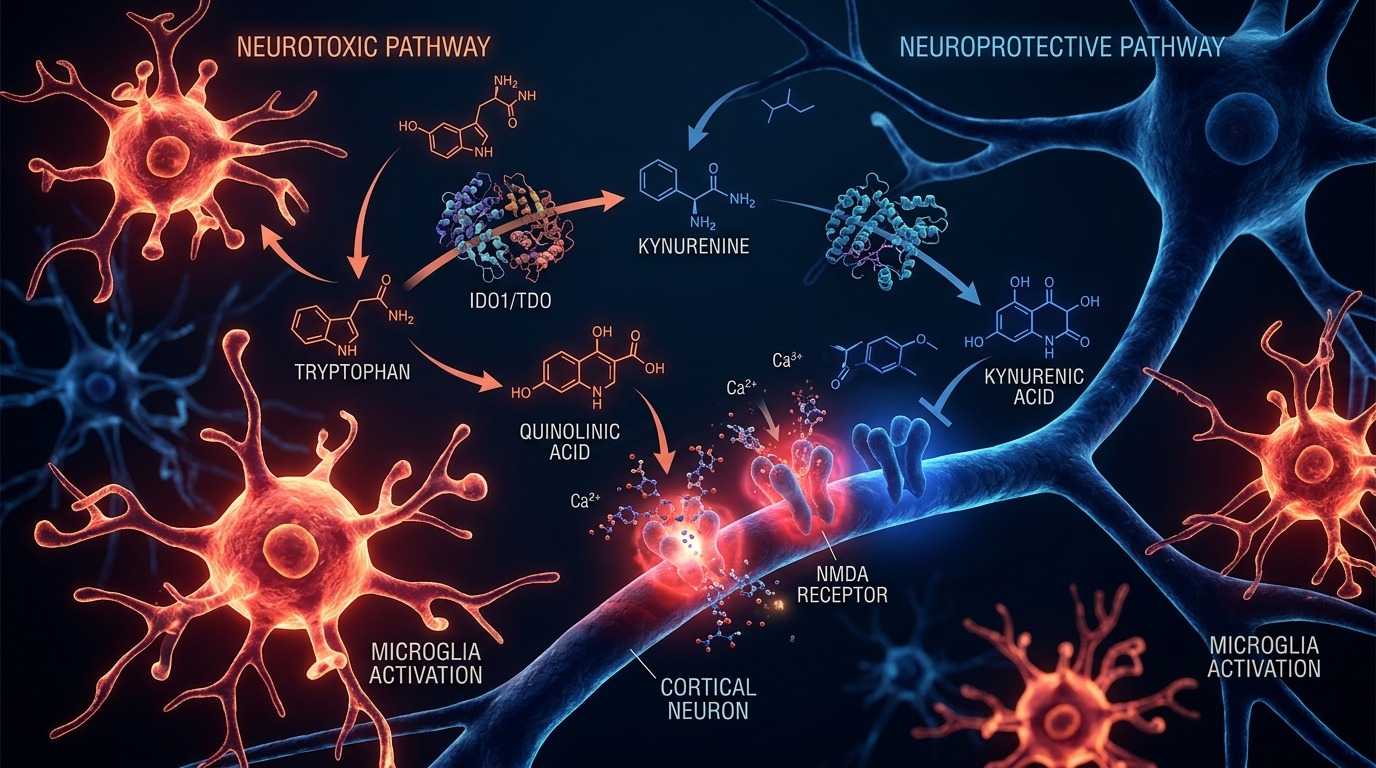
"Imagine the brain as a city with two shipping lanes for Tryptophan raw material. Under normal conditions, Tryptophan is processed into 'happiness goods' Serotonin. However, when the immune system sounds a red alert (inflammation), a checkpoint diverts all raw materials to the 'armory' of the Kynurenine pathway. Instead of Serotonin, this factory produces toxic metabolites that damage the city's power lines, causing short circuits in neural signaling."
Molecular Pathway Flowchart
Tryptophan
Enzyme IDO/TDO
Kynurenine
Quinolinic Acid
NMDA Receptor Overactivation
Neurotoxicity & Depression
1. Molecular Mechanisms: When IDO Becomes a Toxic Regulator
At the heart of this metabolic shift are the enzymes Indoleamine 2,3-dioxygenase (IDO) and Tryptophan 2,3-dioxygenase (TDO). Under homeostatic conditions, Tryptophan is converted into 5-HTP for Serotonin synthesis. However, when pro-inflammatory cytokines such as IFN-gamma or TNF-alpha are elevated, they strongly upregulate IDO expression. Once IDO becomes dominant, it consumes up to 90-95% of available Tryptophan. The most critical byproduct is Quinolinic acid (QUIN). QUIN is an endogenous neurotoxin capable of binding and over-activating NMDA receptors on glial cells and neurons. This over-activation triggers a massive influx of Calcium into the cell, causing severe oxidative stress and leading to programmed cell death (apoptosis). Another product of this pathway is Kynurenic acid (KYNA), which is neuroprotective; however, in chronic inflammation, the QUIN/KYNA ratio shifts heavily toward the neurotoxic side. This explains why supplementing Tryptophan without controlling inflammation inadvertently fuels the production of neurotoxins, exacerbating the pathology rather than improving mood.
2. Biological Paradox: Depression is Not Just a Neurotransmitter Deficiency
The greatest paradox in modern psychiatry is the reductionist view of depression as a simple neurotransmitter deficiency. Empirical data shows that in depressed patients, plasma Tryptophan levels might be low, but Kynurenine metabolite levels are abnormally high. This proves that the root cause is not a lack of raw materials, but the erroneous diversion of the metabolic pathway.
| Physiological State | Molecular Concentration (QUIN/KYNA Ratio) | Clinical Endpoint |
|---|---|---|
| Homeostatic Baseline | Low (Ratio < 1) | Neuroprotection, stable mood |
| Chronic Inflammation | High (Ratio > 5) | Neurotoxicity, depression, cognitive decline |
| IDO Inhibition Intervention | Decreased (Return to < 1) | Restored signaling, reduced inflammation |
The table above demonstrates that the QUIN/KYNA ratio is a critical biomarker. When chronic inflammation occurs, the body prioritizes immune system protection by increasing Kynurenine metabolite production (which has immunomodulatory properties) at the cost of brain health. This is an evolutionary trade-off that, in modern society with sustained inflammation from diet and lifestyle, has become a harmful biological trap.
Practical Takeaways & Clinical Translation: 3. Clinical Strategies: Metabolic Optimization and Inflammation Control
To resolve the Kynurenine paradox, clinical strategies cannot rely solely on Serotonin precursor supplementation. The core objective is to inhibit IDO enzyme activity and restore metabolic balance. First, controlling pro-inflammatory cytokines is paramount. Natural compounds like Curcumin or Omega-3 EPA have been shown to inhibit the NF-kB pathway, thereby reducing IDO activation signals. Second, supporting cofactors that steer Kynurenine metabolism toward the safer branch is essential. Vitamin B6 (in the form of P5P) plays a crucial role in converting Kynurenine into Kynurenic acid (the neuroprotective agent) rather than letting it convert into Quinolinic acid (the neurotoxin). Third, lifestyle changes to reduce oxidative stress are mandatory. Chronic stress increases cortisol, and cortisol is a driver of the TDO enzyme (a hepatic analogue of IDO), creating a toxic loop. The clinical advice: before considering Tryptophan or 5-HTP, check inflammatory markers (hs-CRP) and audit your diet to eliminate inflammatory triggers. If hs-CRP is high, Tryptophan supplementation may backfire. Prioritize anti-inflammatory strategies, supplement with Zinc and Magnesium to stabilize NMDA receptors, and focus on restoring gut health, the origin of 70% of systemic immune responses.