
Phytocodex emblemPhytocodex
🇬🇧 English Edition|Scientific Literature Synthesis
01 · The executive secretary announcing closing time across the office
Circadian Zeitgeber

Melatonin does not chemically knock your brain out. It quietly delivers a rhythmic temporal cue notifying organs to lower core body temperature for rest.

02 · An industrial loudspeaker blaring until morning
0.3 mg Physiological vs. 10 mg Megadose Paradox

The pineal gland naturally releases roughly 0.3 mg. Taking 10 mg floods and desensitizes melatonin receptors, leaving you with heavy morning grogginess.

03 · The master pacemaker deceived by artificial daylight
Suprachiasmatic Nucleus (SCN) & Blue Light

Screen light at 480 nm tricks the brain's SCN clock into believing it is high noon, immediately halting pineal melatonin secretion.

FundamentalsBrain Literature-Synthesized & EBM-Verified 7 min read

Melatonin is a Circadian Zeitgeber, Not a Sedative Hypnotic: Deciphering the 0.3 mg vs 10 mg Paradox

Why taking 5-10 mg of melatonin frequently triggers daytime grogginess and sleep inertia, whereas physiological micro-dosing at 0.3 mg effectively re-anchors restorative deep sleep? A neuroendocrine perspective on zeitgeber kinetics.

CH
Dr. Xuan Chien HoangDoctor of Natural Sciences (Dr. rer. nat.) · University of Hamburg, Germany
2026-09-15T09:00:00ZDOI: 10.1210/jc.2015-2756 2 Referenced Literature

Across the contemporary sleep supplement market, one of the most widespread clinical paradoxes is the relentless escalation of melatonin dosage: formulations readily leap from 1 mg to 3 mg, 5 mg, 10 mg, and even 20 mg within a single chewable gummy or capsule.

Consequently, millions of individuals administering supra-physiological doses at bedtime report:

  • Drifting into an unnatural, heavy stupor characterized by fragmented slow-wave cycles and vivid nightmares.
  • Waking up with persistent morning grogginess, brain fog, and psychomotor sluggishness persisting into midday (the classic "Melatonin Hangover").
  • Developing physiological dependence after several weeks, accompanied by down-regulated endogenous nocturnal signaling.

This widespread misuse stems from a fundamental pharmacological misconception: Melatonin is not a sedative hypnotic like zolpidem or benzodiazepines. Melatonin is a Zeitgeber, a biological clock synchronizer.
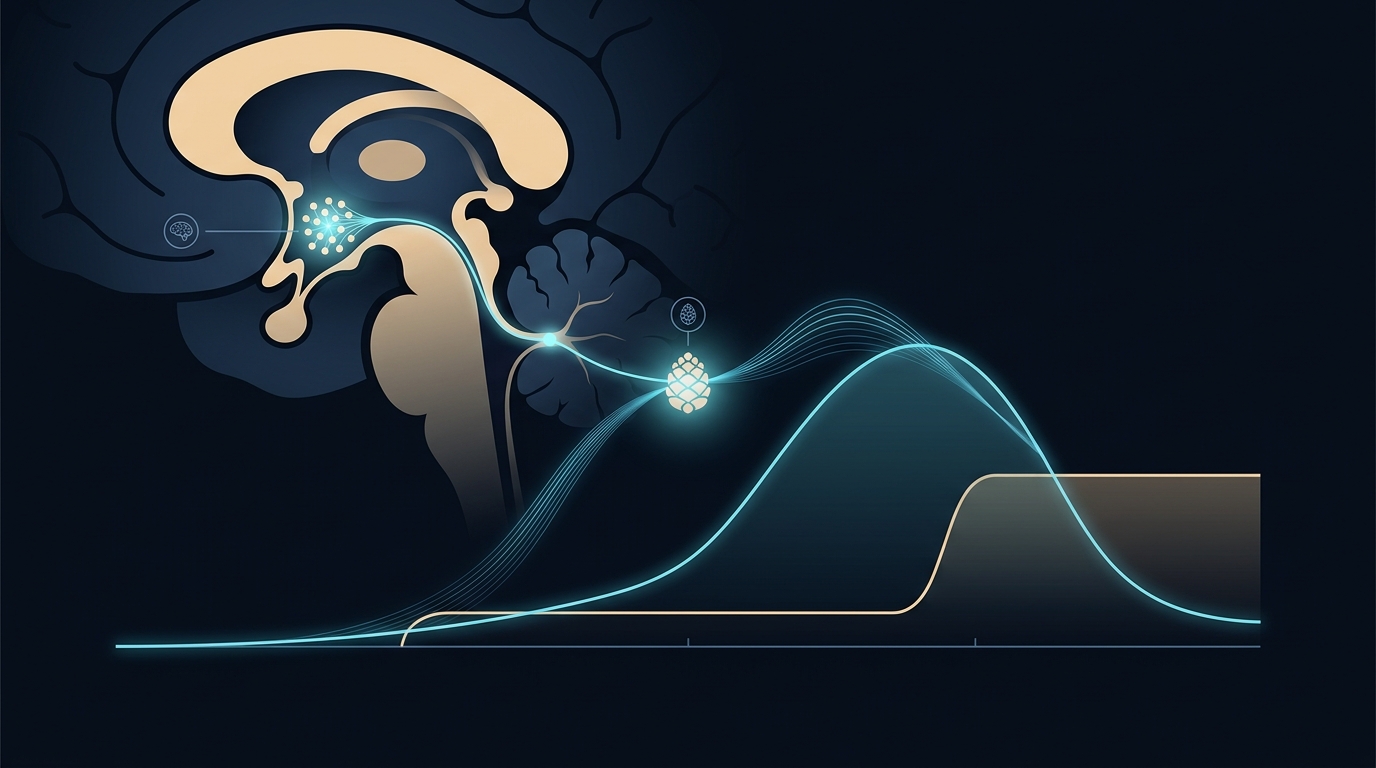
Neuroendocrine circadian signaling axis between the suprachiasmatic nucleus SCN and pineal gland

"Endogenous melatonin acts like an executive secretary speaking quietly through the office intercom: 'Office hours are concluding; prepare to power down workstations'. The secretary merely delivers a gentle, rhythmic notice. Consuming 10 mg of melatonin is equivalent to hiring an operator with an industrial loudspeaker blaring into your ears all night: you are not coaxed into peaceful slumber, but knocked unconscious by acoustic overload, waking up with deafening mental exhaustion the next morning."


1. Neurobiology: The Suprachiasmatic Nucleus (SCN) and Pineal Gland

Deep within the hypothalamus resides a master pacemaker comprised of roughly 20,000 neurons known as the Suprachiasmatic Nucleus (SCN), situated directly above the optic chiasm:

Molecular Mechanism Pipeline
Daytime Light Exposure3 Stages
PHASE 01STIMULUS

Retinal blue light perception

Next ➔Inspect
PHASE 02INHIBITION

SCN inhibition

Next ➔Inspect
PHASE 03INHIBITION

Suppression of pineal melatonin

Terminal ✓Inspect
Complete Darkness Phase3 Stages
PHASE 01STIMULUS

Complete darkness

Next ➔Inspect
PHASE 02SIGNAL HUB

SCN activation

Next ➔Inspect
PHASE 03ENDPOINT

Physiological melatonin surge

Terminal ✓Inspect

In a healthy adult human, the total endogenous melatonin synthesized and secreted by the pineal gland across an entire 8-hour nocturnal cycle amounts to merely 0.1 mg to 0.3 mg.

This tiny micro-dose is biologically optimal to saturate high-affinity MT1 and MT2 G-protein coupled receptors in the central nervous system, triggering mild peripheral vasodilation, modest core hypothermia, and opening the permissive physiological gate for non-REM restorative sleep.


2. Clinical Pharmacokinetic Comparison: Physiological 0.3 mg vs Commercial 5-10 mg

Pharmacological ParameterPhysiological Standard Dose (0.3 mg - 0.5 mg)Commercial Mega-Dose (5 mg - 10 mg)
Peak Serum Concentration (Cmax)100 - 200 pg/mL (Closely mirrors natural pineal peak)2,000 - 10,000 pg/mL (Exceeds physiological levels by 20 to 50 fold)
Hepatic Clearance WindowApproximately 4 - 6 hours (Cleared before sunrise)Prolonged across 10 - 14 hours (Elevated serum levels persist into daytime)
MT1 / MT2 Receptor DynamicsGentle activation preserving receptor sensitivityReceptor over-saturation and desensitization
Morning Awakening ProfileClear-headed, alert, fully refreshedMarked sleep inertia, lethargy, cognitive fog
Primary Clinical IndicationCircadian phase-shifting (Jet lag, shift work adaptation)Forcible hypnotic sedation via receptor flooding

3. Practical Protocols & Clinical Action Plan for Circadian Restoration

For those struggling with disrupted sleep architecture, optimizing neuroendocrine zeitgeber timing proves infinitely superior to escalating exogenous hormone intake:

Protocol 1: Securing Morning Photonic Synchronization

  • Dawn Sunlight Exposure: Within 30 to 60 minutes of waking, obtain 10 to 15 minutes of direct natural sunlight (without sunglasses). Photons striking melanopsin-expressing retinal ganglion cells (ipRGCs) halt nocturnal melatonin and trigger a healthy cortisol awakening response, anchoring the 16-hour circadian timer.

Protocol 2: Evening Blue Light Attenuation

  • Photonic Wind-Down: After 9:00 PM, eliminate direct exposure to 460-480 nm blue light from mobile devices and overhead LED lighting. Blue photons suppress pineal melatonin synthesis by up to 80%, artificially simulating daytime and delaying the onset of slow-wave sleep.

Protocol 3: Physiological Micro-Dosing (When Phase-Shifting is Needed)

  • Physiological Dosage: If navigating jet lag or circadian shift work, administer an ultra-low physiological micro-dose (0.3 mg to 0.5 mg) approximately 60 to 90 minutes before your target sleep window. This mirrors natural pineal amplitude without triggering receptor down-regulation or morning grogginess.

Clinical Safety Caveats:

  • Never utilize supra-physiological mega-doses (5 mg to 10 mg) as a nightly chronic crutch. Chronic receptor inundation down-regulates hypothalamic MT1/MT2 density and can exacerbate daytime fatigue and mood instability.
  • Individuals with autoimmune disorders should exercise caution with chronic melatonin supplementation, as melatonin stimulates Th1 immune activity and pro-inflammatory cytokine expression.

Recognizing melatonin as a circadian time-giver rather than a biochemical hammer allows you to reclaim authentic restorative sleep while safeguarding next-day cognitive clarity.

§ 6 · References & Primary Evidence

Verified Source List.

References indexed via NCBI PubMed & CrossRef

  1. 01
    Meta-Analysis of Randomized Controlled Trialsn = 19 RCTs (n=1,683)
  2. 02
    Entrainment of the Human Circadian Clock

    Cold Spring Harb Symp Quant Biol · 2007

    Chronobiology Landmark Reviewn = systematic/in-vitro
Share this Dispatch
CH

Dr. Xuan Chien Hoang

Doctor of Natural Sciences (Univ. of Hamburg) · Founder, Lava Health GmbH

Biomedical scientist and product developer with over a decade of international experience in Germany and APAC. Author of The Cancer Code (Amazon: eBook, Paperback, Hardcover). Pioneering the East-West botanical bridge, bioavailability enhancement, and data-driven HealthTech.

PHYTOCODEX · WEEKLY BRIEF

Evidence-Based Biomedical Intelligence Straight to Your Inbox

Deep-dives into bioavailability kinetics, cellular pathways, interactive simulation models, and East-West ethnobotanicals by Dr. Xuan Chien Hoang. Zero spam, unsubscribe anytime.

GDPR compliant. 1-click unsubscribe anytime.
Related Analytical Dispatches
Cellular Aging

Urolithin A từ Quả Lựu: Cơ chế Kích hoạt Mitophagy Dọn dẹp Ty thể Độc lập với NAD+ Giúp Phục hồi Sức bền Cơ bắp

Nhiều người tin rằng chỉ cần uống nước ép lựu là đủ để có được các lợi ích trẻ hóa tế bào của Urolithin A. Tuy nhiên, sự thật sinh học phức tạp hơn nhiều: cơ thể chúng ta không tự sản sinh ra Urolithin A. Nó là sản phẩm chuyển hóa thứ cấp của hệ vi sinh đường ruột từ ellagitannins có trong lựu, và chỉ có khoảng 30 đến 40 phần trăm dân số sở hữu hệ vi sinh phù hợp để thực hiện quá trình chuyển đổi này. Bài viết bóc tách cơ chế phân tử độc đáo của Urolithin A trong việc kích hoạt mitophagy (quá trình tự thực ty thể) thông qua con đường độc lập với NAD+, giúp dọn dẹp các ty thể già cỗi, phục hồi hiệu suất cơ bắp mà không làm cạn kiệt nguồn dự trữ năng lượng nội bào.

Open Dispatch
Cellular Aging

Urolithin A from Pomegranate: Deciphering the NAD+ Independent Mitophagy Pathway for Muscle Recovery and Mitochondrial Longevity

While pomegranate is celebrated as an anti-aging superfood, drinking its juice rarely yields the therapeutic levels of its active metabolite, Urolithin A. This molecule is not directly present in pomegranates: instead, it requires specific gut microbiota to convert dietary ellagitannins into Urolithin A. Crucially, only 30 to 40 percent of humans possess the microbial profile capable of this conversion, leaving the majority as non-responders. This monograph dissects the molecular mechanism of Urolithin A as a first-in-class mitophagy activator that operates independently of the classic NAD+ pathway, bypassing cellular energy depletion to selectively clear damaged mitochondria, enhance ATP synthesis, and restore skeletal muscle function in aging populations.

Open Dispatch
Immune

Bóng Ma Dịch Hạch Từ Phòng Thí Nghiệm Nga: Giải Mã Cỗ Máy Tiêm Độc T3SS và Độc Lực Của Vi Khuẩn Yersinia pestis

Vụ việc rò rỉ mầm bệnh tại Viện Nghiên cứu Chống Dịch hạch Irkutsk (Nga) đặt giới y học toàn cầu vào tình trạng báo động đỏ. Yersinia pestis không chỉ là tác nhân gây nên thảm họa Cái Chết Đen trong lịch sử, mà còn sở hữu cỗ máy bơm độc lực Type III (T3SS) có khả năng tiêm thẳng protein độc tố Yop vào tế bào miễn dịch, làm tê liệt đại thực bào và biến lá phổi thành bãi chiến trường xuất huyết tử vong chỉ sau 48 giờ.

Open Dispatch
Melatonin is a Circadian Zeitgeber, Not a Sedative Hypnotic: Deciphering the 0.3 mg vs 10 mg Paradox · Phytocodex · Phytocodex