
Introduction: The "Fountain of Youth" Fad and an Unspoken Paradox
Over the past few years, anyone browsing longevity forums or wellness media has encountered glossy advertisements promoting precursors like NMN (Nicotinamide Mononucleotide) or NR (Nicotinamide Riboside): "The secret to cellular reversal used by Silicon Valley founders", "Repairing DNA architecture from within".
These daily supplements command steep price tags, often costing hundreds of dollars per bottle every month.
Why the intense hype and premium pricing? Because their explicit objective is elevating cellular concentrations of a master coenzyme: NAD+ (Nicotinamide Adenine Dinucleotide).
Yet, rigorous molecular biology reveals an uncomfortable paradox: Countless individuals take expensive NAD+ precursors for months, only to see their baseline inflammatory markers and cellular fatigue stubbornly refuse to budge.
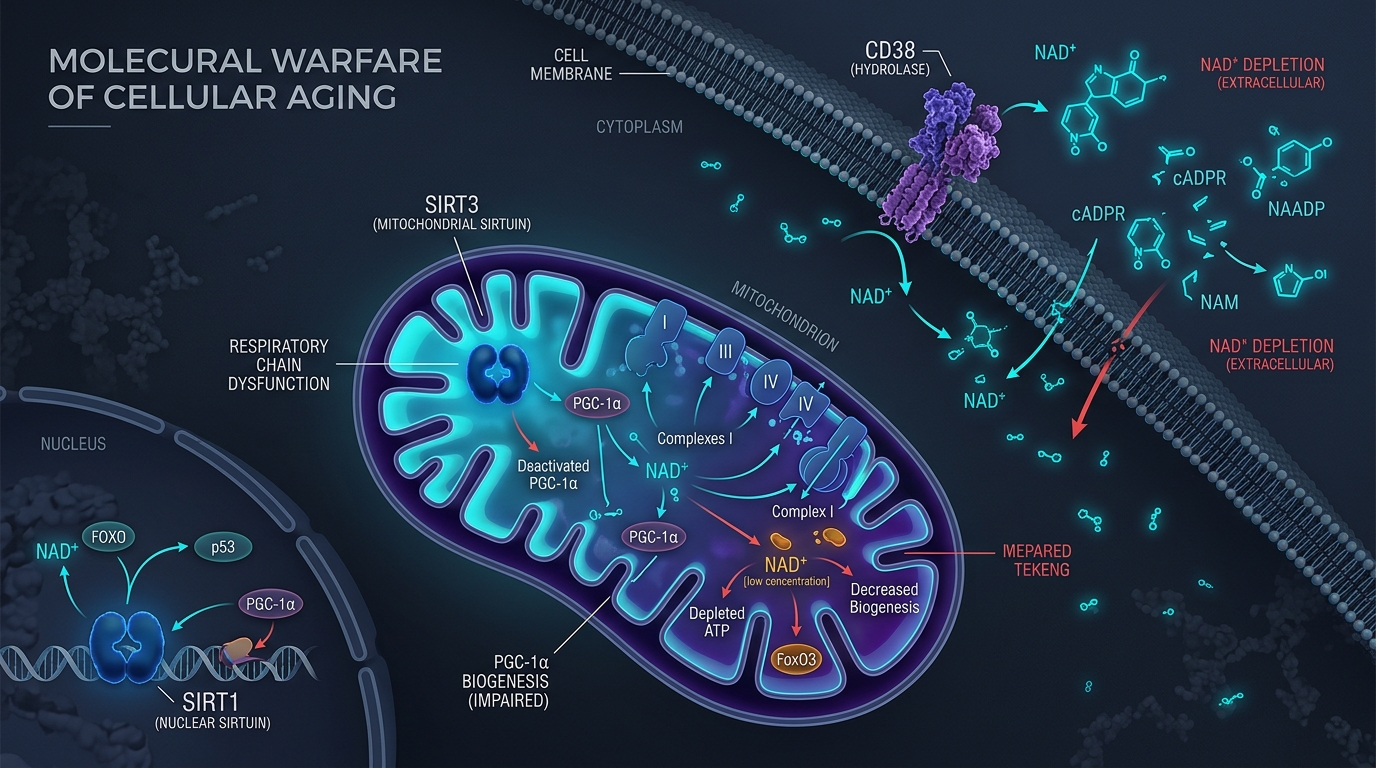
Why does this happen? The answer lies with an enzymatic thief lurking on your cell membranes: an aggressive hydrolase known as CD38.
"NAD+ behaves as the high-liquidity cash reserves funding every operational transaction in an enterprise. Sirtuins represent visionary executive stewards, eager to reinvest capital into retrofitting mitochondrial power plants and repairing DNA code. Meanwhile, the inflammatory enzyme CD38 acts as a rogue accountant blowing millions of dollars in cash reserves merely to print out single worthless receipts before leadership can intervene."
1. Demystifying NAD+: The Primordial Energy Currency of Cellular Life
To navigate the science without drowning in jargon, what actually is NAD+?
In simple terms: if the food you ingest (carbohydrates, amino acids, fats) is unrefined crude oil, and intracellular ATP molecules are refined electricity powering light bulbs, then NAD+ is the obligate electron ferry required to convert crude fuel into usable wattage.
Without sufficient NAD+, the respiratory chain inside your mitochondria grinds to an immediate halt:
- Cells lose the capacity to generate bioenergetic voltage for cardiac rhythm or muscular contraction.
- DNA-repair surveillance enzymes such as PARP1 can no longer stitch together double-stranded breaks caused by ultraviolet radiation and oxidative radicals.
The sobering biological dilemma is: As we age, cellular NAD+ pools plummet drastically. By age 50, intracellular NAD+ levels drop to less than half of their youthful baseline. Deprived of fuel, cells stall, enter replicative senescence, and transform into inflammatory "zombie cells" that poison neighboring tissues.
2. Unmasking the Culprit: CD38 as a High-Velocity NAD+ Sink
Upon discovering that NAD+ declines with age, the intuitive response is simple: "Just take more precursors!" Hence, the multi-billion-dollar precursor industry was born.
Seminal research from the Mayo Clinic, however, exposed a startling physiological reality: Aging cells do not lack NAD+ because they forget how to synthesize it: they lack NAD+ because a hyperactive enzyme is voraciously destroying it!
That catalytic sink is CD38 (Cluster of Differentiation 38), an ectoenzyme predominantly expressed on the surface of tissue-resident immune macrophages.
Senescent Cells Secrete Inflammatory SASP
Macrophage CD38 Expression Surges 300% - 500%
CD38 Consumes 100 NAD+ Molecules Per Cycle
Sirtuins Are Starved
Mitochondrial Breakdown Accelerates
How voracious is CD38? Biochemical assays reveal that to synthesize a single second-messenger molecule, CD38 indiscriminately hydrolyzes and incinerates up to 100 intact NAD+ molecules!
As chronic sterile inflammation spreads during aging, macrophage CD38 expression skyrockets by 300% to 500%. Trying to elevate NAD+ with precursor pills while CD38 is hyperactive is like pouring mineral water into a bucket with a gaping hole at the bottom.
3. The Downstream Collapse: Starving the Sirtuin Longevity Network
When CD38 hoards and dismantles systemic NAD+ availability, who suffers the greatest collateral damage?
The primary victims are the longevity guardians: the Sirtuin enzyme family (chiefly SIRT1 in the nucleus and SIRT3 inside mitochondria). Sirtuins strictly require NAD+ as an obligate co-substrate to function:
- SIRT1 (Nuclear): Deacetylates the master transcription factor PGC-1α, giving the biological green light for de novo mitochondrial biogenesis.
- SIRT3 (Mitochondrial): Activates the primary antioxidant enzyme SOD2 (Superoxide Dismutase 2) to quell reactive oxygen species (ROS) leaking from the respiratory chain.
| Molecular Biomarker | Youthful Tissue Baseline | Unchecked Senescence | CD38 Inhibition + Strategic Protocol |
|---|---|---|---|
| Intracellular NAD+ Pool | 100% (Abundant reserves) | Depleted by 50% - 70% | Restored to 85% - 95% physiological peak |
| CD38 Ectoenzyme Activity | Low, strictly regulated | Hyperactive (+300% to 500%) | Suppressed back to balanced physiological range |
| Sirtuin Deacetylase Activity | Optimal (Continual DNA repair) | Paralyzed due to substrate starvation | Reactivated, robustly renewing damaged organelles |
| Mitochondrial Health & Vitality | Robust respiratory complexes | Fragmented, bioenergetically depleted | Healthy network cleared of damaged mitochondria |
When CD38 burns through the NAD+ pool, Sirtuins are left completely starved. Defective mitochondria accumulate, reactive oxygen species damage membranes, and cellular vitality deteriorates.
4. Actionable Protocols: How to Naturally Plug the CD38 Leak First
Instead of blindly spending thousands on precursor pills, modern metabolic medicine suggests a rational hierarchy: Plug the enzymatic CD38 leak first, then nourish the biological system.
Here are 3 evidence-based, translational interventions supported by premier literature:
1. Apigenin: Nature's Potent Selective CD38 Inhibitor
The plant-derived flavonoid Apigenin (concentrated in celery, parsley, and chamomile blossoms) has been identified as one of the most effective natural, non-competitive inhibitors of CD38. Apigenin directly binds to the catalytic pocket of CD38, temporarily jamming the hydrolytic machinery and conserving endogenous NAD+ reserves.
2. Quercetin: Quelling the Senescent Secretome (SASP)
Why does CD38 spike in the first place? Because senescent cells secrete an inflammatory cocktail known as SASP, commanding macrophages to produce CD38. Quercetin acts as a targeted senolytic flavonoid, clearing lingering senescent cells and eliminating the upstream trigger of CD38 proliferation.
3. High-Intensity Interval Training (HIIT) to Fuel NAMPT Recycling
Your body possesses a native salvage pathway orchestrated by the enzyme NAMPT. Pulsed high-intensity interval training strongly stimulates NAMPT expression, recycling nicotinamide waste back into pristine NAD+ without complete dependence on exogenous supplementation.
True metabolic longevity is not about buying every hyped molecule: it is about mastering the elegant biochemical machinery of your own biology.