
The Nobel Assembly at Karolinska Institutet in Sweden has officially awarded the 2026 Nobel Prize in Physiology or Medicine jointly to three visionary pioneers:
- Prof. Dr. Peter Hegemann (Humboldt University of Berlin, Germany)
- Prof. Dr. Georg Nagel (University of Würzburg, Germany)
- Prof. Dr. Karl Deisseroth (Stanford University, USA)
They are honored for an epoch-defining breakthrough: The discovery of light-gated ion channels and the development of Optogenetics. This technology empowers neuroscientists to utilize brief flashes of laser light to selectively ignite or extinguish individual neurons inside an intact, living brain with sub-millisecond precision.
"Prior to optogenetics, attempting to study the human central nervous system was akin to trying to repair an intricate smartphone microprocessor by slamming a metallic electrode hammer onto the logic board: crude electrical shocks dispersed chaotically across thousands of unintended components, making it impossible to determine which circuit governed specific behaviors. The breakthrough discovered by these three laureates provided a precision optical scalpel: one can now shine a microscopic laser pulse to trigger a single, genetically chosen neuron without disturbing a single neighboring cell."
1. A Curious Origin in Green Algae: The Discoveries of Peter Hegemann & Georg Nagel
This Nobel-winning saga originated not within a sterile neurosurgery suite, but through fundamental photobiology investigations into a unicellular green alga called Chlamydomonas reinhardtii.
This micro-alga possesses an innate ability to swim toward sunlight to optimize photosynthesis, a phenomenon termed phototaxis. German biophysicist Peter Hegemann dedicated decades to unraveling a fundamental enigma: How does a single-celled organism devoid of eyes or nerves perceive and navigate light?
In landmark studies published in Science (2002) and PNAS (2003), Peter Hegemann and Georg Nagel unveiled the molecular answer:
- They identified and isolated two novel photoreceptor proteins embedded in the algal plasma membrane, naming them Channelrhodopsin-1 (ChR1) and Channelrhodopsin-2 (ChR2).
- Unlike mammalian rhodopsins in the human retina that rely on slow, multi-step G-protein biochemical cascades, Channelrhodopsins are direct light-gated ion channels:
- Upon absorbing a single photon of blue light (470 nm wavelength), the retinal chromophore undergoes allosteric retinal photoisomerization, instantly opening a transmembrane pore.
- Positively charged cations (Na+, Ca2+, and H+) surge into the cell within milliseconds.
Nature's own direct light-driven biological switch had finally been unlocked.
2. The Historic Leap by Karl Deisseroth: Engineering Algal Genes into Mammalian Brains
The German discovery triggered an audacious hypothesis: If the algal Channelrhodopsin gene could be stably expressed inside mammalian neurons, could scientists command neural circuits using beams of light?
In 2005 at Stanford University, neuroscientist and psychiatrist Karl Deisseroth (alongside young investigators Edward Boyden and Feng Zhang) turned this theoretical vision into laboratory reality:
Blue Laser Pulse 470 nm
Channelrhodopsin-2 Influx
Rapid Inward Na+ Current
Instant Action Potential Firing
Yellow Laser Pulse 580 nm
Halorhodopsin Cl- Pumping
Membrane Hyperpolarization
Complete Neuronal Silencing
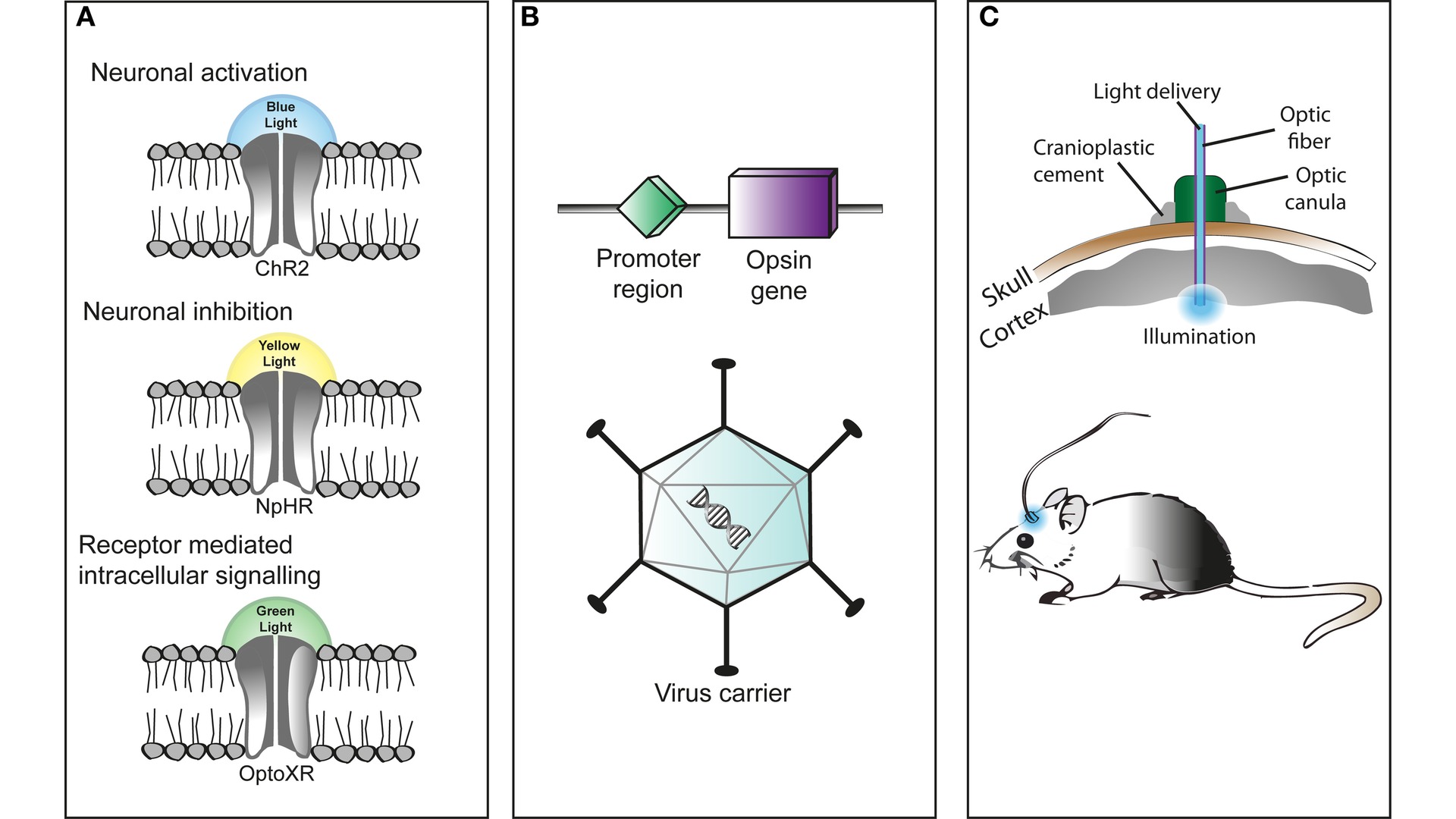
This engineering feat hinges upon three interdependent technological steps:
- Step 1 (Cell-Type Genetic Targeting): The Channelrhodopsin gene is packaged inside an adeno-associated virus (AAV) vector under the control of cell-specific promoters. Consequently, the viral vector delivers the opsin exclusively to designated neuronal subtypes (e.g., dopaminergic projecting neurons, leaving neighboring GABAergic interneurons untouched).
- Step 2 (Membrane Protein Expression): Over subsequent weeks, the host neurons transcribe and translate Channelrhodopsin, trafficking functional ion channels directly to their cell membranes.
- Step 3 (Optical Interrogation): By implanting a micro-fiber optic cannula into the targeted brain region, investigators flash blue light (470 nm) to trigger membrane depolarization and immediate action potential firing. Conversely, flashing yellow-orange light (580 nm) through the chloride pump Halorhodopsin hyperpolarizes the membrane, instantly silencing all neural activity.
For the first time in scientific history, researchers could modulate living neural networks with millisecond temporal resolution and flawless cellular specificity.
| Evaluative Axis | Traditional Electrical Stimulation (Electrodes) | Small-Molecule Pharmacology | Optogenetic Neuromodulation |
|---|---|---|---|
| Temporal Precision | Fast (milliseconds) | Very Slow (minutes to hours) | Sub-millisecond optical control |
| Cell-Type Specificity | Poor (indiscriminately shocks adjacent tissue) | Moderate (receptor-dependent, systemic spread) | Absolute (100% restricted to target promoter) |
| Reversibility | Difficult bidirectional control | Dependent on hepatic and renal clearance | Instant ON/OFF switching via photon pulses |
| Tissue Invasiveness | Provokes micro-glial scarring and wire fouling | Causes systemic off-target toxicities | Delivered via biocompatible fibers or wireless upconversion |
3. Revolutionary Impact: Deciphering the Enigmas of Neuroscience
Over the past two decades, optogenetics has evolved into an indispensable paradigm shift, solving questions previously deemed intractable:
A. Materializing Memory Engrams
Neuroscientists demonstrated that memory is not an abstract philosophical concept, but a tangible physical trace within specific neuronal ensembles. By optically activating specific hippocampal engram cells, researchers can awaken dormant memories or neutralize fear-conditioned post-traumatic stress traces in experimental models.
B. Mapping Motivation, Emotion, and Compulsion
With the flip of an optical switch, researchers can instantly induce or arrest predatory hunting aggression, extinguish acute panic responses, or map the exact hedonic valence circuits driving appetite, maternal bonding, and substance use disorders.
C. Pinpointing Pathophysiology in Neuropsychiatric Illness
Optogenetics has isolated the precise aberrant circuits responsible for Parkinsonian motor tremors, refractory major depression, and obsessive-compulsive disorders, moving clinical research beyond imprecise systemic pharmacological guesswork.
4. Clinical Applications & Actionable Future Horizon: Light as a Direct Therapeutic Modality
Beyond basic neurobiology, the 2026 Nobel Prize honors optogenetics because its translational clinical applications are actively advancing into human clinical trials:
- Restoring Sight to the Blind (Retinitis Pigmentosa & Macular Degeneration): Pioneering clinical gene therapy trials introduce Channelrhodopsin into surviving retinal ganglion cells of blind patients. When paired with light-stimulating goggles emitting calibrated amber wavelengths, these dormant ganglion cells transform into artificial photoreceptors, enabling previously blind patients to recognize objects and regain spatial mobility.
- Quelling Focal Epileptic Seizures in 10 Milliseconds: Rather than surgical lobectomy or sedating anticonvulsants, closed-loop optogenetic neuroprosthetics detect paroxysmal epileptiform spikes and automatically trigger localized inhibitory yellow light, terminating clinical seizures before convulsions spread.
- Non-Opioid Neuropathic Pain Relief: By expressing optogenetic silencing channels in dorsal root ganglion nociceptors, clinicians can inhibit persistent chronic neuropathic pain using transdermal light without the dangers of addiction or respiratory depression.
- Next-Generation Optical Brain-Computer Interfaces (BCIs): Overcoming the chronic glial scarring and signal degradation common to metal electrode arrays, bidirectional optical interfaces promise thousand-fold higher bandwidth communication between the human brain and computational devices.
Conclusion: The Convergence of Fundamental Biophysics and Bioengineering
The 2026 Nobel Prize in Physiology or Medicine celebrates the quintessential spirit of scientific inquiry: What started as curiosity regarding how single-cell pond algae detect sunlight evolved into the most transformative revolution in twentieth-first-century neuroscience.
The fusion of German fundamental biophysical rigour (Peter Hegemann, Georg Nagel) and American bioengineering ingenuity (Karl Deisseroth) has bestowed humanity a profound gift: The power to illuminate, understand, and heal the brain through the gentle grace of photons.