
When reviewing standard lipid panels, patients and clinicians instinctively gravitate toward the LDL-C metric (frequently labeled "bad cholesterol"). If this single number drifts above standard reference thresholds, alarm bells ring, and statin prescriptions are promptly drafted.
Yet contemporary molecular cardiovascular medicine has established a critical reality: The LDL-C measurement on a basic lipid panel reflects merely the gross mass of cholesterol carried inside all LDL particles, revealing nothing about particle count, physical geometry, or biochemical toxicity.
Inside your vasculature, not all LDL particles are created equal. Large buoyant particles circulate peacefully, whereas small dense and oxidized particles carry genuine pathogenicity: Small Dense LDL (sdLDL) and Oxidized LDL (oxLDL).
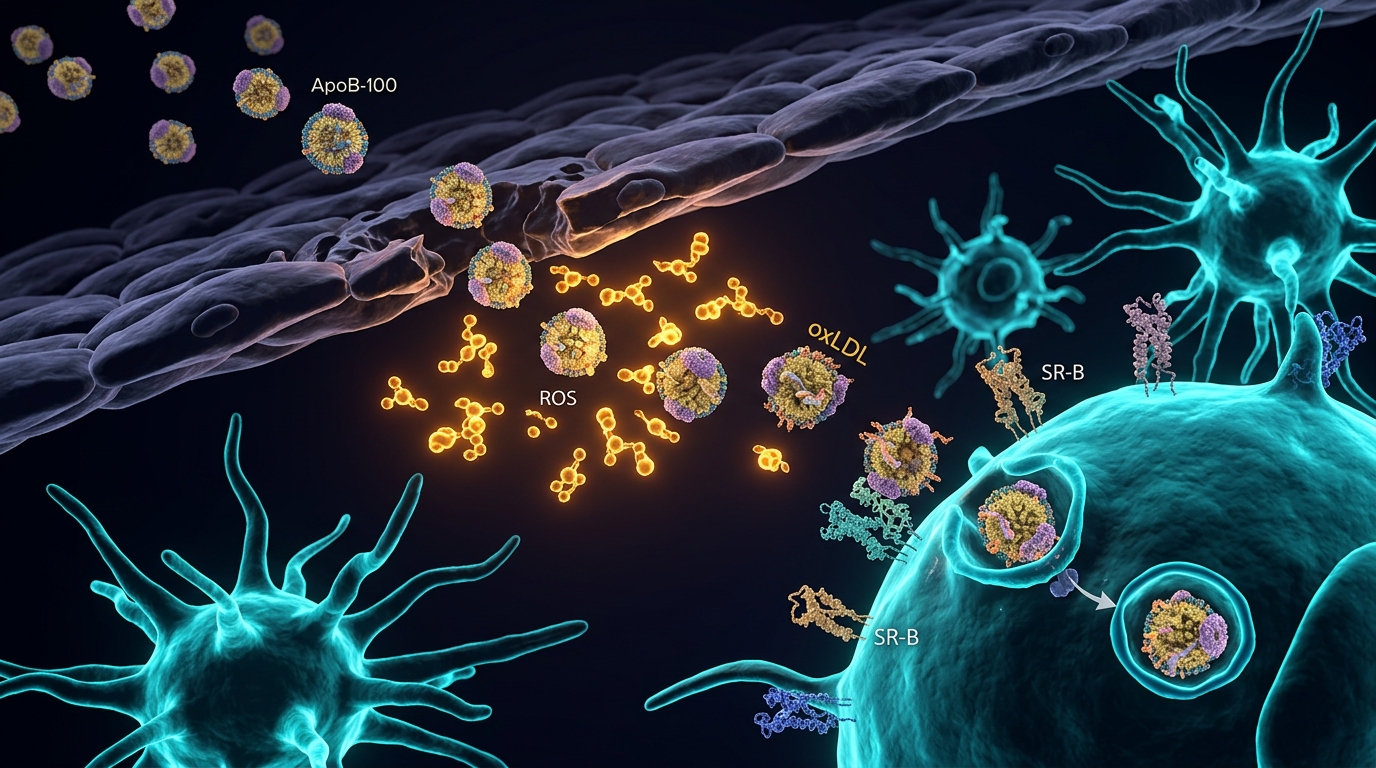
"Picture the bloodstream as a swift canal and the vascular wall as a cobblestone embankment. Large, fluffy LDL particles (Pattern A) resemble lightweight beach balls, floating smoothly along the current without ever slipping into crevices between the stones. Small dense LDL particles (sdLDL), by contrast, act like miniature steel ball bearings that slip deep into subendothelial cracks; once oxidized into rusty oxLDL, they detonate an inflammatory blast that degrades the structural integrity of the arterial wall from within."
1. Two Lipoprotein Phenotypes: Pattern A vs Pattern B
Modern lipoprotein subfraction testing categorizes individuals into two distinct metabolic phenotypes:
- Pattern A (Large Buoyant LDL): Particles exceeding 25.5 nm in diameter, buoyant, lipid-rich, and shielded by a generous tocopherol (vitamin E) outer coat. They exhibit short serum half-lives, are efficiently recognized and cleared by hepatic LDL receptors, and cannot easily cross intact endothelium.
- Pattern B (Small Dense LDL - sdLDL):
Particles measuring under 25.5 nm, dense, protein-heavy, and depleted of cholesterol esters. These constitute the true atherogenic drivers:
- Readily penetrate through loosened endothelial tight junctions.
- Bind aggressively to subendothelial matrix proteoglycans, resisting egress.
- Highly vulnerable to free radical attack due to depleted antioxidant shielding.
- Deformed conformation prevents hepatic LDL receptor recognition, prolonging serum transit time by multiple days and multiplying the probability of oxidative conversion.
2. Molecular Mechanism: How oxLDL Transforms Macrophages into Foam Cells
Oxidation alters the tertiary structure of Apolipoprotein B100 (ApoB100), triggering an uninhibited immune engulfment loop:
sdLDL trapped in subendothelium
Free Radicals induce oxLDL conversion
Unregulated CD36 Scavenger Uptake
Foam Cell Necrosis & Lipid Core Expansion
- Failure of Feedback Ingestion Controls: Physiological somatic cells regulate native LDL receptors tightly: once internal cholesterol needs are met, receptor synthesis is downregulated. However, macrophages recognize oxLDL via Scavenger Receptors (CD36 and SR-A), which possess no negative feedback mechanisms. Macrophages continuously engulf oxLDL until they burst.
- Foam Cell Accumulation (Fatty Streaks): Engorged with modified lipid droplets, macrophages swell into dysfunctional foam cells. Aggregations of foam cells constitute the initial "fatty streak" along coronary intima.
- Secretion of Matrix Metalloproteinases (MMPs) & Plaque Instability: As foam cells undergo programmed necrosis, they release proteolytic MMP enzymes that digest the surrounding collagen fibrous cap. When this protective cap thins under hemodynamic shear stress, it ruptures, exposing the thrombogenic core to circulating platelets and triggering acute luminal thrombosis within minutes.
3. Biological Comparison: Large Buoyant LDL vs sdLDL & oxLDL
| Characteristic | Large Buoyant LDL (Pattern A) | Small Dense & Oxidized LDL (Pattern B) |
|---|---|---|
| Particle Diameter | 25.5 - 28.5 nm (Large, buoyant) | 19.0 - 25.4 nm (Small, dense) |
| Endothelial Penetration | Minimal, excluded by physical size | High, slips through intercellular junctions |
| Oxidative Susceptibility | Low, protected by thick antioxidant shell | Extremely high, rapidly converted to cytotoxic oxLDL |
| Circulation Half-Life | Short (~2 days before hepatic receptor uptake) | Prolonged (~5 days, increasing exposure to damage) |
| Metabolic Correlate | High insulin sensitivity, minimal refined carbohydrates | Insulin resistance, metabolic syndrome, elevated triglycerides |
4. Practical Protocols & Clinical Action Plan to Inhibit sdLDL and oxLDL Genesis
Halting the subendothelial cascade of sdLDL and oxLDL requires targeting the nutritional and metabolic roots of hepatic de novo lipogenesis and lipid peroxidation:
Protocol 1: Eliminating the Substrates of Small Dense LDL
- Curtailing Industrial Fructose & Refined Starches: Hepatic fructose metabolism bypasses phosphofructokinase regulation, directly driving de novo lipogenesis (DNL). The liver churns out large, triglyceride-overloaded VLDL particles, which cholesteryl ester transfer protein (CETP) and hepatic lipase progressively sculpt into atherogenic small dense LDL (sdLDL).
- Monitoring the TG/HDL Surrogacy: Keep your fasting Triglyceride to HDL ratio below 1.5 (in mg/dL). A ratio under 1.5 strongly indicates a predominantly large, buoyant Pattern A profile.
Protocol 2: Shielding Circulating Lipids from Oxidative Peroxidation
- Eliminating Thermally Oxidized Seed Oils: Repeatedly heated industrial omega-6 oils (corn, soybean, cottonseed) contain pre-formed lipid hydroperoxides (4-HNE, MDA) that directly integrate into circulating lipoprotein shells, priming them for rapid macrophage CD36 uptake.
- Endogenous Antioxidant Synergy: Supplemental Ubiquinol (100 to 200 mg) and Alpha-Lipoic Acid (300 mg) preserve endogenous alpha-tocopherol within the lipoprotein outer shell, preventing the initiation of lipid peroxidation.
Protocol 3: Endothelial Tight Junction Integrity
- Glycemic Stabilization: Avoiding postprandial glucose excursions above 140 mg/dL prevents protein kinase C (PKC) activation, maintaining tight junction claudins and occludins so circulating lipoproteins cannot slip into the subendothelial space.
Clinical Safety Caveats:
- Advanced cardiovascular prevention requires assessing total atherogenic particle burden through Apolipoprotein B (ApoB) testing. Lowering sdLDL via lifestyle works synergistically with, but does not replace, medical therapies when baseline risk remains elevated.
- Always evaluate hs-CRP alongside sdLDL: the presence of sdLDL in an artery devoid of inflammatory sparks poses markedly lower acute rupture risk than when severe systemic inflammation is present.