
Phytocodex emblemPhytocodex
🇬🇧 English Edition|Scientific Literature Synthesis
01 · The high-water mark after opening the supply tap
Cmax (Peak Concentration)

Following oral administration, active molecules crest at Cmax. Exceeding Cmax risks acute organ toxicity; failing to reach it renders therapy inert.

02 · The duration for the drainage valve to empty half the pool
Elimination Half-Life (T1/2)

The time needed for metabolic enzymes and kidneys to eliminate 50% of circulating drug. A 6-hour half-life dictates a precise multi-dose regimen.

03 · Total cumulative systemic drug exposure over time
Area Under the Curve (AUC)

AUC measures the full duration and depth of biological exposure. High-fat meals can boost the AUC of lipophilic agents by 300% to 500%.

FundamentalsMetabolic Literature-Synthesized & EBM-Verified 7 min read

Reading a Serum Concentration-Time Curve: The 4 Numbers Defining Therapeutic Reality

Cmax, Tmax, elimination half-life t½, and area under the curve AUC: 4 mathematical coordinates that demarcate the boundary between a genuinely therapeutic dose, an inert compound, and toxic accumulation.

CH
Dr. Xuan Chien HoangDoctor of Natural Sciences (Dr. rer. nat.) · University of Hamburg, Germany
2026-05-04T09:00:00ZDOI: 10.1002/9780470740412 2 Referenced Literature

In evidence-based medicine and clinical pharmacology, an immutable axiom prevails: No matter how miraculous a molecule appears in an in vitro Petri dish, if it cannot penetrate the bloodstream at a sufficient concentration and remain there long enough, it is therapeutically useless.

Many health consumers still cling to the intuitive fallacy that "more milligrams equate to more benefit," or become mesmerized by marketing claims touting thousands of milligrams without knowing the actual circulating plasma concentration.

To evaluate whether a pharmaceutical drug or natural botanical extract actually exerts biological activity in vivo, pharmacologists examine not the bottle label, but the Serum Concentration-Time Curve.
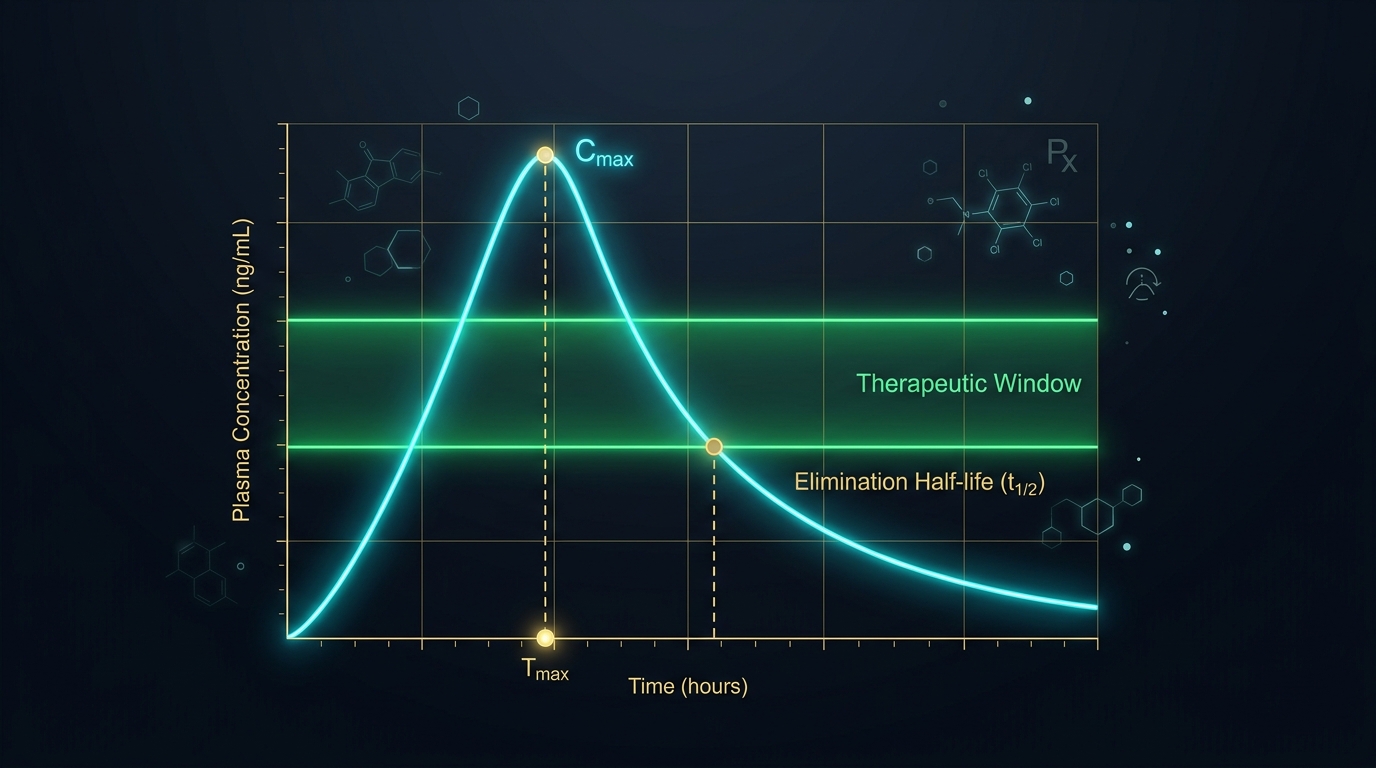
One-compartment pharmacokinetic graph illustrating peak concentration Cmax, time to peak Tmax, and the clinical therapeutic window

"Our body behaves like a swimming pool fitted with an inflow pipe (the rate of intestinal absorption) and an unclosable drain at the bottom (the rate of hepatic and renal clearance). If you want the pool to maintain an ideal water depth for swimming without drying out or overflowing, the pumping speed and drainage rate must be mathematically calculated down to the minute."


1. Four Golden Coordinates of Clinical Pharmacokinetics

Following a single oral dose, every classical one-compartment pharmacokinetic curve traces four decisive physiological milestones:

Molecular Mechanism Pipeline
PHASE 01STIMULUS

Oral Administration

Next ➔Inspect
PHASE 02SIGNAL HUB

Progressive Absorption

Next ➔Inspect
PHASE 03SIGNAL HUB

Peak Cmax at Tmax

Next ➔Inspect
PHASE 04ENDPOINT

Elimination & Clearance via t½

Terminal ✓Inspect

1. Cmax (Peak Plasma Concentration)

The highest systemic concentration achieved in circulating blood. If Cmax fails to cross the Minimum Effective Concentration (MEC), target cell receptors will show zero biological response.

2. Tmax (Time to Peak Concentration)

The duration elapsed from ingestion until blood levels reach Cmax:

  • Short Tmax (30 - 60 minutes): Ideal for acute analgesics or antipyretics requiring rapid onset.
  • Prolonged Tmax (3 - 6 hours): Characteristic of sustained-release formulations intended for steady 24-hour baseline coverage.

3. Elimination Half-Life (t½)

The time required for systemic drug concentration to decline by 50%. This parameter determines dosing frequency:

  • If t1/2t_{1/2} = 2 hours: The compound requires dosing 3 to 4 times daily to sustain efficacy.
  • If t1/2t_{1/2} = 24 hours: A single once-daily dose provides stable therapeutic coverage.

4. AUC (Area Under the Curve)

The most critical metric of total systemic exposure, representing the cumulative amount of bioactive substrate the body receives across the entire absorption-clearance cycle.


2. Common Clinical Pharmacokinetic Profiles

Curve ProfileBiological CauseClinical OutcomeFormulation Engineering Solution
Cmax Below MECPoor aqueous solubility or aggressive first-pass hepatic clearanceComplete therapeutic failure despite large oral dosePhytosome encapsulation, self-emulsifying lipid carriers
Cmax Above MTCExcessively rapid bolus absorptionHigh risk of acute toxicity, adverse side effects, or hypotensionExtended-release microencapsulation matrix
Short Elimination t½Rapid renal filtration and hepatic glucuronidationTransient spike followed by rapid loss of efficacyCo-administration of clearance inhibitors (e.g. piperine)
Optimized AUCFully situated within the Therapeutic WindowMaximized clinical benefit with zero toxicityCalibrated dosing scheduled around meal composition

3. Practical Protocols & Clinical Action Plan: Optimizing Absorption Kinetics

A pervasive mistake among health enthusiasts is taking all supplements on an empty stomach under the unscientific assumption that an empty stomach always speeds up nutrient uptake. In reality, pharmacokinetic curves dictate distinct timing protocols:

Protocol 1: Lipophilic Bioactives (Curcumin, CoQ10, Vitamin D3, Omega-3)

  • The Fed State Requirement: Lipophilic molecules require bile salts and pancreatic lipases to assemble into mixed micelles for enterocyte uptake. Taking them on an empty stomach drops Cmax by 70% to 80%.
  • The Dietary Lipid Matrix: Always ingest lipophilic compounds alongside a meal providing at least 10 to 15 grams of healthy dietary fats (extra virgin olive oil, eggs, or avocado) to expand the total Area Under the Curve (AUC) by 300% to 500%.

Protocol 2: Water-Soluble Compounds & Amino Acids (B-Vitamins, NAC, L-Tyrosine)

  • Empty Stomach Timing: Water-soluble vitamins and free-form amino acids compete with dietary peptides for intestinal peptide transporter (PEPT1) absorption. Administer 30 to 45 minutes prior to meals with a full glass of water to achieve a rapid, unobstructed Tmax peak.

Protocol 3: Sustained Exposure via Half-Life Matching

  • Divided Dosing: For molecules with short biological half-lives (t1/2 < 3 hours, such as Vitamin C or unformulated berberine), dividing the total daily intake into 2 or 3 smaller doses sustains serum concentrations comfortably within the Minimum Effective Concentration (MEC) window throughout the entire day.

Clinical Safety Caveats:

  • Never crush, chew, or split extended-release (ER/XR) pharmaceutical tablets. Doing so destroys the matrix coating, causing immediate drug "dumping" where Cmax spikes dangerously above the Maximum Tolerated Concentration (MTC).
  • If renal or hepatic clearance function is impaired (elevated creatinine or AST/ALT), drug elimination half-life is substantially prolonged, mandating dosage adjustments to prevent cumulative systemic toxicity.

Understanding pharmacokinetic curves replaces guesswork with rigorous biological precision, ensuring every health investment produces measurable physiological outcomes.

§ 6 · References & Primary Evidence

Verified Source List.

References indexed via NCBI PubMed & CrossRef

  1. 01
    Comprehensive Clinical Pharmacology Reviewn = systematic/in-vitro
  2. 02
    Clearance concepts in pharmacokinetics

    J Pharmacokinet Biopharm · 1973

    Landmark Pharmacokinetics Formulationn = systematic/in-vitro
Interactive Laboratory Simulation

Model calculations execute entirely client-side.

Gizmo 01Mô phỏng Dược động học & Sinh khả dụng
kịch bản mẫu

Điều khiển tham số

500mg

Dạng bào chế

Tình trạng dạ dày

Ghi chú sinh khả dụng

Chiết xuất thô tự nhiên, độ hòa tan kém. F = 1.1%.

0 byte truyền ngoài

DẢI NỒNG ĐỘ TÁC DỤNG LÂM SÀNG (12% Cmax)0.000.010.030.040.0604812162024THỜI GIAN SAU KHI UỐNG (GIỜ)NỒNG ĐỘ TRONG HUYẾT TƯƠNG (µg/mL)Cmax 0.030Tmax 2.1 hSTANDARD EXTRACT · 500 mg · kₑ = 0.099

Nồng độ đỉnh (Cmax)

0.030µg/mL

Thời gian đỉnh (Tmax)

2.1h

Thời gian bán thải (t½)

7.0h

Lượng hấp thu (AUC₀₋₂₄)

0.34µg·h/mL

Phân tích khoa học

Nồng độ dược chất trong máu tuân theo phương trình dược động học: C(t) = F·D·kₐ / (V(kₐ−kₑ)) · (e^−kₑt − e^−kₐt) với hằng số đào thải kₑ được cố định ở mức 0.099 h⁻¹ (thời gian bán thải t½ 7.0 giờ). Dải hiệu quả điều trị tối thiểu được đặt ở mức 12% Cmax — một công thức bào chế được đánh giá cao khi nó duy trì nồng độ ổn định trong dải này suốt nhiều giờ chứ không phải là đỉnh vọt lên rồi tụt dốc tức thì.

💡 Góc Giải Thích Dược Động Học Dễ Hiểu

Bốn chỉ số vàng quyết định một viên thuốc hay thực phẩm bổ sung có thực sự phát huy tác dụng:

1-COMPARTMENT PK
Cmax · Nồng độ đỉnh

Giống như 'tốc độ tối đa' mà chiếc xe có thể đạt được. Cmax càng cao thì lượng hoạt chất thấm vào máu trong một thời điểm càng mạnh.

Tmax · Thời gian lên đỉnh

Thời gian từ lúc nuốt viên uống đến khi nồng độ đạt đỉnh cao nhất. Uống lúc đói giúp Tmax đến sớm hơn, sau ăn no làm chậm hấp thu.

t½ · Thời gian bán thải

Thời gian để cơ thể đào thải một nửa lượng hoạt chất trong máu. t½ càng dài thì bạn càng ít phải uống nhắc lại nhiều lần trong ngày.

AUC · Diện tích dưới đường cong

Thước đo tổng lượng hoạt chất cơ thể thực sự hấp thu và sử dụng được suốt cả ngày. Đây là con số quan trọng nhất của một sản phẩm.

Share this Dispatch
CH

Dr. Xuan Chien Hoang

Doctor of Natural Sciences (Univ. of Hamburg) · Founder, Lava Health GmbH

Biomedical scientist and product developer with over a decade of international experience in Germany and APAC. Author of The Cancer Code (Amazon: eBook, Paperback, Hardcover). Pioneering the East-West botanical bridge, bioavailability enhancement, and data-driven HealthTech.

PHYTOCODEX · WEEKLY BRIEF

Evidence-Based Biomedical Intelligence Straight to Your Inbox

Deep-dives into bioavailability kinetics, cellular pathways, interactive simulation models, and East-West ethnobotanicals by Dr. Xuan Chien Hoang. Zero spam, unsubscribe anytime.

GDPR compliant. 1-click unsubscribe anytime.
Related Analytical Dispatches
Cellular Aging

Urolithin A từ Quả Lựu: Cơ chế Kích hoạt Mitophagy Dọn dẹp Ty thể Độc lập với NAD+ Giúp Phục hồi Sức bền Cơ bắp

Nhiều người tin rằng chỉ cần uống nước ép lựu là đủ để có được các lợi ích trẻ hóa tế bào của Urolithin A. Tuy nhiên, sự thật sinh học phức tạp hơn nhiều: cơ thể chúng ta không tự sản sinh ra Urolithin A. Nó là sản phẩm chuyển hóa thứ cấp của hệ vi sinh đường ruột từ ellagitannins có trong lựu, và chỉ có khoảng 30 đến 40 phần trăm dân số sở hữu hệ vi sinh phù hợp để thực hiện quá trình chuyển đổi này. Bài viết bóc tách cơ chế phân tử độc đáo của Urolithin A trong việc kích hoạt mitophagy (quá trình tự thực ty thể) thông qua con đường độc lập với NAD+, giúp dọn dẹp các ty thể già cỗi, phục hồi hiệu suất cơ bắp mà không làm cạn kiệt nguồn dự trữ năng lượng nội bào.

Open Dispatch
Cellular Aging

Urolithin A from Pomegranate: Deciphering the NAD+ Independent Mitophagy Pathway for Muscle Recovery and Mitochondrial Longevity

While pomegranate is celebrated as an anti-aging superfood, drinking its juice rarely yields the therapeutic levels of its active metabolite, Urolithin A. This molecule is not directly present in pomegranates: instead, it requires specific gut microbiota to convert dietary ellagitannins into Urolithin A. Crucially, only 30 to 40 percent of humans possess the microbial profile capable of this conversion, leaving the majority as non-responders. This monograph dissects the molecular mechanism of Urolithin A as a first-in-class mitophagy activator that operates independently of the classic NAD+ pathway, bypassing cellular energy depletion to selectively clear damaged mitochondria, enhance ATP synthesis, and restore skeletal muscle function in aging populations.

Open Dispatch
Immune

Bóng Ma Dịch Hạch Từ Phòng Thí Nghiệm Nga: Giải Mã Cỗ Máy Tiêm Độc T3SS và Độc Lực Của Vi Khuẩn Yersinia pestis

Vụ việc rò rỉ mầm bệnh tại Viện Nghiên cứu Chống Dịch hạch Irkutsk (Nga) đặt giới y học toàn cầu vào tình trạng báo động đỏ. Yersinia pestis không chỉ là tác nhân gây nên thảm họa Cái Chết Đen trong lịch sử, mà còn sở hữu cỗ máy bơm độc lực Type III (T3SS) có khả năng tiêm thẳng protein độc tố Yop vào tế bào miễn dịch, làm tê liệt đại thực bào và biến lá phổi thành bãi chiến trường xuất huyết tử vong chỉ sau 48 giờ.

Open Dispatch
Reading a Serum Concentration-Time Curve: The 4 Numbers Defining Therapeutic Reality · Phytocodex · Phytocodex