
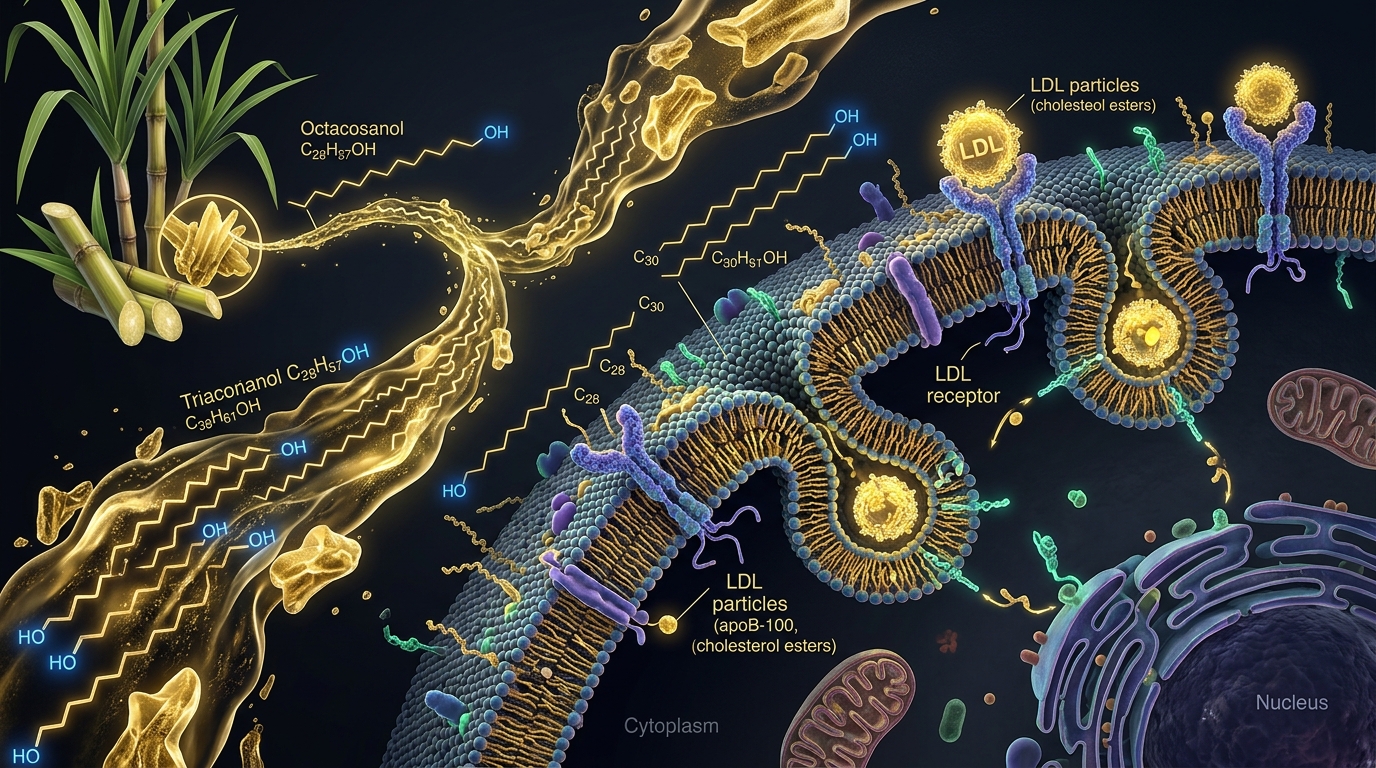
In the persistent clinical quest for natural lipid-lowering compounds devoid of statin-associated muscle symptoms, Policosanol—a mixture of very long-chain primary aliphatic alcohols purified from sugarcane wax (Saccharum officinarum)—stood for years as an apparent botanical miracle from the Caribbean.
Dozens of trials published throughout the 1990s and early 2000s reported that daily doses of 10 to 20 mg policosanol decreased low-density lipoprotein cholesterol (LDL-C) by 17% to 25% while simultaneously raising high-density lipoprotein cholesterol (HDL-C) by 15% to 28%, rivaling first-generation statin regimens.
Yet, when independent investigators across Germany, the United States, and Western Europe executed rigorous double-blind, randomized, placebo-controlled trials, an unmistakable disparity surfaced: The Replication Gap.
"In evidence-based medicine, a finding possesses genuine validity only when it can be reproduced across independent international laboratories. When clinical efficacy thrives exclusively within a single institutional sphere but vanishes under external scrutiny, physicians must pause and critically reassess."
1. Biochemical Composition and Proposed Mode of Action
Policosanol is not a single chemical entity, but rather a defined blend of very long-chain aliphatic alcohols (24 to 34 carbons):
- 1-Octacosanol (): Constituting 60%–70% of total mass.
- 1-Triacontanol (): Accounting for 10%–15%.
- 1-Hexacosanol () and minor higher homologues.
Original Cuban mechanistic models proposed two cellular pathways:
- Indirect HMG-CoA Reductase Inhibition: Unlike statins, which directly occupy the enzyme's catalytic pocket, policosanol was hypothesized to trigger AMP-activated protein kinase (AMPK) phosphorylation, thereby downregulating de novo sterol synthesis.
- Upregulation of Hepatic LDL Receptors: Enhancing LDL-R density on hepatocytes to drive lysosomal clearance of ApoB-100 particles.
Policosanol
Hepatic AMPK Activation (?)
HMG-CoA Reductase Phosphorylation
Suppressed Cholesterol
└
Increased Hepatic LDL-R Density
Accelerated LDL Clearance
2. The European Replication Gap: The Landmark Berthold Trial
The debate came to an empirical head in 2006 when Professor Heiner K. Berthold and colleagues conducted a multi-center, randomized, double-blind, placebo-controlled trial across Cologne and Bonn, published in JAMA.
Enrolling 143 hypercholesterolemic subjects across 12 weeks with escalating daily doses of policosanol (10 mg, 20 mg, 40 mg, and 80 mg/day—up to eight times standard dosing), the findings were unequivocal:
- LDL-Cholesterol: Exhibited zero statistically significant reduction compared with placebo (-0.5% to +2.1%).
- HDL-Cholesterol & Triglycerides: Remained indistinguishable from the placebo arm.
Subsequent trials in the Netherlands and Italy confirmed this absence of bioactivity in humans, highlighting negligible intestinal absorption of very long-chain saturated aliphatic waxes and challenging the external validity of earlier trials.
3. Comparative Clinical Matrix: Policosanol vs. Statins vs. Red Yeast Rice
| Parameter | Sugarcane Policosanol | Standard Statin (Atorvastatin 10-20mg) | Red Yeast Rice (Monacolin K 3-10mg) |
|---|---|---|---|
| LDL-C Reduction (Original Literature) | 17% – 25% | 35% – 50% | 15% – 25% |
| LDL-C Reduction (Independent European RCTs) | 0% – 3% (Clinically inert) | 35% – 50% (100% reproducible) | 15% – 22% (Highly reproducible) |
| Molecular Target Validation | Unproven in human enterocytes | Direct competitive HMG-CoA blockade | Contains natural lovastatin isomer |
| Hard Cardiovascular Outcome Data | None available | Proven reduction in MACE across thousands | Moderate secondary trial data (CCSPS) |
| Adverse Effect Profile | Excellent tolerability | SAMS / myalgia risk in 5%–10% | Mild myalgia risk at active doses |
4. Evidence-Based Clinical Recommendations
From modern translational pharmacology, clear clinical conclusions emerge:
- Never Discontinue Prescribed Statins for Policosanol: In secondary cardiovascular prevention or high-risk patients (history of ACS, PCI, type 2 diabetes), substituting statins with policosanol leaves atherosclerotic plaque progression unchecked.
- Account for Enteric Bioavailability Limits: C28–C30 aliphatic waxes have extremely low solubility in aqueous intestinal micellar systems, leading to minimal systemic bio-accessibility.
- Evidence-Backed Non-Statin Alternatives: If genuine statin intolerance exists, evidence supports alternatives with demonstrated independent reproducibility:
- Purified Red Yeast Rice (standardized Monacolin K with certified citrinin absence).
- Berberine (stabilizing hepatic LDL-R mRNA and downregulating PCSK9).
- Plant Sterols & Stanols (inhibiting intestinal Niemann-Pick C1-Like 1 micellar uptake).
- Viscous Soluble Fiber (beta-glucan, psyllium for bile-acid sequestration).
Scientific medicine honors objective reality. Reconsidering policosanol is not an indictment of botanical medicine, but a defense of empirical rigor to safeguard patient cardiovascular outcomes.