
We often perceive aging as an inevitable decline, an hourglass that cannot be stopped. In reality, individuals who achieve extreme longevity share a common trait: remarkable genomic stability. For decades, researchers focused on clearing cellular waste or optimizing mitochondria, often overlooking the most critical 'butler' residing within the cell nucleus. Sirt6, a member of the Sirtuin family, has emerged as a decisive factor in maintaining DNA integrity. The most common misconception is that boosting NAD+ levels alone is sufficient. However, without enough Sirt6 to coordinate, repair signals fail to initiate correctly. This article will delve into the mechanism by which Sirt6 protects us from genetic chaos, an invisible yet robust barrier against aging.
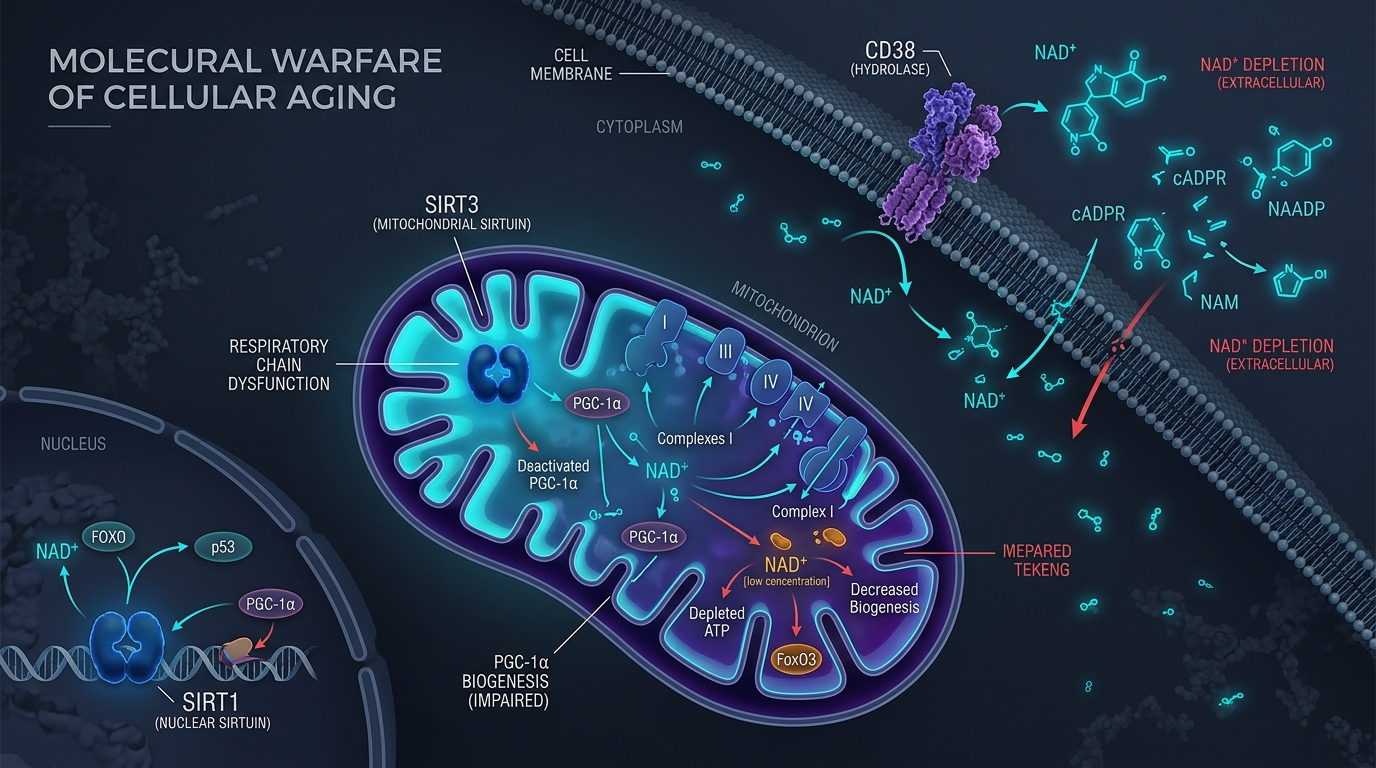
"Imagine your genome as a library containing the master blueprints for your entire body. Over time, these books get torn or smudged due to environmental stress. Sirt6 acts as a diligent librarian who not only identifies damaged pages for repair but also regulates the 'book borrowing' process, ensuring that only the most critical information is transcribed, preventing the library from being overwhelmed by outdated or corrupted copies."
Molecular Pathway Flowchart
Stress/DNA damage signals
Sirt6 Activation
Histone H3K9 Deacetylation
Telomere Stability/DNA Repair
Inflammation Suppression/Metabolic Homeostasis
1. Molecular Mechanisms: Sirt6 and Chromatin Control
Sirt6 (Sirtuin 6) is a NAD+-dependent enzyme with both deacetylase and mono-ADP-ribosyltransferase activities. Unlike other Sirtuins localized in the cytoplasm or mitochondria, Sirt6 resides in the cell nucleus, where it binds tightly to chromatin. Its core function is to remove acetyl groups from histone H3 at lysine 9 (H3K9ac). This deacetylation acts as a genetic 'lock,' tightening chromatin structure and preventing the overexpression of pro-inflammatory genes and unwanted genetic elements. When DNA is damaged by radiation or oxidation, Sirt6 is recruited to the break site, acting as a scaffold to recruit repair proteins such as PARP1 (Poly ADP-ribose polymerase 1). Without Sirt6, DNA breaks remain unrecognized, leading to genomic instability, a precursor to cancer and premature aging.
2. Biological Paradox & Clinical Metrics
The paradox lies in the fact that declining Sirt6 levels with age not only drive aging but also fundamentally alter glucose metabolism. Sirt6 inhibits HIF1-alpha (Hypoxia-inducible factor 1-alpha), thereby preventing cells from shifting into a state of excessive glucose consumption (the Warburg effect). When Sirt6 is deficient, cells 'perceive' themselves to be in a hypoxic environment, leading to unnecessary glucose uptake, insulin resistance, and oxidative stress. The following table contrasts physiological states:
| Physiological State | Sirt6 Expression | Metabolic Status |
|---|---|---|
| Youthful (Baseline) | High / Optimal | Metabolic flexibility, efficient DNA repair |
| Aging (Senescence) | Low / Depleted | Insulin resistance, genomic instability, chronic inflammation |
| Optimized (Intervention) | Restored / Activated | Enhanced insulin sensitivity, anti-inflammatory, telomere stability |
Sirt6 depletion creates a positive feedback loop: increased DNA damage consumes more Sirt6, and this depletion further impairs repair capacity, accelerating cellular senescence.
Practical Takeaways & Clinical Translation: 3. Clinical Strategies & Lifestyle Optimization
Optimizing Sirt6 activity goes beyond supplementing NAD+ precursors like NMN or NR; it requires a favorable cellular environment. First, Caloric Restriction (CR) has been proven to powerfully activate Sirtuins by altering the NAD+/NADH ratio. Second, glycemic control is vital; chronically high blood sugar depletes NAD+ pools and inhibits Sirt6's ability to bind to chromatin. Clinically, natural compounds like Quercetin or Resveratrol may act as indirect modulators, supporting Sirt6 in maintaining chromosomal structure. However, patients should note that high-dose supplementation without metabolic monitoring can lead to imbalances. The safety recommendation is to focus on maintaining circadian rhythms (consistent sleep) and resistance training, as these are the most potent natural signals to sustain Sirt6 gene expression. Do not self-administer active compounds without first checking HbA1c and chronic inflammation markers (hs-CRP).