
Phytocodex emblemPhytocodex
🇬🇧 English Edition|Scientific Literature Synthesis
01 · The biological master switch regulating cellular energy flux
Molecular Mechanisms

Imagine your intestinal barrier as a high-tech border checkpoint.

02 · The safety-relief valve dampening oxidative stress cascades
Biological Paradox and Clinical Metrics

The tight junction proteins act as diligent security officers, only allowing vetted nutrient molecules to pass.

03 · Actionable lifestyle levers synchronizing cellular rhythm
Translational Clinical Protocols

Zonulin functions like an emergency override command, ordering these officers to temporarily step aside for rapid transit.

Clinical Deep-DiveGut Literature-Synthesized & EBM-Verified 9 min read

The Cellular Gatekeeper and the Zonulin Paradox: Deciphering Leaky Gut Syndrome in Metabolic Aging

Leaky gut syndrome is often misconstrued as mere physical damage to the intestinal lining. In reality, it is a complex molecular regulatory failure involving the Zonulin protein, which compromises the integrity of tight junctions. This article dissects the metabolic mechanisms that allow LPS endotoxins to enter the bloodstream, triggering systemic inflammation and accelerating cellular aging.

CH
Dr. Xuan Chien HoangDoctor of Natural Sciences (Dr. rer. nat.) · University of Hamburg, Germany
2026-10-10T09:00:00ZDOI: 10.1111/j.1749-6632.2012.06538.x 3 Referenced Literature

We often hear about 'leaky gut' as a trendy term in wellness circles, yet few understand the molecular reality behind it. Many believe that simply eliminating gluten or dairy is sufficient to heal the gut. However, the truth is far more complex. Leaky gut is not a physical tear in the tissue, but a functional decline in the protein complexes that control intestinal permeability. When this process occurs, bacterial debris and LPS endotoxins leak into the bloodstream. This triggers not only digestive issues but also metabolic disorders, low-grade chronic inflammation, and cognitive decline. In this article, we will delve into the role of Zonulin, a molecular switch that, when over-activated, disrupts the body's homeostasis, turning a sophisticated defense system into an open door for pathogens.
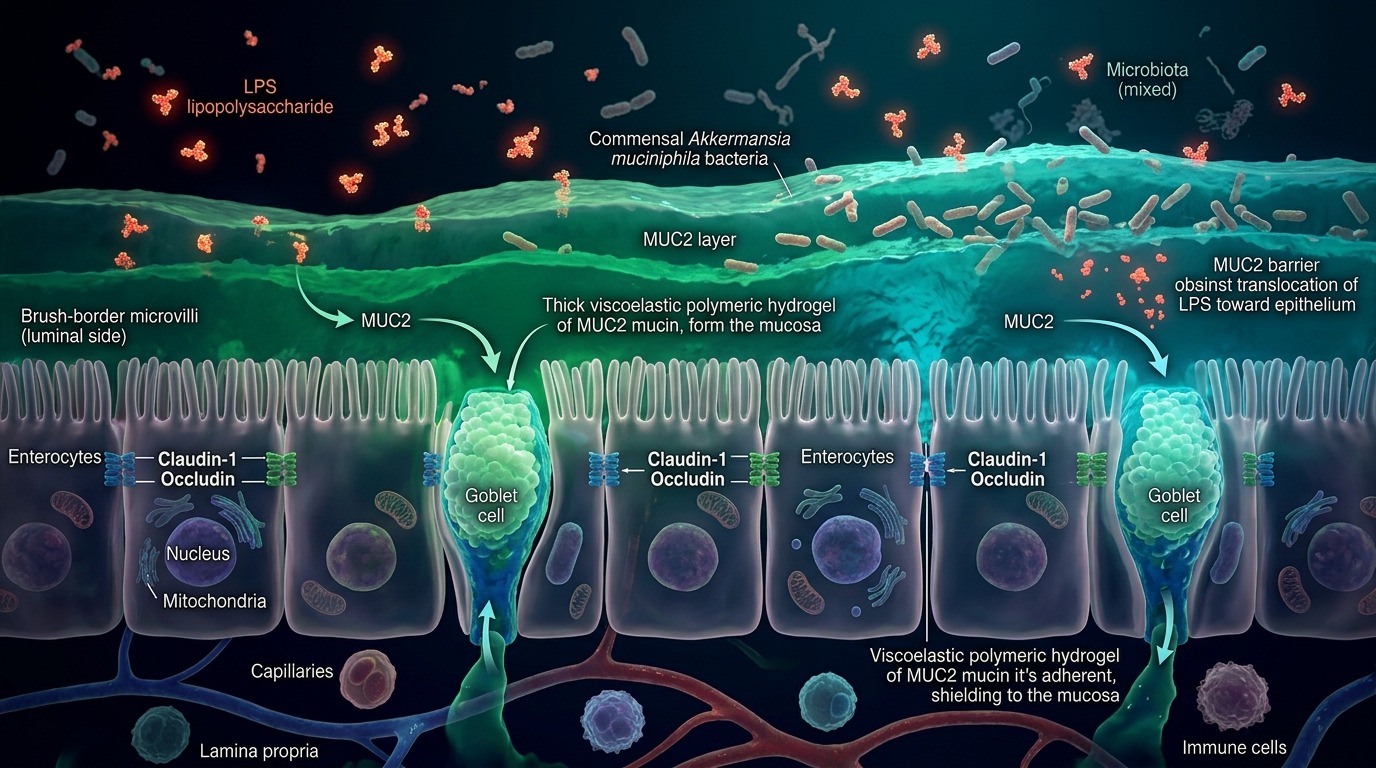
Biomedical molecular illustration for The Cellular Gatekeeper and the Zonulin Paradox: Deciphering Leaky Gut Syndrome in Metabolic Aging

"Imagine your intestinal barrier as a high-tech border checkpoint. The tight junction proteins act as diligent security officers, only allowing vetted nutrient molecules to pass. Zonulin functions like an emergency override command, ordering these officers to temporarily step aside for rapid transit. When this system malfunctions, the Zonulin command is issued incessantly without cause, leaving the border unguarded. This allows foreign 'saboteurs' like LPS to infiltrate the interior, causing systemic instability throughout the body."


Molecular Pathway Flowchart

Molecular Mechanism Pipeline
PHASE 01STIMULUS

Stimulus (Gliadin/Bacteria)

Next ➔Inspect
PHASE 02SIGNAL HUB

Cell Surface Receptor (PAR2/EGFR)

Next ➔Inspect
PHASE 03SIGNAL HUB

Zonulin Release

Next ➔Inspect
PHASE 04SIGNAL HUB

Dissociation of Occludin/Claudin Complex

Next ➔Inspect
PHASE 05SIGNAL HUB

Increased Permeability

Next ➔Inspect
PHASE 06PATHOLOGY

LPS Translocation

Next ➔Inspect
PHASE 07PATHOLOGY

Systemic Inflammation

Terminal ✓Inspect

1. Molecular Mechanisms: Zonulin as the Molecular Betrayer

Zonulin is an endogenous regulatory protein that plays a critical role in controlling the permeability of tight junctions between intestinal epithelial cells. Physiologically, Zonulin helps regulate the flow of fluids, nutrients, and immune cells through the paracellular space. However, under the influence of triggers such as Gliadin (a component of Gluten) or dysbiosis, the PAR2 (Protease-activated receptor 2) or EGFR (Epidermal growth factor receptor) receptors are over-activated. This leads to the release of Zonulin into the intestinal lumen. Zonulin then binds to receptors on epithelial cells, triggering an intracellular signaling cascade that phosphorylates junctional proteins like Occludin and Claudin. Consequently, the tight junction structure is disrupted, creating large gaps that allow macromolecules, particularly Lipopolysaccharide (LPS) from gram-negative bacterial cell walls, to penetrate the sub-mucosal layer. The presence of LPS in the bloodstream not only activates the innate immune system via TLR4 (Toll-like receptor 4) but also induces a state of chronic low-grade inflammation (metabolic endotoxemia), consuming the body's energy resources and impairing mitochondrial function.


2. Biological Paradox and Clinical Metrics

The paradox lies in the fact that Zonulin is essentially a biological defense mechanism, but in a modern environment saturated with triggers, it becomes a weapon of self-harm. We often confuse temporary digestive discomfort with chronic leaky gut. The table below contrasts clinical states to help you differentiate these conditions.

Physiological StateZonulin ConcentrationCirculating LPS StatusClinical Endpoint
Homeostatic BaselineLow / StableNegligibleOptimal nutrient absorption
Zonulin ActivationHigh / SpikesMinor leakage detectedMild inflammation, bloating
Chronic Leaky GutPersistent / ChronicHigh (Endotoxemia)Autoimmunity, metabolic disorder

Zonulin elevation is not merely a sign of digestive disease; it is an early biomarker of metabolic aging. When LPS infiltrates, the liver is overworked to neutralize toxins, leading to non-alcoholic fatty liver disease (NAFLD). Simultaneously, this inflammation exerts feedback on the central nervous system via the vagus nerve, explaining why gut issues are frequently accompanied by brain fog and cognitive decline in aging populations.


Practical Takeaways & Clinical Translation: 3. Clinical Strategies and Gut Barrier Optimization

To optimize the mucosal barrier, clinical strategy must extend beyond simple dietary restrictions. First, focus on stabilizing the microbiome with probiotics capable of inhibiting LPS-producing bacteria (such as Akkermansia muciniphila). Second, supplement with precursors that aid mucosal regeneration, such as L-Glutamine and Butyrate. Butyrate, a short-chain fatty acid produced by bacterial fermentation of fiber, serves as the primary 'fuel' for intestinal epithelial cells. Butyrate not only provides energy but also directly reinforces tight junction proteins, reducing reliance on Zonulin signaling. Furthermore, stress management is paramount; excess cortisol weakens the gut immune system, making the mucosa more vulnerable to triggers. Safety recommendation: Before initiating any supplementation protocol, perform quantitative Zonulin testing (stool or blood) to determine the actual level of permeability. Avoid overusing non-steroidal anti-inflammatory drugs (NSAIDs) as they are primary agents that directly damage tight junctions, exacerbating leaky gut. Prioritize polyphenol-rich foods such as green tea and berries, as they possess the ability to inhibit the PAR2 pathway, preventing Zonulin release at the source.

§ 6 · References & Primary Evidence

Verified Source List.

References indexed via NCBI PubMed & CrossRef

  1. 01
    Zonulin and its regulation of intestinal barrier function: the biological door to inflammation, autoimmunity, and cancer

    Physiol Rev · 2011

    Zonulin is the sole physiological mediator known to reversibly regulate intestinal paracellular permeability. Elevated expression orchestrates mucosal barrier loss and drives systemic autoimmunity.

    Landmark Physiological Reviewn = systematic/in-vitro
  2. 02
    Zonulin, regulation of tight junctions, and autoimmune diseases

    Ann N Y Acad Sci · 2012

    Examines the molecular cascade through which Zonulin uncouples tight junction protein complexes, facilitating macromolecular translocation.

    Mechanistic Synthesis and Clinical Translationn = systematic/in-vitro
  3. 03
    Zonulin, a newly discovered modulator of intestinal permeability, and its expression in coeliac disease

    Lancet · 2000

    Pioneering report identifying Zonulin as a novel human intestinal protein regulating macromolecular trafficking across tight junctions.

    Foundational Discovery Studyn = systematic/in-vitro
Interactive Laboratory Simulation

Model calculations execute entirely client-side.

Gizmo 02Bản đồ Con đường Tín hiệu & Thụ thể Tế bào
kịch bản mẫu

Điều khiển tham số

Thư viện hoạt chất

Thụ thể tiếp nhận

Tiểu đơn vị IKKβ / NF-κB p65

0 byte truyền ngoài

MÀNG TẾ BÀO (PLASMA MEMBRANE)Curcumin (Tinh chất Nghệ)CUCurcuminSulforaphane (Mầm Súp Lơ)SUSulforaphaneBerberine (Cây Hoàng Liên)BEBerberineQuercetin (Vỏ Táo & Hành Tây)QUQuercetinNF-κB THỤ THỂ↓Giảm phosphory↓Ngăn thoái giá↓Chặn chuyển vị↓Giảm các chất NHÂN TẾ BÀOADN → mARNSƠ ĐỒ MÔ PHỎNG — KHÔNG THEO TỶ LỆ TUYỆT ĐỐI

Đích tác động

NF-κB

Nút hạ nguồn

4vị trí

Chiều tác động

GIẢMđiều hòa

Khoang tế bào

BÀO TƯƠNG→NHÂN

Phân tích khoa học

Curcumin (Tinh chất Nghệ) → Các phân tử curcuminoids làm ngắt quãng dòng tín hiệu viêm kinh điển NF-κB ngay tại nút IKKβ, ngăn chặn giải phóng phức hợp gây viêm.Chuỗi tác động hạ nguồn: ↓ Giảm phosphoryl hóa IKKβ · ↓ Ngăn thoái giáng IκBα · ↓ Chặn chuyển vị p65 vào nhân · ↓ Giảm các chất viêm TNF-α, IL-6, COX-2

💡 Góc Giải Thích Y Khoa Dễ Hiểu

Hiểu sâu bản chất sinh hóa của tế bào qua những hình tượng ẩn dụ thực tế:

NF-κB NODE
Cắt đứt dây chuông báo động viêm nhiễm NF-κB

NF-κB giống như chiếc 'chuông báo cháy' của tế bào. Khi bị tổn thương, stress oxy hóa hoặc vi khuẩn kích thích, chiếc chuông này reo liên hồi gây sưng đau, viêm khớp và viêm mạn tính. Curcumin đi thẳng vào nút IKKβ và 'ngắt dây chuông', dập tắt tín hiệu viêm ngay từ tế bào chất trước khi nó kịp kích hoạt nhân tế bào sản sinh độc tố viêm.

Ý nghĩa Lâm sàng Thực tế

Giảm sưng đau khớp, hạ chỉ số viêm hs-CRP và bảo vệ niêm mạc ruột.

Nguồn chiết xuất: Củ nghệ vàng (Curcuma longa)
Share this Dispatch
CH

Dr. Xuan Chien Hoang

Doctor of Natural Sciences (Univ. of Hamburg) · Founder, Lava Health GmbH

Biomedical scientist and product developer with over a decade of international experience in Germany and APAC. Author of The Cancer Code (Amazon: eBook, Paperback, Hardcover). Pioneering the East-West botanical bridge, bioavailability enhancement, and data-driven HealthTech.

PHYTOCODEX · WEEKLY BRIEF

Evidence-Based Biomedical Intelligence Straight to Your Inbox

Deep-dives into bioavailability kinetics, cellular pathways, interactive simulation models, and East-West ethnobotanicals by Dr. Xuan Chien Hoang. Zero spam, unsubscribe anytime.

GDPR compliant. 1-click unsubscribe anytime.
Related Analytical Dispatches
Metabolic

Sirt6: Người gác đền của bộ gen và chìa khóa cho sự trường thọ tế bào

Nhiều người lầm tưởng rằng lão hóa là một quá trình không thể đảo ngược do sự tích tụ sai hỏng ngẫu nhiên. Tuy nhiên, khoa học hiện đại đã xác định được một 'người gác đền' phân tử mang tên Sirt6. Bài viết này bóc tách nghịch lý sinh học: tại sao việc tăng cường enzyme này không chỉ đơn thuần là sửa chữa DNA, mà còn là công tắc điều chỉnh nhịp sinh học và chuyển hóa năng lượng, giúp tế bào duy trì sự trẻ trung bất chấp thời gian.

Open Dispatch
Metabolic

Sirt6: The Guardian of the Genome and the Key to Cellular Longevity

Many assume aging is an irreversible process caused by random damage accumulation. However, modern science has identified a molecular guardian named Sirt6. This article dissects the biological paradox: why enhancing this enzyme is not merely about DNA repair, but also a master switch for circadian rhythms and metabolic flux, enabling cells to maintain youthful function despite the passage of time.

Open Dispatch
Gut

Cánh cửa tế bào và nghịch lý Zonulin: Giải mã hội chứng rò rỉ ruột trong lão hóa chuyển hóa

Hội chứng rò rỉ ruột thường bị hiểu lầm là sự tổn thương vật lý đơn thuần của niêm mạc. Thực tế, đây là một quá trình điều hòa phân tử phức tạp liên quan đến protein Zonulin, làm mất khả năng kiểm soát của các mối nối chặt (tight junctions). Bài viết bóc tách cơ chế chuyển hóa khiến nội độc tố LPS tràn vào tuần hoàn, kích hoạt phản ứng viêm hệ thống và đẩy nhanh quá trình lão hóa tế bào.

Open Dispatch
The Cellular Gatekeeper and the Zonulin Paradox: Deciphering Leaky Gut Syndrome in Metabolic Aging · Phytocodex · Phytocodex