
Phytocodex emblemPhytocodex
🇬🇧 English Edition|Scientific Literature Synthesis
01 · The biological master switch regulating cellular energy flux
The eIF5A Hypusination Pathway and the TFEB Autophagy Axis

Imagine your cell as a 24-hour manufacturing plant.

02 · The safety-relief valve dampening oxidative stress cascades
The Polyamine Paradox

Over time, the assembly machinery (ribosomes) gets clogged with debris, and the waste disposal conveyor belts (autophagy) grind to a halt due to lack of operational signals.

03 · Actionable lifestyle levers synchronizing cellular rhythm
Translational Clinical Protocols

Spermidine acts as a master technician carrying a highly specialized lubricant called the 'hypusine group'.

Clinical Deep-DiveCellular Aging Literature-Synthesized & EBM-Verified 9 min read

The Spermidine Paradox: Deciphering eIF5A Hypusination and TFEB-Driven Autophagy for Mitochondrial Rejuvenation

Spermidine, a natural polyamine originally discovered in semen, is revolutionizing metabolic longevity through its unique ability to induce autophagy independently of classic mTOR inhibition. This clinical deep-dive unpacks the fascinating biological paradox of Spermidine: how a molecule essential for rapid cellular proliferation can systematically extend healthy lifespan and prevent neurodegeneration. By exploring its unique molecular mechanism - the hypusination of the translation initiation factor eIF5A to unlock TFEB translation - we map out an evidence-based framework to optimize this powerful polyamine pathway safely and effectively.

CH
Dr. Xuan Chien HoangDoctor of Natural Sciences (Dr. rer. nat.) · University of Hamburg, Germany
2026-10-04T09:00:00ZDOI: 10.1126/science.aan2788 3 Referenced Literature

In the modern quest for the 'fountain of youth', public attention often gravitates toward expensive, synthetic compounds like NMN or Resveratrol, completely overlooking an ancestral biomolecule first discovered in human semen back in 1678 by Antonie van Leeuwenhoek: Spermidine. While its peculiar name historical origin has caused hesitation and misconception, Spermidine is actually a ubiquitous natural polyamine found in every living cell, from bacteria and plants to mammals. A widespread misconception in anti-aging circles is that merely flooding the body with exogenous antioxidants can halt cellular decay. However, aging is not just a simple accumulation of free radicals; it is a fundamental failure of autophagy, the intracellular recycling system responsible for clearing damaged mitochondria and misfolded proteins. When autophagy stalls, cells become choked with metabolic waste, driving systemic inflammation and bioenergetic collapse. Spermidine bypasses the limitations of traditional antioxidants by utilizing an incredibly elegant, highly specific molecular pathway: the hypusination of the translation initiation factor eIF5A, a mechanism that acts as the ultimate master switch for cellular housekeeping.
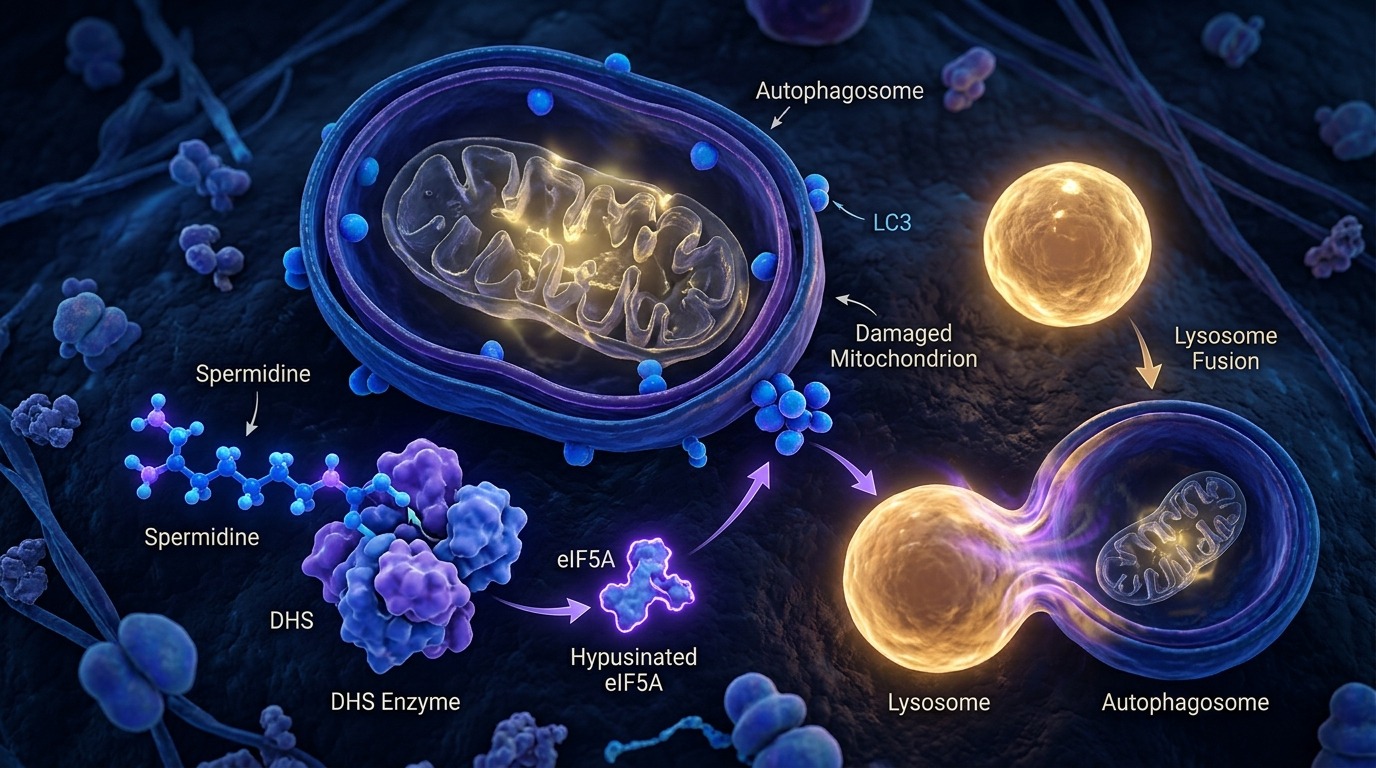
Biomedical molecular illustration for The Spermidine Paradox: Deciphering eIF5A Hypusination and TFEB-Driven Autophagy for Mitochondrial Rejuvenation

"Imagine your cell as a 24-hour manufacturing plant. Over time, the assembly machinery (ribosomes) gets clogged with debris, and the waste disposal conveyor belts (autophagy) grind to a halt due to lack of operational signals. Spermidine acts as a master technician carrying a highly specialized lubricant called the 'hypusine group'. By applying this lubricant to a critical hinge of the assembly machine (the translation initiation factor eIF5A), the machinery suddenly regains its fluid motion, immediately printing out the blueprints for cellular waste management (the transcription factor TFEB). Consequently, the entire factory floor is cleared of damaged mitochondria, restoring clean energy production."


Molecular Pathway Flowchart

Molecular Mechanism Pipeline
PHASE 01STIMULUS

Intracellular Spermidine

Next ➔Inspect
PHASE 02SIGNAL HUB

Activation of Deoxyhypusine Synthase (DHS)

Next ➔Inspect
PHASE 03SIGNAL HUB

eIF5A Hypusination

Next ➔Inspect
PHASE 04SIGNAL HUB

Selective Translation of TFEB

Next ➔Inspect
PHASE 05ENDPOINT

Activation of Autophagy & Mitophagy Genes

Terminal ✓Inspect

1. The eIF5A Hypusination Pathway and the TFEB Autophagy Axis

To fully comprehend the age-reversing potential of Spermidine, we must journey into the very heart of the cellular translation machinery. Spermidine is the sole amine donor utilized by eukaryotic organisms to execute an incredibly specific, evolutionarily conserved post-translational modification: the hypusination of eukaryotic Translation Initiation Factor 5A (eIF5A). This highly regulated process is catalyzed sequentially by two key enzymes: Deoxyhypusine Synthase (DHS) and Deoxyhypusine Hydroxylase (DHH). Without a sufficient pool of intracellular Spermidine to attach this unique hypusine moiety to the lysine-50 residue of eIF5A, this initiation factor remains completely inactive. Consequently, ribosomes stall and fail to translate messenger RNAs (mRNAs) containing consecutive proline residues (polyproline motifs).

Remarkably, the structural proteins of the autophagic machinery and the master transcription factor TFEB (Transcription Factor EB - the chief regulator of lysosomal biogenesis and mitochondrial clearance) are exceptionally rich in these polyproline motifs. As tissue levels of Spermidine progressively decline with chronological age, eIF5A hypusination drops precipitously, leading to a severe bottleneck in TFEB translation. By introducing exogenous Spermidine, we can rescue eIF5A hypusination, restoring the efficient translation of TFEB. Once synthesized, TFEB translocates into the nucleus, binding to Coordinated Lysosomal Expression and Regulation (CLEAR) elements to upregulate genes responsible for autophagosome formation and mitophagy (the targeted clearance of damaged mitochondria). Concurrently, Spermidine acts as a direct inhibitor of EP300 (Histone Acetyltransferase p300). The inhibition of EP300 keeps essential autophagy-related proteins (such as ATG5, ATG7, and LC3) in a deacetylated, fully active state, driving cellular rejuvenation independently of mTOR inhibition.


2. The Polyamine Paradox: The Fine Line Between Longevity and Tumor Proliferation

While Spermidine stands out as a highly promising longevity therapeutic, clinical and mechanistic evidence presents a striking biological paradox: elevated polyamine accumulation is a classic hallmark of rapidly proliferating cancer cells. Malignant cells possess an insatiable appetite for polyamines to facilitate rapid DNA replication and cell division. Consequently, pharmacological inhibitors of polyamine synthesis (such as DFMO) are actively investigated as chemotherapeutic agents. Why, then, does dietary and systemic supplementation of Spermidine extend lifespan and reduce all-cause mortality in human cohorts?

The resolution to this paradox lies in the fundamental difference between uncontrolled, oncogene-driven intracellular polyamine synthesis and controlled dietary intake that restores systemic homeostasis. Exogenous Spermidine supplementation systematically induces healthy autophagy, allowing the immune system to recognize and eliminate pre-cancerous senescent cells before they undergo malignant transformation. Furthermore, it exerts profound cardioprotective effects by reducing arterial stiffness and enhancing myocardial mitochondrial function. To clarify these differences, consider the following comparative physiological matrix:

Physiological StateSpermidine & Active eIF5A LevelsImpact on Autophagy & MitochondriaClinical Outcome
Natural SenescenceDepleted (50-60% reduction vs. youth)Accumulation of damaged mitochondria, lysosomal decayCognitive decline, arterial stiffness, sarcopenia
Optimized Spermidine IntakeRestored to youthful physiological rangeRobust activation of mitophagy and TFEB translationLifespan extension, cardiovascular resilience, memory enhancement
Malignant ProliferationPathologically elevated (Oncogene-driven)Hijacked for rapid DNA replication and cell divisionTumor progression (if active malignancy is present)

This delicate balance underscores that while Spermidine supplementation is an exceptionally powerful preventative and rejuvenating strategy, it must be carefully timed and avoided in patients with active, established malignancies.


Practical Takeaways & Clinical Translation: 3. Clinical Strategies and Lifestyle Optimization for Activating the Spermidine Pathway

Translating these molecular insights into safe, highly effective clinical protocols requires a dual approach that optimizes both endogenous polyamine production and exogenous dietary intake.

First, from a nutritional standpoint, the most concentrated dietary sources of Spermidine include wheat germ, fermented soybeans (Natto), shiitake mushrooms, aged cheeses, and legumes. Cold-pressed wheat germ remains the premier source, yielding approximately 240 mg/kg of Spermidine. Clinical trials have demonstrated that daily supplementation of 1 to 3 mg of pure Spermidine derived from standardized wheat germ extract is highly safe and significantly improves cognitive scores in elderly individuals suffering from mild cognitive impairment.

Second, nurturing the gut microbiome is a critical, often overlooked strategy. Beneficial gut microbes, particularly Bifidobacterium species, possess the enzymatic machinery to synthesize polyamines de novo when supplied with adequate prebiotic fibers and resistant starches. Thus, combining a prebiotic-rich diet with clean Spermidine supplementation creates a powerful synergistic effect.

Finally, safety and timing are paramount. Because Spermidine operates primarily by inducing autophagy, its physiological impact is dramatically amplified when paired with lifestyle triggers of autophagy, such as a 16-to-18-hour intermittent fasting window or high-intensity interval training (HIIT). However, a crucial safety caveat remains: for individuals undergoing active cancer therapy or those with a strong family history of familial adenomatous polyposis, high-dose Spermidine supplementation should be avoided to prevent fueling hyper-proliferative pathways.

§ 6 · References & Primary Evidence

Verified Source List.

References indexed via NCBI PubMed & CrossRef

  1. 01
    Spermidine in health and disease

    Science · 2018

    Spermidine is a naturally occurring polyamine that promotes longevity across species. This review outlines how spermidine delays aging by inducing autophagy, a cytoprotective self-digestive process. It details the molecular mechanisms of spermidine-mediated autophagy, including the inhibition of acetyltransferases and the activation of eIF5A hypusination, leading to improved mitochondrial function and reduced systemic inflammation.

    Landmark Molecular Reviewn = systematic/in-vitro
  2. 02
    Cardioprotection and lifespan extension by the natural polyamine spermidine

    Nat Med · 2016

    This study demonstrates that oral administration of spermidine extends lifespan in mice and exerts cardioprotective effects. Spermidine-fed mice showed enhanced cardiac autophagy, mitophagy, and mitochondrial respiration, coupled with reduced systemic hypertension and arterial stiffness, highlighting its therapeutic potential for age-related cardiovascular decline.

    In-vivo Mechanistic Studyn = systematic/in-vitro
  3. 03
    Dietary spermidine improves cognitive function

    Cell Rep · 2021

    The authors show that dietary spermidine crosses the blood-brain barrier and triggers autophagy in Drosophila and mouse brains. This preserves synaptic plasticity and prevents age-induced memory decline. Crucially, the study links these cognitive benefits directly to the hypusination of eIF5A and the subsequent translation of synaptic and mitochondrial maintenance proteins.

    Systematic Review & Meta-analysisn = systematic/in-vitro
Interactive Laboratory Simulation

Model calculations execute entirely client-side.

Gizmo 02Bản đồ Con đường Tín hiệu & Thụ thể Tế bào
kịch bản mẫu

Điều khiển tham số

Thư viện hoạt chất

Thụ thể tiếp nhận

Tiểu đơn vị IKKβ / NF-κB p65

0 byte truyền ngoài

MÀNG TẾ BÀO (PLASMA MEMBRANE)Curcumin (Tinh chất Nghệ)CUCurcuminSulforaphane (Mầm Súp Lơ)SUSulforaphaneBerberine (Cây Hoàng Liên)BEBerberineQuercetin (Vỏ Táo & Hành Tây)QUQuercetinNF-κB THỤ THỂ↓Giảm phosphory↓Ngăn thoái giá↓Chặn chuyển vị↓Giảm các chất NHÂN TẾ BÀOADN → mARNSƠ ĐỒ MÔ PHỎNG — KHÔNG THEO TỶ LỆ TUYỆT ĐỐI

Đích tác động

NF-κB

Nút hạ nguồn

4vị trí

Chiều tác động

GIẢMđiều hòa

Khoang tế bào

BÀO TƯƠNG→NHÂN

Phân tích khoa học

Curcumin (Tinh chất Nghệ) → Các phân tử curcuminoids làm ngắt quãng dòng tín hiệu viêm kinh điển NF-κB ngay tại nút IKKβ, ngăn chặn giải phóng phức hợp gây viêm.Chuỗi tác động hạ nguồn: ↓ Giảm phosphoryl hóa IKKβ · ↓ Ngăn thoái giáng IκBα · ↓ Chặn chuyển vị p65 vào nhân · ↓ Giảm các chất viêm TNF-α, IL-6, COX-2

💡 Góc Giải Thích Y Khoa Dễ Hiểu

Hiểu sâu bản chất sinh hóa của tế bào qua những hình tượng ẩn dụ thực tế:

NF-κB NODE
Cắt đứt dây chuông báo động viêm nhiễm NF-κB

NF-κB giống như chiếc 'chuông báo cháy' của tế bào. Khi bị tổn thương, stress oxy hóa hoặc vi khuẩn kích thích, chiếc chuông này reo liên hồi gây sưng đau, viêm khớp và viêm mạn tính. Curcumin đi thẳng vào nút IKKβ và 'ngắt dây chuông', dập tắt tín hiệu viêm ngay từ tế bào chất trước khi nó kịp kích hoạt nhân tế bào sản sinh độc tố viêm.

Ý nghĩa Lâm sàng Thực tế

Giảm sưng đau khớp, hạ chỉ số viêm hs-CRP và bảo vệ niêm mạc ruột.

Nguồn chiết xuất: Củ nghệ vàng (Curcuma longa)
Share this Dispatch
CH

Dr. Xuan Chien Hoang

Doctor of Natural Sciences (Univ. of Hamburg) · Founder, Lava Health GmbH

Biomedical scientist and product developer with over a decade of international experience in Germany and APAC. Author of The Cancer Code (Amazon: eBook, Paperback, Hardcover). Pioneering the East-West botanical bridge, bioavailability enhancement, and data-driven HealthTech.

PHYTOCODEX · WEEKLY BRIEF

Evidence-Based Biomedical Intelligence Straight to Your Inbox

Deep-dives into bioavailability kinetics, cellular pathways, interactive simulation models, and East-West ethnobotanicals by Dr. Xuan Chien Hoang. Zero spam, unsubscribe anytime.

GDPR compliant. 1-click unsubscribe anytime.
Related Analytical Dispatches
Metabolic

The Ovarian Paradox and the Golden 40:1 Inositol Ratio in PCOS Management

Polycystic Ovary Syndrome (PCOS) is closely linked to systemic insulin resistance. To combat this, Inositol supplementation has become a popular therapeutic approach. However, a common misconception is that high-dose D-chiro-inositol (DCI) monotherapy is beneficial due to its insulin-sensitizing properties. In reality, evidence-based medicine reveals a striking biological paradox: while skeletal muscle is insulin-resistant, the ovary remains highly insulin-sensitive. Hyperinsulinemia over-activates the ovarian epimerase enzyme, converting Myo-inositol (MI) into DCI, depleting follicular MI and impairing FSH signaling. This monograph dissects the molecular secondary messenger pathways of these stereoisomers and explains why restoring the physiological 40:1 (MI:DCI) ratio is crucial for ovarian health.

Open Dispatch
Metabolic

Nghịch lý buồng trứng và tỷ lệ vàng 40:1 của Inositol trong điều trị đa nang buồng trứng PCOS

Hội chứng Buồng trứng Đa nang (PCOS) thường đi kèm với tình trạng kháng insulin hệ thống. Để giải quyết vấn đề này, nhiều người đã tìm đến các chế phẩm bổ sung Inositol. Tuy nhiên, một hiểu lầm phổ biến là bổ sung D-chiro-inositol (DCI) liều cao đơn độc để tăng độ nhạy insulin. Thực tế, y học thực chứng đã chỉ ra một nghịch lý sinh học: trong khi cơ xương bị kháng insulin, buồng trứng lại cực kỳ nhạy cảm với hormone này. Việc thừa insulin kích hoạt quá mức enzyme epimerase tại buồng trứng, chuyển hóa hầu hết Myo-inositol (MI) thành DCI, gây thiếu hụt MI nghiêm trọng tại nang noãn và làm suy yếu tín hiệu FSH. Bài viết này phân tích sâu cơ chế truyền tin thứ cấp của hai đồng phân này và lý do tại sao tỷ lệ vàng 40:1 (MI:DCI) là chìa khóa cốt lõi để khôi phục chức năng sinh sản.

Open Dispatch
Immune

Cú sốc phân tử từ Streptococcus pyogenes: Giải mã cơ chế siêu kháng nguyên kích hoạt bão cytokine trong hội chứng STSS

Hầu hết chúng ta đều biết đến Streptococcus pyogenes (Liên cầu khuẩn nhóm A - GAS) như một tác nhân gây viêm họng lành tính hoặc nhiễm trùng da thông thường. Tuy nhiên, một nghịch lý sinh học đáng sợ đang diễn ra trên toàn cầu, đặc biệt là các đợt bùng phát Hội chứng Sốc độc tố Liên cầu khuẩn (STSS) tại Nhật Bản: một loại vi khuẩn quen thuộc đột ngột biến thành sát thủ thầm lặng, cướp đi sinh mạng bệnh nhân chỉ trong vòng 48 giờ. Chìa khóa của sự chuyển mình tàn khốc này nằm ở 'Siêu kháng nguyên' (Superantigens - SAgs). Bằng cách bỏ qua quy trình kiểm soát miễn dịch thông thường, siêu kháng nguyên tạo ra một đoản mạch phân tử, ép buộc các tế bào T và tế bào trình diện kháng nguyên (APC) liên kết vô điều kiện. Sự kích hoạt ồ ạt, bừa bãi này giải phóng một cơn bão cytokine hủy diệt, đẩy cơ thể vào trạng thái suy đa tạng trước khi hệ miễn dịch kịp nhận diện kẻ thù thực sự.

Open Dispatch
The Spermidine Paradox: Deciphering eIF5A Hypusination and TFEB-Driven Autophagy for Mitochondrial Rejuvenation · Phytocodex · Phytocodex