
Phytocodex emblemPhytocodex
🇻🇳 Phiên bản Tiếng Việt|Diễn giải y sinh thực chứng · Dễ hiểu
01 · Pure chemical fuel directly igniting the inner mitochondrial furnace
Succinate Metabolite

Succinate enters brown adipocytes via MCT transport, delivering high-density reducing equivalents directly to Complex II to fuel non-shivering heat.

02 · A controlled flare signal triggering emergency cellular valves
Physiological ROS Burst

Transient reactive oxygen species (ROS) produced by succinate oxidation act not as destructive toxins, but as critical cues unlocking UCP1 proton pores.

03 · Venting the steam turbine to generate pure thermal comfort
Proton Uncoupling

Protons bypass ATP synthase, dissipating electrochemical gradients directly into heat and accelerating substrate clearance from blood.

Clinical Deep-DiveCellular Aging Literature-Synthesized & EBM-Verified 12 min read

The Succinate-UCP1 Axis in Brown Adipose Tissue: Unlocking Mitochondrial Uncoupling for Metabolic Longevity

Modern biomedical research has completely revolutionized our understanding of adipose tissue, shifting its paradigm from a passive energy storage depot to a highly active endocrine organ. At the heart of this revolution is brown adipose tissue (BAT) and its capacity for non-shivering thermogenesis mediated by mitochondrial Uncoupling Protein 1 (UCP1). This monograph dissects the unexpected role of succinate, a classic Krebs cycle intermediate, acting as a master signaling molecule that drives UCP1 activation via localized, selective reactive oxygen species (ROS) production at complex II. By reprogramming this mitochondrial pathway, we can actively dissipate excess energy, reverse insulin resistance, mitigate systemic inflammation, and unlock a groundbreaking frontier in longevity medicine.

CH
Dr. Xuan Chien HoangDoctor of Natural Sciences (Dr. rer. nat.) · University of Hamburg, Germany
2026-10-02T09:00:00ZDOI: 10.1038/s41586-018-0353-2 1 Referenced Literature

For decades, modern medicine viewed adipose tissue merely as a passive energy storage depot, a redundant warehouse driving obesity and cardiovascular metabolic diseases. However, the rediscovery of active Brown Adipose Tissue (BAT) in adult humans has completely revolutionized classical physiological paradigms. Unlike White Adipose Tissue (WAT), which is specialized in storing triglycerides, brown fat is a hyperactive metabolic and endocrine organ, boasting an exceptionally high mitochondrial density and the exclusive expression of Uncoupling Protein 1 (UCP1). By dissipating energy as heat instead of synthesizing ATP, BAT acts as a biological radiator, actively burning excess glucose and lipids. Recently, pioneering studies have revealed that succinate, a classic Krebs cycle intermediate, is not just a metabolic fuel but a master signaling molecule that drives thermogenesis through selective reactive oxygen species (ROS) production at complex II of the electron transport chain. Deciphering this molecular switch opens a new era in treating obesity, type 2 diabetes, and extending metabolic lifespan by reprogramming mitochondrial bioenergetics.
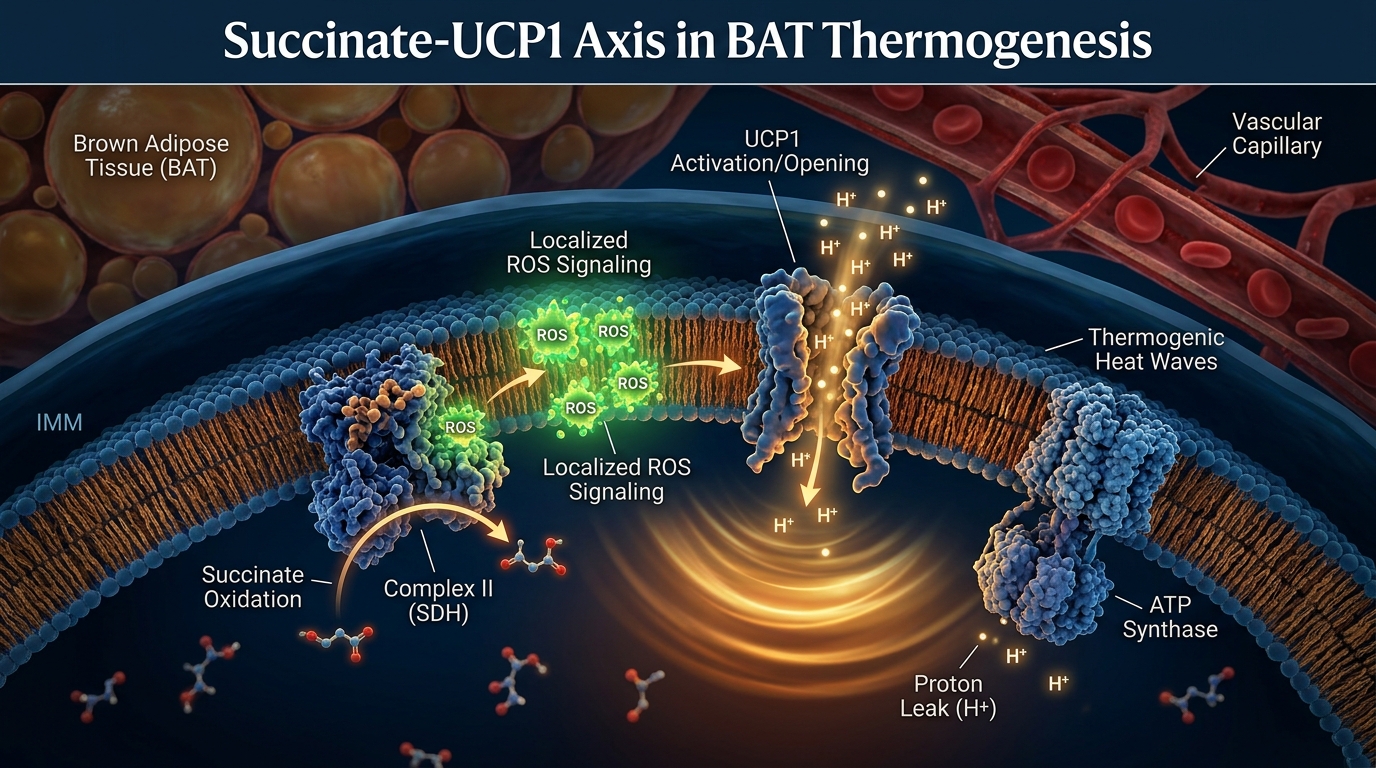
Biomedical molecular illustration for The Succinate-UCP1 Axis in Brown Adipose Tissue: Unlocking Mitochondrial Uncoupling for Metabolic Longevity

"Imagine mitochondria as busy nuclear power plants in the cell. Normally, the water flow (protons) rushes through the turbine (ATP synthase) to generate electricity (ATP) stored for the city. However, when a harsh winter strikes, the city desperately needs warmth rather than more electricity. At this moment, the UCP1 (Uncoupling Protein 1) bypass valve is opened, allowing the proton flow to rush freely through an auxiliary dam without turning the generator turbine. The entire kinetic energy of the flow is instantly converted into pure thermal energy, warming up the body. Succinate acts as a powerful chemical booster, throwing this bypass valve wide open by driving the electron transport chain to its absolute limit."


Molecular Pathway Flowchart

Molecular Mechanism Pipeline
PHASE 01STIMULUS

Cold / Adrenergic Activation

Next ➔Inspect
PHASE 02SIGNAL HUB

Elevated cAMP & PKA

Next ➔Inspect
PHASE 03SIGNAL HUB

Extracellular Succinate Influx

Next ➔Inspect
PHASE 04SIGNAL HUB

SLC25A10 Mitochondrial Import

Next ➔Inspect
PHASE 05SIGNAL HUB

Rapid Complex II (SDH) Oxidation

Next ➔Inspect
PHASE 06SIGNAL HUB

Reverse Electron Transport (RET) to Complex I

Next ➔Inspect
PHASE 07SIGNAL HUB

Selective Complex I ROS Burst

Next ➔Inspect
PHASE 08SIGNAL HUB

UCP1 Cysteine-253 Sulfenylation

Next ➔Inspect
PHASE 09SIGNAL HUB

UCP1 Channel Opening & Proton Leak

Next ➔Inspect
PHASE 010ENDPOINT

Non-Shivering Thermogenesis & Energy Dissipation

Terminal ✓Inspect

1. Molecular Machinery of Non-Shivering Thermogenesis via the Succinate-UCP1 Axis

Non-shivering thermogenesis in brown adipose tissue (BAT) is primarily driven by Uncoupling Protein 1 (UCP1), a specialized transmembrane protein located in the Inner Mitochondrial Membrane (IMM). Upon cold exposure, the sympathetic nervous system releases norepinephrine, which binds to beta-3 adrenergic receptors (B3-AR) on the surface of brown adipocytes. This binding activates adenylyl cyclase, elevating intracellular cAMP levels and activating protein kinase A (PKA). Activated PKA subsequently phosphorylates hormone-sensitive lipase (HSL), promoting lipolysis to release free fatty acids (FFAs). These FFAs serve not only as substrates for beta-oxidation but also act as direct allosteric activators of UCP1.

However, a landmark discovery identified succinate as the ultimate metabolic trigger for this thermogenic process. Upon activation, BAT actively sequester extracellular succinate from the circulation via sodium-dependent dicarboxylate transporters (such as SLC25A10 on the mitochondrial membrane). Within the mitochondrial matrix, succinate is rapidly oxidized by Succinate Dehydrogenase (SDH, also known as Complex II of the electron transport chain). This rapid oxidation generates a high electron pressure, forcing electrons backward from Complex II to Complex I in a process known as Reverse Electron Transport (RET). This RET event generates localized, selective reactive oxygen species (ROS) at Complex I. Rather than causing cellular damage, this localized ROS serves as a crucial physiological signal, driving the sulfenylation of a sensitive Cysteine-253 (Cys253) residue on the UCP1 protein. This post-translational modification alters UCP1 conformation, releasing it from purine nucleotide (ATP/ADP) inhibition and allowing protons (H+) to leak back into the matrix. The kinetic energy of the proton gradient is thus dissipated entirely as heat.


2. The Biological Paradox: When ROS Becomes a Physiological Savior & Comparative Analysis

In classical biogerontology, reactive oxygen species (ROS) have long been vilified as toxic byproducts that damage DNA, membrane lipids, and proteins, ultimately driving cellular senescence. However, the Succinate-UCP1 axis exposes a beautiful biological paradox: RET-derived ROS is an obligatory and beneficial physiological signal. Without this localized ROS production, UCP1 remains locked in an inactive state by intracellular ATP, and thermogenesis is completely blunted. This is a prime example of mitochondrial hormesis (mitohormesis), where a transient, localized stressor triggers adaptive, survival-promoting metabolic pathways.

To understand the distinct physiological and clinical roles of different adipose tissues, consider the following comparative analysis:

Physiological & Clinical MarkersWhite Adipose (WAT)Brown Adipose (BAT)Beige Adipose (Beige)
Mitochondrial DensityVery lowExtremely highIntermediate to high
UCP1 ExpressionNegligibleConstitutively highHighly inducible
Lipid Droplet MorphologyUnilocular (Single large droplet)Multilocular (Multiple small droplets)Multilocular (Upon activation)
Cellular LineageMyf5-negative lineageMyf5-positive lineageMyf5-negative lineage
Primary FunctionExcess energy storage as triglyceridesNon-shivering thermogenesis, energy dissipationInducible thermogenesis upon stimuli
Metabolic ImpactPro-inflammatory, drives insulin resistanceEnhances insulin sensitivity, clears glucoseImproves systemic glucose tolerance
VascularizationPoorly developedExtremely richModerately developed

3. Translational Protocols & Clinical Strategies for BAT Activation

Actively harnessing the Succinate-UCP1 axis offers promising clinical avenues for treating obesity, metabolic syndrome, and extending healthspan. Below are evidence-based translational protocols: - Controlled Cold Thermogenesis: Daily exposure to mild cold temperatures (14 to 15 degrees C) for 2 hours has been shown to significantly increase BAT volume and metabolic activity in adult humans. This protocol stimulates sympathetic norepinephrine release, driving the cAMP-PKA cascade and accumulating endogenous succinate. - Nutraceutical Activators:

  1. Capsaicin and Capsinoids: Act as agonists of the TRPV1 receptor on sensory neurons in the gut, indirectly stimulating the sympathetic nervous system to upregulate UCP1 expression.
  2. Resveratrol and Quercetin: Activate SIRT1 and PGC-1alpha, promoting mitochondrial biogenesis and the browning of white adipose tissue.
  3. Ursolic Acid: Found in apple peels, it has been shown to increase skeletal muscle mass and brown fat thermogenesis by elevating circulating irisin levels. - Targeted Pharmacological Interventions: The use of novel selective beta-3 adrenergic receptor agonists (such as Mirabegron) has been clinically shown to robustly activate human BAT, raising resting metabolic rate and improving glucose tolerance without the adverse cardiovascular side effects associated with older generations. Combining B3-AR agonists with metabolic precursors like succinate represents a highly promising therapeutic frontier.
§ 6 · References & Primary Evidence

Verified Source List.

References indexed via NCBI PubMed & CrossRef

  1. 01
    Accumulation of succinate controls activation of adipose tissue thermogenesis

    Nature · 2018

    Thermogenic adipose tissue expends chemical energy as heat to counteract hypothermia and obesity. We demonstrate that selective accumulation of the Krebs cycle intermediate succinate is a primary metabolic driver of brown adipose tissue thermogenesis in response to cold exposure. Succinate oxidation by complex II rapidly initiates localized reactive oxygen species production, activating UCP1-dependent thermogenesis and protecting against diet-induced obesity.

    In-vivo mechanistic & metabolomic landmark studyn = systematic/in-vitro
Interactive Laboratory Simulation

Model calculations execute entirely client-side.

Gizmo 02Bản đồ Con đường Tín hiệu & Thụ thể Tế bào
kịch bản mẫu

Điều khiển tham số

Thư viện hoạt chất

Thụ thể tiếp nhận

Tiểu đơn vị IKKβ / NF-κB p65

0 byte truyền ngoài

MÀNG TẾ BÀO (PLASMA MEMBRANE)Curcumin (Tinh chất Nghệ)CUCurcuminSulforaphane (Mầm Súp Lơ)SUSulforaphaneBerberine (Cây Hoàng Liên)BEBerberineQuercetin (Vỏ Táo & Hành Tây)QUQuercetinNF-κB THỤ THỂ↓Giảm phosphory↓Ngăn thoái giá↓Chặn chuyển vị↓Giảm các chất NHÂN TẾ BÀOADN → mARNSƠ ĐỒ MÔ PHỎNG — KHÔNG THEO TỶ LỆ TUYỆT ĐỐI

Đích tác động

NF-κB

Nút hạ nguồn

4vị trí

Chiều tác động

GIẢMđiều hòa

Khoang tế bào

BÀO TƯƠNG→NHÂN

Phân tích khoa học

Curcumin (Tinh chất Nghệ) → Các phân tử curcuminoids làm ngắt quãng dòng tín hiệu viêm kinh điển NF-κB ngay tại nút IKKβ, ngăn chặn giải phóng phức hợp gây viêm.Chuỗi tác động hạ nguồn: ↓ Giảm phosphoryl hóa IKKβ · ↓ Ngăn thoái giáng IκBα · ↓ Chặn chuyển vị p65 vào nhân · ↓ Giảm các chất viêm TNF-α, IL-6, COX-2

💡 Góc Giải Thích Y Khoa Dễ Hiểu

Hiểu sâu bản chất sinh hóa của tế bào qua những hình tượng ẩn dụ thực tế:

NF-κB NODE
Cắt đứt dây chuông báo động viêm nhiễm NF-κB

NF-κB giống như chiếc 'chuông báo cháy' của tế bào. Khi bị tổn thương, stress oxy hóa hoặc vi khuẩn kích thích, chiếc chuông này reo liên hồi gây sưng đau, viêm khớp và viêm mạn tính. Curcumin đi thẳng vào nút IKKβ và 'ngắt dây chuông', dập tắt tín hiệu viêm ngay từ tế bào chất trước khi nó kịp kích hoạt nhân tế bào sản sinh độc tố viêm.

Ý nghĩa Lâm sàng Thực tế

Giảm sưng đau khớp, hạ chỉ số viêm hs-CRP và bảo vệ niêm mạc ruột.

Nguồn chiết xuất: Củ nghệ vàng (Curcuma longa)
Share this Dispatch
CH

Dr. Xuan Chien Hoang

Doctor of Natural Sciences (Univ. of Hamburg) · Founder, Lava Health GmbH

Biomedical scientist and product developer with over a decade of international experience in Germany and APAC. Author of The Cancer Code (Amazon: eBook, Paperback, Hardcover). Pioneering the East-West botanical bridge, bioavailability enhancement, and data-driven HealthTech.

PHYTOCODEX · WEEKLY BRIEF

Evidence-Based Biomedical Intelligence Straight to Your Inbox

Deep-dives into bioavailability kinetics, cellular pathways, interactive simulation models, and East-West ethnobotanicals by Dr. Xuan Chien Hoang. Zero spam, unsubscribe anytime.

GDPR compliant. 1-click unsubscribe anytime.
Related Analytical Dispatches
Cellular Aging

Urolithin A từ Quả Lựu: Cơ chế Kích hoạt Mitophagy Dọn dẹp Ty thể Độc lập với NAD+ Giúp Phục hồi Sức bền Cơ bắp

Nhiều người tin rằng chỉ cần uống nước ép lựu là đủ để có được các lợi ích trẻ hóa tế bào của Urolithin A. Tuy nhiên, sự thật sinh học phức tạp hơn nhiều: cơ thể chúng ta không tự sản sinh ra Urolithin A. Nó là sản phẩm chuyển hóa thứ cấp của hệ vi sinh đường ruột từ ellagitannins có trong lựu, và chỉ có khoảng 30 đến 40 phần trăm dân số sở hữu hệ vi sinh phù hợp để thực hiện quá trình chuyển đổi này. Bài viết bóc tách cơ chế phân tử độc đáo của Urolithin A trong việc kích hoạt mitophagy (quá trình tự thực ty thể) thông qua con đường độc lập với NAD+, giúp dọn dẹp các ty thể già cỗi, phục hồi hiệu suất cơ bắp mà không làm cạn kiệt nguồn dự trữ năng lượng nội bào.

Open Dispatch
Cellular Aging

Urolithin A from Pomegranate: Deciphering the NAD+ Independent Mitophagy Pathway for Muscle Recovery and Mitochondrial Longevity

While pomegranate is celebrated as an anti-aging superfood, drinking its juice rarely yields the therapeutic levels of its active metabolite, Urolithin A. This molecule is not directly present in pomegranates: instead, it requires specific gut microbiota to convert dietary ellagitannins into Urolithin A. Crucially, only 30 to 40 percent of humans possess the microbial profile capable of this conversion, leaving the majority as non-responders. This monograph dissects the molecular mechanism of Urolithin A as a first-in-class mitophagy activator that operates independently of the classic NAD+ pathway, bypassing cellular energy depletion to selectively clear damaged mitochondria, enhance ATP synthesis, and restore skeletal muscle function in aging populations.

Open Dispatch
Immune

Bóng Ma Dịch Hạch Từ Phòng Thí Nghiệm Nga: Giải Mã Cỗ Máy Tiêm Độc T3SS và Độc Lực Của Vi Khuẩn Yersinia pestis

Vụ việc rò rỉ mầm bệnh tại Viện Nghiên cứu Chống Dịch hạch Irkutsk (Nga) đặt giới y học toàn cầu vào tình trạng báo động đỏ. Yersinia pestis không chỉ là tác nhân gây nên thảm họa Cái Chết Đen trong lịch sử, mà còn sở hữu cỗ máy bơm độc lực Type III (T3SS) có khả năng tiêm thẳng protein độc tố Yop vào tế bào miễn dịch, làm tê liệt đại thực bào và biến lá phổi thành bãi chiến trường xuất huyết tử vong chỉ sau 48 giờ.

Open Dispatch
The Succinate-UCP1 Axis in Brown Adipose Tissue: Unlocking Mitochondrial Uncoupling for Metabolic Longevity · Phytocodex · Phytocodex