
Phytocodex emblemPhytocodex
🇬🇧 English Edition|Scientific Literature Synthesis
01 · A binary chemical grenade requiring a separate detonator fuse
Glucoraphanin & Myrosinase Enzyme

Cruciferous plants store precursor glucoraphanin and detonator myrosinase in separate compartments. Mastication or chopping ruptures cells, synthesizing sulforaphane.

02 · The crucial window allowing complete enzymatic synthesis before heat
The 'Chop & Hold' 40-Minute Protocol

Boiling water rapidly denatures fragile myrosinase proteins. Chopping raw broccoli and waiting 40 minutes lets sulforaphane fully generate prior to cooking.

03 · Cellular handcuffs tethering the master antioxidant commander
The Keap1-Nrf2 Master Switch

Sulforaphane modifies cysteine sensors on Keap1 handcuffs, freeing Nrf2 to migrate into the cell nucleus and transcribe hundreds of detoxifying genes.

Lab GizmoCellular Aging Literature-Synthesized & EBM-Verified 7 min read

The Nrf2 Activation Window from Sulforaphane: Why Over-Boiling Broccoli Destroys Its Anticancer Potential

Sulforaphane does not pre-exist in raw broccoli; it is synthesized only when myrosinase hydrolyzes glucoraphanin upon mastication or chopping. Discover the 4-hour golden window of endogenous Nrf2 detoxification and culinary strategies to preserve maximum bioactivity.

CH
Dr. Xuan Chien HoangDoctor of Natural Sciences (Dr. rer. nat.) · University of Hamburg, Germany
2026-07-21T09:00:00ZDOI: 10.1093/carcin/bgs275 2 Referenced Literature

In modern nutritional medicine, broccoli is often celebrated as the undisputed sovereign of cruciferous vegetables. Millions of wellness-conscious individuals regularly purchase heads of broccoli, boiling them until completely soft with the intention of purifying their bodies.

Yet viewed through the lens of botanical biochemistry, most people are inadvertently discarding up to 90% of the plant's most valuable bioactive payload right into the boiling pot.

The biochemical paradox is straightforward: Fresh broccoli contains virtually zero Sulforaphane!
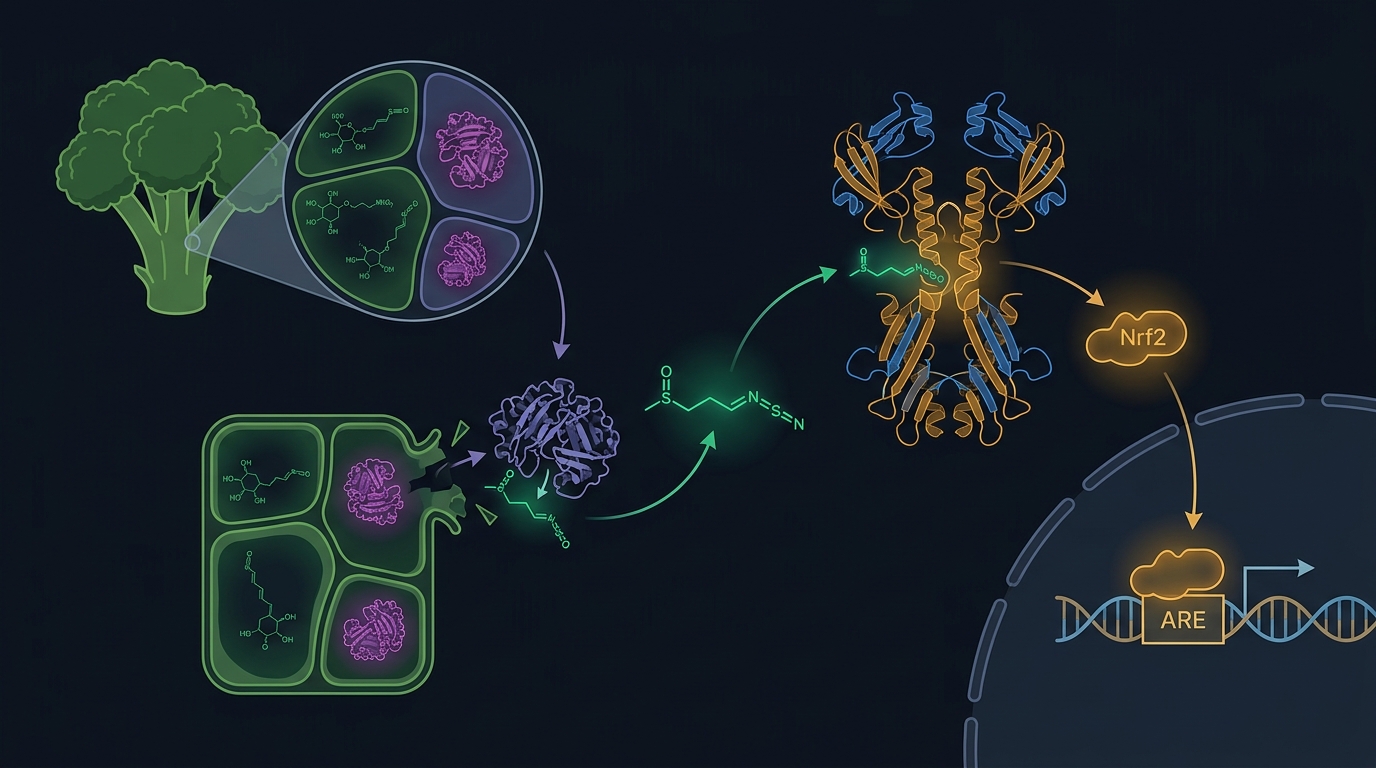
Myrosinase enzyme hydrolyzing glucoraphanin into sulforaphane, liberating Nrf2 into the cell nucleus

"A head of broccoli behaves like a two-part binary chemical grenade engineered by evolution to deter pests. The inactive precursor Glucoraphanin resides in one cellular compartment, while the catalytic detonator enzyme Myrosinase is sequestered in an entirely separate vacuole. Only when an insect bites (or human teeth crush) the cell wall do the two reactants mix, detonating the synthesis of active Sulforaphane. If you plunge raw broccoli directly into rolling boiling water from the start, high heat denatures the fragile protein fuse before the grenade can ever activate."


1. The Biochemical Pathway: From Mastication to Nuclear DNA

The conversion and downstream genetic signaling cascade follows a precise molecular sequence:

Molecular Mechanism Pipeline
PHASE 01STIMULUS

Chop / Chew Broccoli

Next ➔Inspect
PHASE 02SIGNAL HUB

Myrosinase hydrolyzes Glucoraphanin

Next ➔Inspect
PHASE 03SIGNAL HUB

Bioactive Sulforaphane

Next ➔Inspect
PHASE 04ENDPOINT

Keap1 Modification & Nrf2 Nuclear Translocation

Terminal ✓Inspect

The Indirect Free Radical Quenching Mechanism:

Unlike direct exogenous antioxidants such as vitamin C or vitamin E, which neutralize free radicals on a 1-to-1 stoichiometric basis (one antioxidant molecule quenches one free radical and is permanently spent):

  • Sulforaphane is a potent indirect antioxidant: By alkylating cysteine residues on the Keap1 sensor protein, it frees the master transcription factor Nrf2.
  • Liberated Nrf2 translocates directly into the nucleus, docks onto the Antioxidant Response Element (ARE) sequence, and commands the transcription of an entire suite of endogenous Phase II cytoprotective enzymes, including Glutathione S-transferase, NQO1, and Catalase.
  • A single molecule of Sulforaphane can catalyze the neutralization of millions of oxidative free radicals, conferring tissue protection that persists for days.

2. Preparation Methods vs Bioactive Recovery Rates

Preparation MethodThermal ExposureMyrosinase ViabilitySulforaphane Yield
Boiling in water > 5 minutesSustained 100°CCompletely destroyed (0%)Near zero (relies solely on minimal colonic microbiota conversion)
High-power microwavingLocalized 90 - 100°CRapid thermal denaturationBelow 15%
Gentle steaming (3-4 minutes)Core temperature < 70°CPreserves 70 - 80% of enzymeHighly elevated (optimal culinary bioavailability)
Raw chewing or blendingAmbient temperature100% enzyme preservedMaximum (highest instantaneous concentration)
Standardized sprout extractsLyophilized freeze-dryingCalibrated Sulforaphane yield20 to 50 times higher than mature florets

3. The 40-Minute "Chop & Hold" Protocol

If you prefer warm, tender cooked broccoli over raw vegetables, apply this simple food-chemistry protocol:

  1. Chop the florets into bite-sized pieces: Cutting ruptures plant cellular walls, allowing sequestered Myrosinase to contact Glucoraphanin.
  2. Leave resting on the cutting board for 30 to 40 minutes: At room temperature, the enzymatic conversion to Sulforaphane reaches completion.
  3. Cook swiftly: Once formed, Sulforaphane is substantially more heat-tolerant than the protein enzyme Myrosinase. You can now stir-fry or steam briefly without degrading the active compound.
  4. The Mustard Seed Hack: If you accidentally boil raw broccoli without resting it first, sprinkle a pinch of raw ground brown mustard seed powder over the dish. Mustard seeds belong to the Brassicaceae family and supply a potent dose of active, heat-tolerant myrosinase, immediately rescuing the unhydrolyzed glucoraphanin.

Understanding food biochemistry allows us to transform ordinary culinary rituals into precise biomedical interventions that protect our genomes and promote cellular longevity.

§ 6 · References & Primary Evidence

Verified Source List.

References indexed via NCBI PubMed & CrossRef

  1. 01
    Molecular Nutrition & Epigenetics Reviewn = systematic/in-vitro
Share this Dispatch
CH

Dr. Xuan Chien Hoang

Doctor of Natural Sciences (Univ. of Hamburg) · Founder, Lava Health GmbH

Biomedical scientist and product developer with over a decade of international experience in Germany and APAC. Author of The Cancer Code (Amazon: eBook, Paperback, Hardcover). Pioneering the East-West botanical bridge, bioavailability enhancement, and data-driven HealthTech.

PHYTOCODEX · WEEKLY BRIEF

Evidence-Based Biomedical Intelligence Straight to Your Inbox

Deep-dives into bioavailability kinetics, cellular pathways, interactive simulation models, and East-West ethnobotanicals by Dr. Xuan Chien Hoang. Zero spam, unsubscribe anytime.

GDPR compliant. 1-click unsubscribe anytime.
Related Analytical Dispatches
Cellular Aging

Urolithin A từ Quả Lựu: Cơ chế Kích hoạt Mitophagy Dọn dẹp Ty thể Độc lập với NAD+ Giúp Phục hồi Sức bền Cơ bắp

Nhiều người tin rằng chỉ cần uống nước ép lựu là đủ để có được các lợi ích trẻ hóa tế bào của Urolithin A. Tuy nhiên, sự thật sinh học phức tạp hơn nhiều: cơ thể chúng ta không tự sản sinh ra Urolithin A. Nó là sản phẩm chuyển hóa thứ cấp của hệ vi sinh đường ruột từ ellagitannins có trong lựu, và chỉ có khoảng 30 đến 40 phần trăm dân số sở hữu hệ vi sinh phù hợp để thực hiện quá trình chuyển đổi này. Bài viết bóc tách cơ chế phân tử độc đáo của Urolithin A trong việc kích hoạt mitophagy (quá trình tự thực ty thể) thông qua con đường độc lập với NAD+, giúp dọn dẹp các ty thể già cỗi, phục hồi hiệu suất cơ bắp mà không làm cạn kiệt nguồn dự trữ năng lượng nội bào.

Open Dispatch
Cellular Aging

Urolithin A from Pomegranate: Deciphering the NAD+ Independent Mitophagy Pathway for Muscle Recovery and Mitochondrial Longevity

While pomegranate is celebrated as an anti-aging superfood, drinking its juice rarely yields the therapeutic levels of its active metabolite, Urolithin A. This molecule is not directly present in pomegranates: instead, it requires specific gut microbiota to convert dietary ellagitannins into Urolithin A. Crucially, only 30 to 40 percent of humans possess the microbial profile capable of this conversion, leaving the majority as non-responders. This monograph dissects the molecular mechanism of Urolithin A as a first-in-class mitophagy activator that operates independently of the classic NAD+ pathway, bypassing cellular energy depletion to selectively clear damaged mitochondria, enhance ATP synthesis, and restore skeletal muscle function in aging populations.

Open Dispatch
Immune

Bóng Ma Dịch Hạch Từ Phòng Thí Nghiệm Nga: Giải Mã Cỗ Máy Tiêm Độc T3SS và Độc Lực Của Vi Khuẩn Yersinia pestis

Vụ việc rò rỉ mầm bệnh tại Viện Nghiên cứu Chống Dịch hạch Irkutsk (Nga) đặt giới y học toàn cầu vào tình trạng báo động đỏ. Yersinia pestis không chỉ là tác nhân gây nên thảm họa Cái Chết Đen trong lịch sử, mà còn sở hữu cỗ máy bơm độc lực Type III (T3SS) có khả năng tiêm thẳng protein độc tố Yop vào tế bào miễn dịch, làm tê liệt đại thực bào và biến lá phổi thành bãi chiến trường xuất huyết tử vong chỉ sau 48 giờ.

Open Dispatch
The Nrf2 Activation Window from Sulforaphane: Why Over-Boiling Broccoli Destroys Its Anticancer Potential · Phytocodex · Phytocodex