
For nearly a century, oncology was dominated almost exclusively by the hunt for random genetic mutations (Somatic Mutation Theory). Yet the deeper researchers sequence tumor genomes, the more confounding the reality becomes: Two patients diagnosed with identical breast or lung tumors can harbor hundreds of entirely non-overlapping genetic mutations.
However, there is one universal metabolic hallmark that nearly every cancer cell on Earth shares: They consume glucose at an astonishing velocity, ten to fifty times faster than healthy somatic tissue.
Discovered in the 1920s by Nobel laureate Otto Warburg, this physiological phenomenon is recognized in contemporary molecular medicine as a foundational hallmark of cancer: The Warburg Effect.
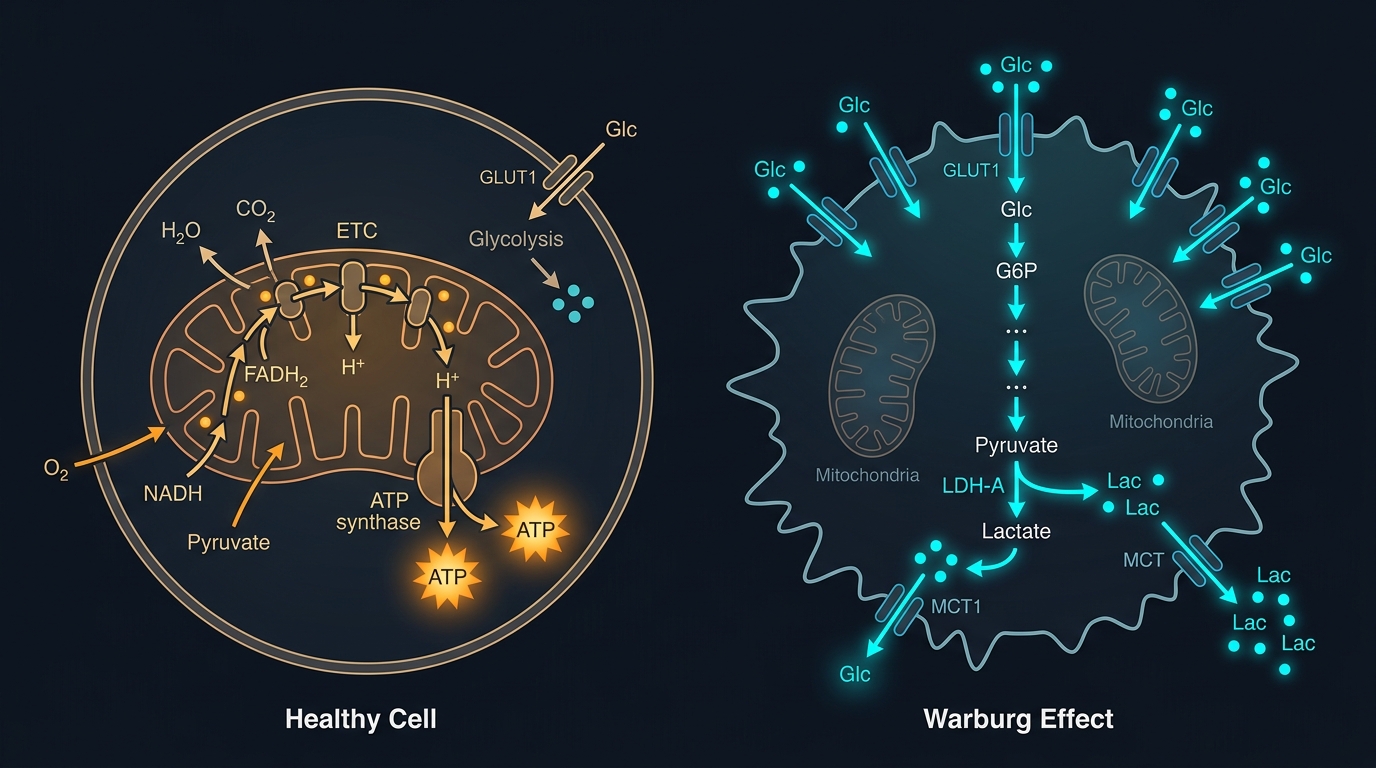
"A normal cell behaves like an ultra-efficient hybrid automobile, using its mitochondrial internal combustion engine to fully burn one molecule of glucose into 36 clean units of ATP energy. A cancer cell behaves like a classic car with fouled spark plugs: it rejects the mitochondrial engine and reverts to primitive coal-burning (glycolysis), yielding a meager 2 ATP while spewing out clouds of acidic lactate smoke. To stay in motion, it must devour an immense pile of sugar coal every single day."
1. Biochemical Rationale: Why Do Malignant Cells Choose Inefficiency?
Why would an aggressively proliferating malignant cell rely on an energy production pathway eighteen times less efficient (2 ATP versus 36 ATP)?
The answer resides in the core biological imperative of cancer: It does not prioritize energy economy; it requires molecular building blocks for biomass duplication!
Glucose influx via GLUT1
Rapid Aerobic Glycolysis
Diverted Biosynthesis: Nucleotides & Lipids
Lactate Secretion & Acidification
- Harvesting Biosynthetic Building Blocks (Biomass Scaffolding): Rapid glycolytic fermentation generates carbon intermediates that supply the pentose phosphate pathway for nucleotide synthesis (DNA replication), non-essential amino acid assembly, and lipid synthesis for rapid cell membrane construction.
- Microenvironmental Acidification (Lactate Efflux): Lactic acid pumped into the extracellular matrix drops local pH into an acidic range (6.2 - 6.8). This hostile microenvironment paralyzes cytotoxic T lymphocytes and natural killer (NK) cells while activating matrix metalloproteinases, clearing tissue pathways for invasion and metastasis.
- The Biophysical Basis of PET-CT Imaging: Clinicians intravenously administer fluorodeoxyglucose (18F-FDG), a radioactive glucose analogue. Because malignant clusters avidly consume sugar dozens of times faster than surrounding parenchyma, tumors illuminate vividly on the PET scanner screen, identifying primary lesions and occult metastases.
2. Metabolic Comparison: Healthy Somatic Cells vs Cancer Cells
| Metabolic Characteristic | Healthy Somatic Cell | Cancer Cell (Warburg Phenotype) |
|---|---|---|
| GLUT1 Glucose Transporters | Moderate density, strictly feedback-regulated | Heavily overexpressed, floodgates wide open |
| Fate of Pyruvate | Enters mitochondrial matrix for complete Krebs cycle oxidation | Diverted by LDH-A enzyme into Lactate |
| ATP Generation Yield | High (~36 ATP per 1 glucose molecule) | Low (2 ATP per 1 glucose molecule) |
| Secreted Metabolic Byproducts | Harmless and Water () | Lactic acid, acidifying the extracellular matrix |
| Ketone Utilization Capacity | High (Brain, myocardium, and skeletal muscle readily adapt) | Severely compromised due to structural mitochondrial decay |
3. Practical Protocols & Clinical Action Plan for Metabolic Terrain Modulation
Viewing malignant transformation through the lens of fuel dysregulation uncovers powerful complementary strategies to manipulate the host metabolic terrain:
Protocol 1: Depriving the Glycolytic Shunt
- Blunting Glycemic Excursions: Restricting refined carbohydrates and industrial sugars deprives tumor cells of continuous glucose surges. Lowering postprandial glucose curves reduces GLUT1-mediated substrate influx, slowing the carbon feedstock needed for the pentose phosphate pathway and nucleotide assembly.
- Fasting-Mimicking Windows: Implementing periodic 14 to 16-hour fasting intervals lowers circulating insulin and IGF-1, withdrawing the primary anabolic growth signals that upregulate glycolytic enzymes.
Protocol 2: Cultivating Ketogenic Metabolic Flexibility
- Beta-Hydroxybutyrate (BHB) Utilization: Transitioning healthy somatic tissues to utilize ketone bodies creates a stark energetic divergence. While healthy neuronal and myocardial mitochondria thrive on ketones, malignant cells with defective respiratory chain complexes cannot efficiently metabolize ketones for biomass expansion.
Protocol 3: Metabolic Kinase Modulation
- AMPK Activation & mTOR Restraint: Targeted AMPK activators (such as berberine at 500 mg before carbohydrate meals, alongside aerobic exercise) inhibit mTORC1 and suppress downstream hypoxia-inducible factor 1-alpha (HIF-1a), choking off the transcription of lactate dehydrogenase A (LDH-A).
Clinical Safety Caveats:
- Metabolic dietary interventions serve strictly as biological terrain modulators and must never replace or delay standard-of-care oncological therapies (surgery, chemotherapy, immunotherapy, radiation).
- Patients undergoing active cancer treatment must not undertake prolonged therapeutic ketosis or severe caloric restriction without oncology supervision, to avoid cachexia and sarcopenic wasting.
Deciphering the Warburg Effect transforms our clinical posture from passive helplessness into proactive orchestration of an internal cellular terrain hostile to tumor survival.